
All of a sudden, after seven appearances and four standalone movies across the span of a decade, Peter Parker somehow became an adult on the big screen right alongside me and my generation. While I can only dream of being a web-slinging hero, “Spider-Man: Brand New Day” highlights what makes Spidey so relatable to so many within my generation: Peter Parker.
After the events of “Spider-Man: No Way Home,” Peter is left stranded and alone without Aunt May and in a world that doesn’t remember him. We meet him four years later, still a ghost to the people he loves, at the start of the most vulnerable chapter of his life.
Instead of rebuilding friendships or finding a new community, Peter closes himself off in an apartment that acts more like a holding cell than a home, convinced that the selfless thing to do is disappear under his mask. He’s fearful that building any connections and relationships might leave the love of his life, MJ (played by Zendaya), or his best friend, Ned Leeds (played by Jacob Batalon), in danger, so he disconnects from them during the time he needs real connection the most.
Instead, Peter rehearses and unhealthily obsesses over the letter he wrote to MJ, reminding himself that he needs to be Spider-Man as a coping mechanism to suppress his loneliness, a decision at the heart of his problem in the film.
Tom Holland called ‘Brand New Day’ “a cautionary tale for the dangers of living a life alone and not having a community, not having friends.”
Peter has already been told the actual lesson (no less by Andrew Garfield’s version of the character in the last movie) that the bravest thing you can do is ask for help. He’s just choosing stubbornly to ignore all the signs that he needs it.
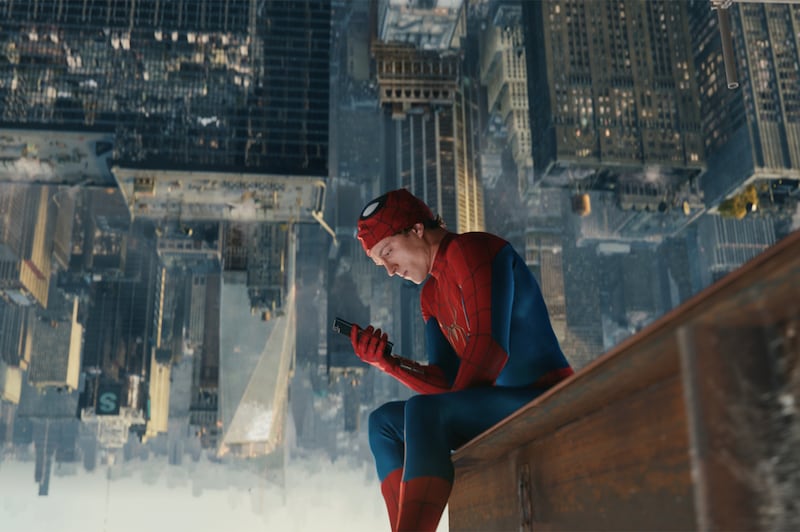
So Peter turns himself into a “superhero-holic,” spending his day and night working in tandem over the phone with Detective Jean DeWolff (played by Liza Colón-Zayas) without ever fostering a genuine relationship with her.
As Spider-Man, he’s killing it, stopping crime through what might be the most convincingly lived-in New York City this franchise has built, featuring a real spider-rogues gallery.
Despite his superhero success, Peter is clearly struggling without human connection. Unlike the multiversal world clash we’ve seen previously, his two lives are smashing together. He swings through New York doing amazing things, then comes home to a grubby apartment to nurse headaches all alone. He can only watch his best friend and the love of his life from afar (or by obsessively stalking them online) never overcoming the grief of the life he used to have. It’s an emotion that even his superhero body can’t suppress, and he starts to change erratically.
Throughout the course of the film, Spider-Man has to reconcile with his self-diagnosed isolation he feels he must undergo as our antagonist(s) seem to threaten those Peter loves the most. As the scope grows, as more characters are introduced, as Spider-Man’s life gets messy, Peter has to find solutions by confronting his insecurities, his fear of change and his need to reconnect with the people he loves most.
With great direction comes great cinematic detail.

To pull off “Brand New Day”’s self-reflective nature while feeling like a new adventure, the film needed to be scaled down from the bombastic multiversal stories we’ve gotten used to. Fortunately for us, Destin Daniel Cretton, first-time Spider-Man director, went above and beyond the task to keep “Brand New Day” “grounded.”
Not just as a style note, but as the actual production philosophy.
In an interview with Patrick Tomasso, Cretton revealed, “Everyone agreed we wanted a grounded movie. . . we wanted the action design to feel real, like it could maybe happen. We wanted the emotions to also feel very grounded. We wanted the cinematography to have that feel, too.”
That intention is felt in almost every choice he makes, from filming on real locations to the decision to keep Holland in a practical suit and in the mask for most of the movie, which reinforces just how isolated Peter’s letting himself become. And small details like a moving chin as he talks, the creases seen on the suit, all add a freshness to a character we’ve watched for over a decade.
There are thousands of artists who worked on this film, and their labor of love shows up in the big and small swings to break new ground for Spidey. Visually speaking, it’s the best-looking live-action Spider-Man film to date and maybe even within the whole MCU, with warm color grading, dark shadows and rich contrast that feels like a genuine homage to the Sam Raimi movies at times (it doesn’t hurt that the film enlisted colorist Tom Poole).
Cretton and cinematographer Brett Pawlak have found innovative ways to show Spider-Man’s evolving powers and physical changes, and many shots even come together to communicate the emotional isolation of Spider-Man, such as the intimate inside-the-mask shot that puts us literally within the suit.

“Brand New Day” is fundamentally about the web. Not the one Spider-Man shoots, but the one that holds him up. “No Way Home” was about honoring the generations of character, while “Brand New Day” hones into the connections between Peter, his inner circle, and the people of New York City. It’s much more of a community-centered film, and every relationship feels intentionally woven into Peter’s journey. Characters we’ve known for years feel more explored. The Ned and Peter dynamic is more interesting here than it’s ever been. The relationship with MJ is handled with care, even as the film complicates it.
Holland serves a career-best performance as Peter Parker with more nuance than we’ve seen him have before. Sadie Sink’s performance is equally impressive, and her character’s introduction warns Peter what isolation could cost him.
Introducing Jon Bernthal’s Punisher into the mix was an amazing decision, as Frank Castle is better here than he’s ever been. As Holland and Bernthal reunite, it felt as if they brought their real-life sibling style relationship into the chemistry between Spider-Man and Punisher, which became easily one of the brightest spots in the entire film. The Hulk (played by Mark Ruffalo) is better than he’s been in a long time, showcased by a great sequence where Cretton gets to flex his creativity behind the camera.
These character introductions work well because they don’t distract the story from being a Spider-Man-focused story or serve just as cameos, as they serve a real purpose in the film within the emotional journey of our beloved webhead.
The emotional and mature undercurrent throughout the film doesn’t come at the expense of humor. “Brand New Day” is one of the funniest in the franchise, and the emotional moments are allowed to actually simmer instead of getting undercut by a quip the second it lands.
In this film, humor isn’t built on one-liners and doesn’t try too hard to extract a laugh from you, but mostly builds comedy from the chemistry of its characters. It pays off, as Spider-Man and Punisher’s back-and-forths had me smiling from ear to ear every time they shared the screen.
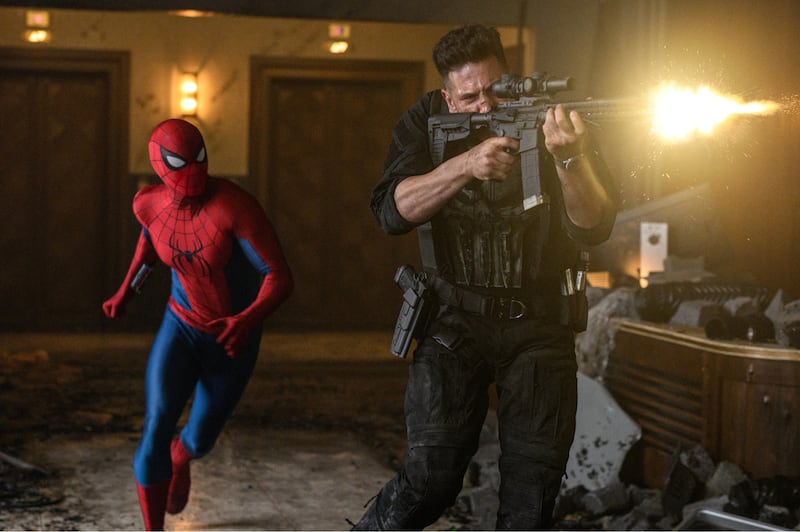
When trying to maintain a Spider-Man adventure with the more moody, “grounded” style of the film, the action becomes crucial to the movie’s enjoyment. Luckily, “Brand New Day” might have the best action sequences the franchise has ever produced, whether it’s chase scenes or standoffs.
Cretton brought in his dynamic style of directing action with the help of Peng Zhang, the same fight choreographer who helped Cretton pull off believable fight scenes in his previous superhero flick, “Shang-Chi and the Legend of the Ten Rings.” Jackie Chan’s stunt team also returned to help Cretton to work on this movie, and you can feel it in the fresh, street-level style of fighting. Sometimes you can even see clear nods to the Insomniac Spider-Man games within the choreography.
The more die-hard Spider-Man fans will also catch little nuggets scattered through the film, such as the recreation of iconic comic covers. The film doesn’t just honor its own trilogy, comics, and video games but feels like the culmination of every live-action era that came before it. There’s some Raimi inspiration, some Garfield-era quips, all filtered through Jon Watts’ foundation and built into something new.

While “Brand New Day’s” highs massively shine over its problems, the problems are worth mentioning. The writers and Cretton were clearly trying to fit a lot of story into one movie, and the structure gets a bit overstuffed in places. It tries to be a detective story, psychological thriller, and buddy comedy. While it mostly succeeds, it does lose some focus in some parts of the film. Again, none of it derails the experience. It just means the film’s ambition was stretched a bit thin and yet, Cretton, Holland and the entire cast and crew gave Spider-Man a worthy fourth standalone film that constantly flirts with comic book perfection.
The best Spider-Man stories have always reflected our own experience back at us, and Peter’s struggle of finding himself as he becomes an isolated adult is the most self-reflective this franchise has been since the likes of “Spider-Man 2.”
In “Brand New Day,” Peter Parker sheds his skin to become who he’s supposed to be. A reminder that the rest of us are allowed to do the same and not move through our next chapter alone.