
On the third and final day of the 2026 Player Plus Media Academy, Fox Sports analyst Stu Holden stood inside Studio C at USC’s Annenberg Media Center to address some of America’s most talented soccer players, ranging from MLS starters to World Cup winners and Olympic medalists, after they took turns reading from a teleprompter. “Nothing will ever replace that feeling of being on that field,” he said. “I know a lot of athletes go through this transition once you’re coming out of playing, and then what’s next? We’ve had this identity our entire lives.”
Holden retired from professional soccer at 30 due to a string of unfortunate injuries. At the height of his 11-year career playing for top clubs in the English Premier League and representing the US Men’s National Team, he would never have planned on being in the broadcast booth, analyzing players rather than playing against them. But today, he’s Fox Sports’ lead soccer analyst, preparing for an audience of millions at what could be the biggest sporting event in history: the 2026 World Cup. Each retired soccer player practicing on a teleprompter in Studio C was on a similar journey, hoping to thrive in the sports industry by drawing on their own experiences.
For all professional soccer players, the love for the beautiful game outlasts the ability to play it. Some players take Jamie Carragher’s infamous advice to “leave the football before the football leaves you.” But historically, there’s been little attention paid to an athlete’s post-professional career. Many players look to carve out a place for themselves in the wide range of sports media but lack the training, education or connections needed to succeed.
The Player Plus Media Academy, now in its second year, is a potential solution. Organized by the U.S. Women’s National Team Players Association and the MLS Players Association, in collaboration with USC Annenberg, the program offers current and retired players an intensive three-day crash course in the sports media landscape, including broadcast journalism, podcasting and personal branding. They are led by journalism professors, former players who’ve established themselves in the industry and other professionals brought in to mentor each participant.
The 2026 cohort consisted of nine soccer athletes who ranged in age from their late 20s to late 40s with a wide range of sports media experience, including McCall Zerboni, a former NWSL champion returning to the program for a second year.
For active players like LA Galaxy goalkeeper JT Marcinkowski, the program offers him the opportunity to take risks, test what he likes and dislikes, and get real exposure to different aspects of sports media. For retired players already transitioning, it’s a chance to gain more experience and receive direct feedback through specific workshops, such as practicing live sideline reporting or conducting a roundtable discussion on the sport’s hottest topics.
“It’s been a nice thing to see a different style of broadcasting,” said Uri Rosell, a former LA Galaxy player looking to carve out a space in sports media and “actually get a grasp of what I feel like I would do well at and other things I wouldn’t want to do.”
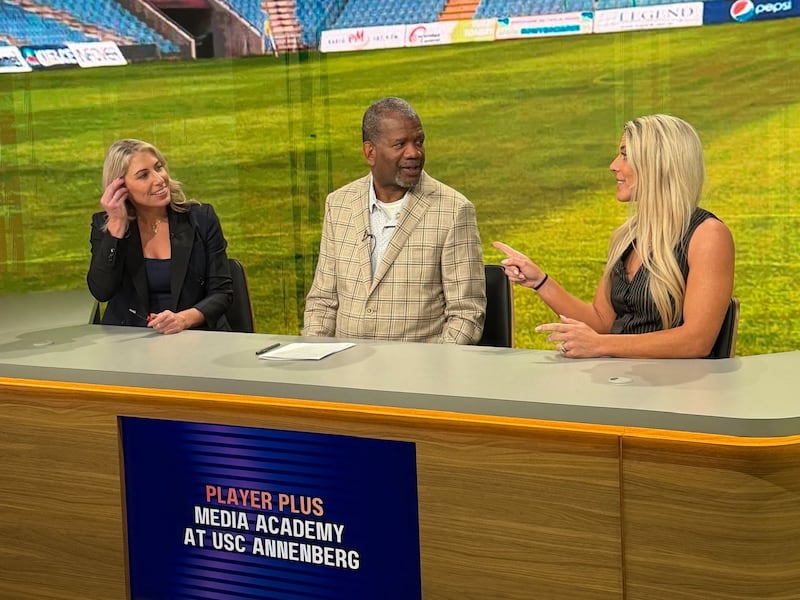
Shannon Boxx, a 12-year USWNT veteran who retired over a decade ago, arrived eager to learn. She has experience as an on-air analyst covering U.S. men’s and women’s matches on Turner Sports and TNT broadcasts. That level of comfort took years to build. She admitted she was too scared to do it when she first retired. “I took risk after risk after risk, which helped me become a great soccer player. It took me years to realize that I needed to do the same thing away from the field. By not worrying about failing, I’ve really enjoyed this process as an analyst, and I know I’m just going to continue to get better.”
Tegan McGrady, a Stanford soccer alum and communications major whose father is a director at NBC News in the Bay Area, grew up around the television industry. Now she’s figuring out where she fits within the modern sports media industry.
Julie Ertz shared that feeling as well. Ertz, a two-time World Cup champion who also majored in communications back in college, recently stepped into a studio analyst role for Fox Sports’ UEFA Women’s EURO 2025 coverage. Even though she arrived with some broadcast experience, she is still transitioning to the media space after her legendary playing career. “The landscape is so different because athletes now have been at the forefront of sports media, the influencing space, fashion, etc,” Ertz said. “We have a lot of opportunity, but the problem sometimes is when you get out, you don’t know where to go or start.”
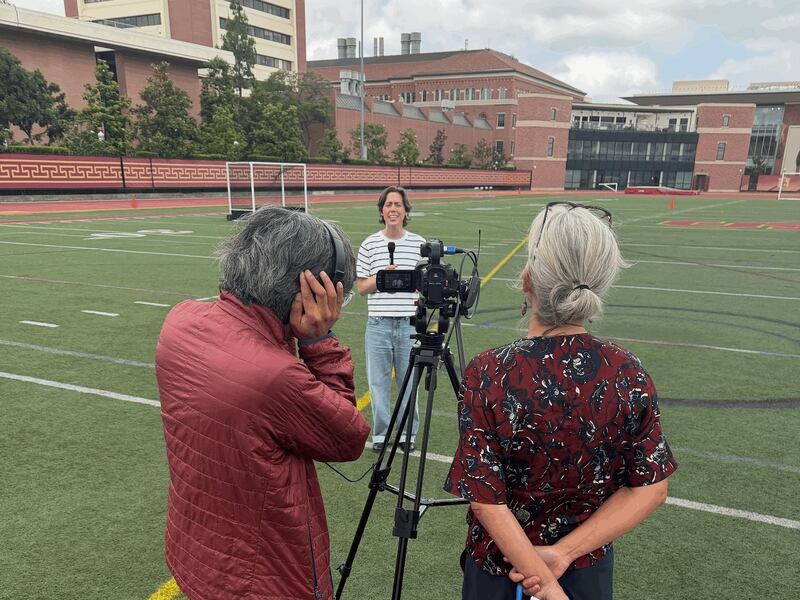
Programs like these can serve as a much-needed pipeline for athletes who would otherwise dive straight into the deep end of sports media without any help or training. It also allows athletes to capitalize on the rise of athlete-owned media.
Karin Kildow, founder of Content Capital Group, a company that specializes in helping athletes strengthen their social media presence, served as one of the program’s facilitators. Kildow told the athletes they’re in “a rare moment in the history of sport and the history of athletes. The power is shifting away from media companies and big brands, and it’s moving into the hands of the athlete. Your voice is so valuable.”
Holden echoed that same sentiment on the final day. “Our position as former athletes, we get a seat because we played this sport. We understand the sport. And people want to hear from you.”
As part of the program, every athlete in the room had to climb what Kildow called “Cringe Mountain” or the uncomfortable, vulnerable stretch where you have to embarrass yourself repeatedly before anything starts to feel natural. The mountain looked different for everyone, whether that be play analysis, hot take roundtables, or live shots on the sidelines. And then there was the lighthearted social media workshop, where players had to create and showcase Instagram reels and memes to grow their personal platforms, an exercise that got a good laugh out of everyone.
The camaraderie built across twelve workshops, three lunches, and one fantastic dinner was an essential part of the experience. Within every workshop, the room was filled with encouragement, from NWSL center-back Lauren Barnes saying “crushed it,” to JT Marcinkowski saying “fire” and former World Cup champion Meghann Klingenberg’s unmistakable “that was amazing!” carrying across the studio. Annenberg professor Vince Gonzalez, who led the program for a second consecutive year, appreciated the athletes he was working with, describing them as “absorbent” and “always prepared to listen and learn, with a good sense of who they are.” The appreciation went both ways.
Julie Foudy, returning for her second year as a facilitator, reminded every athlete in the room to “most importantly, chase what you love. They’re going to try and pigeonhole you as soccer players, but know if you have the opportunity, push people to do different things.”
Former two-time WNBA All-Star and ESPN host Chiney Ogwumike closed out the final day by putting each participant on the spot and giving them a minute to improvise a live sports segment from scratch. DC United’s Alex Bono took the exercise to heart, ranting about LeBron alongside JT Marcinkowski for a full two-and-a-half minutes.

The program’s existence reflects a larger commitment to women athletes in particular. Jeida Mitchell, director of marketing for the USWNTPA said, “The reality is, they’re not getting tens of millions of dollars. We want to figure out what the transition looks like when they retire. And helping build up talent in broadcast helps make the game better and bigger; it’s twofold.”
While the MLS doesn’t currently offer a crash-course-style program, the NWSL ran a two-day program in December called the NWSL Broadcast Bootcamp, focused specifically on live game production. Megan Buchen, the league’s Senior Director of Broadcast and Production, described it as more focused on live game play-by-play and analysis.
For all the players who showed up to USC Annenberg for the second year of the Player Plus Media Academy, they were in an environment where they could figure out what aspects of sports media they were drawn to on their own terms, with a tight-knit group of athletes and instructors who understood exactly where they were coming from.
The 2026 Player Plus: Media Academy closed with a small ceremony where each player received their first Player Plus Academy certification. For McCall Zerboni, however, she picked up her well-earned second certificate, as the group joked that she’ll be back next year for a possible third time at the academy. While there is no confirmation of a 2027 Player Plus: Media Academy at USC Annenberg, as programs like these continue to grow, more players won’t have to figure out what comes next alone.