
“I was in Dooky Chase Restaurant in New Orleans earlier this year having a little lunch, and a lady [said to me], ‘I’ve been fighting breast cancer, and I want to thank you for doing the show about breast cancer because it helped me to fight,’” said Clifton Davis, star of CBS’s “Beyond the Gates.” “It helped her to get the treatment she wanted.”
Thursday night, writers, actors and producers gathered for the “Norman Lear Awards: For TV That Makes a Difference” at the Writers Guild Theater. Presented by Hollywood, Health and Society, a program of the Norman Lear Center, the 26th annual event recognized 10 TV series for their accurate portrayal of stories around health, safety and other timely societal issues.
Davis’s show was one of the honorees, recognized for a storyline on breast cancer and healthcare disparities.
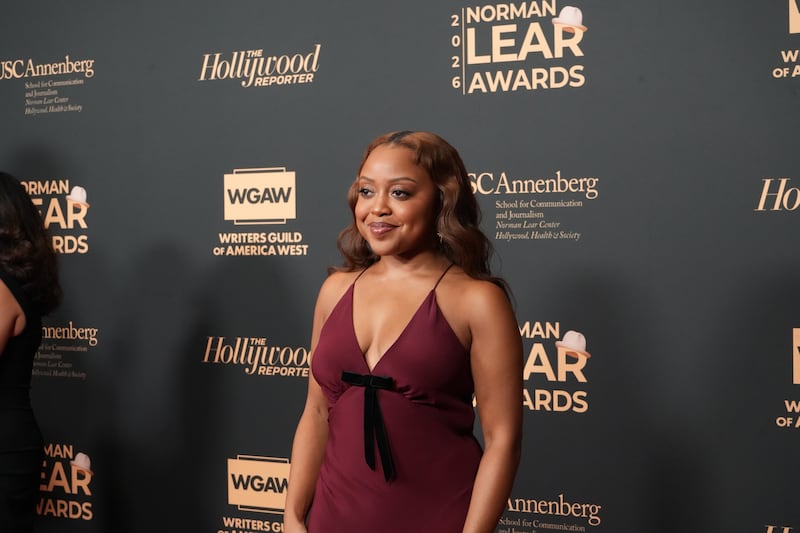
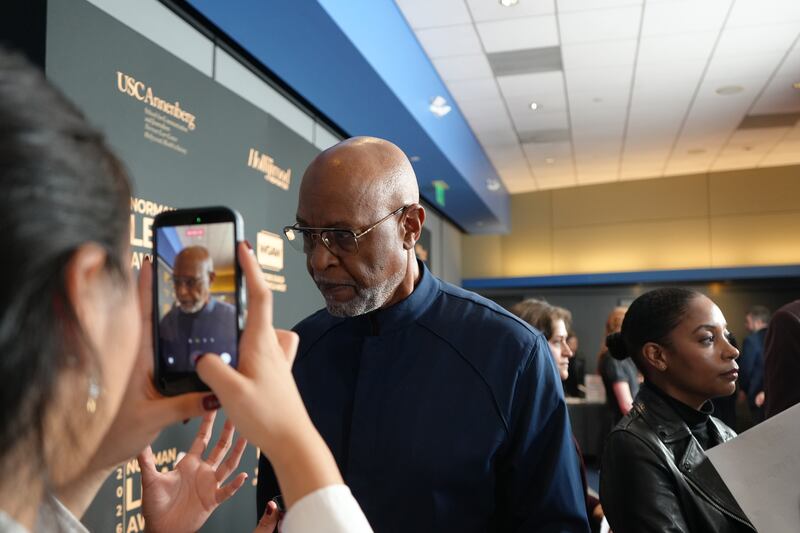
On the red carpet, cameras flashed as honorees filed in under bright lights, many saying it was an honor to be there.

“Receiving any award with Norman Lear’s name on it would be an honor, but an award about representation and making a meaningful difference means even more to us,” said Will Matthews, executive producer and co-creator of the Netflix sci-fi series “The Boroughs.”
Actor, comedian and musician Jay Pharoah hosted the night, in a full-circle moment. Pharoah starred as J.J. Evans in the “Good Times” segment of ABC’s Emmy-winning series “Live in Front of a Studio Audience,” which was co-hosted and produced by Norman Lear.
Between acceptances, short clips played for each honored series. “Beyond the Gates” went first, followed by “The Boroughs,” “Abbott Elementary,” “9-1-1,” “Brilliant Minds,” “Ted” and “Grey’s Anatomy.” For some honorees, the clips were a perk of being there.
“One of my favorite parts about coming here is seeing shows that I don’t have the time to [watch] at home and knowing that I’m going to check them out,” said Megan Carroll, writer of the “Abbott Elementary” episode “Aide.”
Lear, who died in 2023, was known for bringing topics like racism, sexism and homophobia into half-hour comedies like “All in the Family” and “Sanford and Son.” Honorees said that kind of visibility still matters.
“Grey’s Anatomy” won for a prostate cancer storyline, and James Pickens Jr., who plays Dr. Richard Webber, said representation is central to its message.
“In our storylines regarding prostate cancer and how it affects our community, especially Black men, [it gets the message out saying] that it’s okay to get tested,” said Pickens. “Let’s take down the curtain of shame…we need to understand that lives don’t have to be lost because there’s some fear of the unknown.”
Lear used comedy to bring heavy subjects into living rooms, and two honorees said it still works.
“Comedy was made for us to share our experiences, to form a community over things that we know,” said Lisa Ann Walter, actress on “Abbott Elementary.”
Chelsea Davison, who wrote “Ted’s” abortion-focused episode “Roe v. Weed,” said the comedy is part of how the show reaches people.
“It doesn’t feel like a lecture. These are characters you love, and they’re dealing with a human situation, and maybe they’re approaching it in a way you hadn’t considered before,” Davison said. “I think that’s how you actually open people’s minds and you get them to empathize with positions they didn’t before.”
Judges also reviewed each series for the accuracy of its information, along with its entertainment value. On “Grey’s Anatomy,” showrunner Meg Marinis said that meant keeping the facts at the center of Richard’s storyline.
“We wanted to show Richard’s path to recovery and highlight the different treatment options available, but we also really wanted people to walk away with the facts,” Marinis said.
Helping writers tell factual stories is part of what HHS does. The program offers free expert consultations to TV writers, and program director Kate Folb said accuracy can slip without it.
“In the news and in other outlets, we’ve seen where accuracy is kind of pushed to the side for more flashier information. We don’t want to see that happen in entertainment and in narrative stories like ‘Grey’s Anatomy’ or ‘The Pitt,’” Folb said. “We want to be sure that information is as accurate as possible, so audiences can take that and use it to better their own lives.”
Tessa Blake, who directed the honored “9-1-1” episode “Fighting Back,” said creators depend on that accuracy.
“Right this moment, historically, it’s extremely important that we tell truthful stories. Facts matter, research matters, experts matter,” Blake said. “As writers and storytellers and television directors, we desperately need accurate information so that we can tell the best, most moving, most human, most accessible story.”

Beyond the shows themselves, the night was about the people behind the stories. “Beyond the Gates” star Karla Mosley said that it is worth celebrating, especially now.
“During a time when [artificial intelligence] is so prevalent, it can seem like all of the stories have already been created, and we as artists know that that’s not true,” Mosley said. “It’s important to celebrate creators and storytellers who are telling stories specific to their culture, to their identity, that haven’t been told that way before, and to honor the craft that goes into that.”