
On June 6, AniFest 2026 brought together performers and anime fans alike to the Torrance Cultural Arts Center for the seventh time.
Attendees explored vendor and artist booths and watched plenty of performers across the venue’s three unique stages. Some attendees, even a handful of performers, also participated in cosplay, and many of them gathered around, stopped to socialize and took photos together at the art center’s Japanese garden.
“AniFest’s mission is simple: anime fandom shouldn’t have a velvet rope. We’re not here to judge solely on reputation or image. We’re here because we’re fans too, and we remember what it felt like to find your people and community,” said Nagi Alter, a member of the AniFest team. “Every decision we make comes back to that, which is aiming to create a better experience for everyone with a great quality.”
The event’s VStage offered a place for Vtuber (content creators who use virtual avatars as their mascot rather than their real face) fans to watch their favorite creators perform through a large screen on a stage and participate in wotagei, a form of high-energy dances that dedicated fans engage in to celebrate their favorite singers. Some of the featured Vtuber creators included Ainami Rana, Asha, Triggerphish and Mako Sameshima.
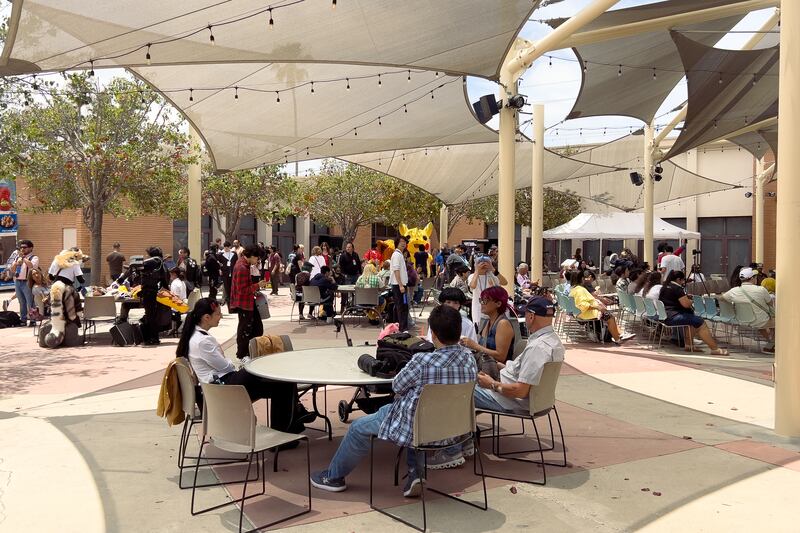
The Matsuri stage was for bands and musical groups to perform. It was an outdoor stage in the center of the activities and vendors. The Matsuri stage had also hosted a Random Dance Play (a game where a mix of random K-pop or J-pop song snippets are played in succession for those who know the choreography) for attendees, a few giveaways between the live entertainment and a cosplay showcase.
The Sakura stage, which was presented by the Arcane Maid Cafe and the Kami Light group, was designed for idols who dance, sing and may cosplay.
Similar to the VStage section, attendees participated in wotagei, fan chants and smaller lightstick dances, but these idols also used the space to sell merchandise and speak directly to fans. The Sakura stage quickly became crowded with fans just an hour after the convention opened.
“I really feed off the energy of the audience and being able to do something that I really love, like singing and expressing my love and sharing music to other people and seeing how many other people also like that kind of music,” said Yurina Kuma, a solo Kaigai idol and cosplayer who also loves Jirai Kei fashion. “I just like being really part of such a sweet community.”

Similar to Yurina Kuma, many of the Sakura stage performers were Kaigai idols, a term which refers to musical artists and groups based outside of Japan whose work is heavily influenced by Japanese idol culture’s music, fashion, fan interactions and aesthetics.
“I always just loved being on stage and singing, I love doing it at anime cons … But at anime cons, it’s like everyone knows their niche interests,” said Mall, a cosplayer and member of the group SYNTH who performed solo at the event. “So if I pop out a song, a lot of people are gonna know it and it’s always fun doing that.”
SYNTH, a Vocaloid (refers to the vocal synthesizer software) themed idol group, was one of the first groups featured at the Sakura stage. The members of SYNTH were introduced on stage as the iconic Vocaloid characters they were dressed as before performing cover dances of popular Vocaloid songs such as “Magnet” and “Popipo.”

Outside of the performance spaces, attendees dressed up in cosplay, J-fashion or had decorated bags and themed outfits that showcased their favorite characters and shows. Cosplay has remained a staple of anime or fan conventions. Cosplayers in AniFest ranged from longtime hobbyists to anime fans who had only recently begun cosplaying after seeing a surge in popularity and wanting to be a part of the community.
“I always was kind of in the anime scene and just aware of all of it … Before, there wasn’t as much opportunity, and so now that it’s become more mainstream and popular, there are so many more things you can go to,” said Anella Dedios, an attendee cosplaying as Erza Scarlet from Fairy Tail. “You don’t have to travel super far to find cons. Whereas, when I was in high school and college in the early 2000s, you’d have to search really hard to go to something.”

As anime conventions and related events become more frequent and accessible, giving fans more opportunities to connect with the anime and cosplay community, challenges with a growing community have begun to emerge.
Some attendees mentioned feeling judged by others for their cosplay or feeling competition and comparisons within the cosplay community, as it has become more prominent on social media. Despite these challenges and pressures, the passion to keep making and wearing cosplays remains.
“If you’re not skinny, if you’re not pretty, you’re not considered a cosplayer, and the hate towards people who are doing this for fun has risen a lot more,” said Bendy Blakeborough, who was cosplaying a Niles from “Fire Emblem Fates.” “Regardless, it makes me feel happier as somebody who has self-esteem issues. It makes me feel more outgoing and like I can be myself without having to be myself.”