
From May 15-16, an LGBTQ+ anime convention took place at Hotel Fera in Anaheim. NijiFest, which translates to“Rainbow Festival,” is a new LGBTQ+ anime convention organized by queer anime fans for queer anime fans. The convention featured more than 50 artists selling their artwork, tabling voice actors, panels for queer creators, arts and crafts, cosplay meet-ups and a cosplay drag show.
NijiFest started as a smaller-scale event at the Almond House Boba Shop in 2025. It was originally a fandom meet-up for “SK8 the Infinity” fans organized by a group of friends around their love for the show.
“SK8 the Infinity” is an anime focused on skateboarding released in 2021, which quickly gained popularity for its character chemistry and queer-coded elements. The “SK8 the Infinity” event celebrated a show that many fans viewed through a queer lens. Alongside the fans, fifteen artists and a few voice actors were invited to the event. It acted as a larger-scale cup sleeve event, a common fan gathering for anime fans at Boba shops and cafes.

“We love our online community, but we should do something in person for this community. It’s one thing to yap online. It’s so different and so wonderful to be able to get together in person,” said Maddie Morrow, one of the lead organizers for NijiFest and its predecessor. “And so in January of 2025, the original idea was to do something that was ‘SK8 the Infinity’ themed because that was like our first love and how we connected.”
NijiFest stemmed from the love of one show but also a desire for a larger space for queer fans to enjoy and celebrate their favorite shows, queer ships (referring to canon and non-canon fictional couples), group cosplays, performances and gay pride.
“It’s for the gays. It’s for inclusivity … It’s meant to build community and make friends,” said Kira Berg, the marketing director at NijiFest. “It’s meant to be somewhere where you can talk to anybody and mingle and talk about your favorite gay stuff and just have a good time. It’s about fandom as well.”

NijiFest had two different artist alleys, one indoors and another outdoors, which also included a stage and tables for cosplayers and performers. This area attracted fans looking for fan-made merchandise of their favorite characters and character pairings because plenty of artists were selling posters, keychains and pins that feature characters from popular and even lesser-known Yuri (romantic anime and Manga between women) and Yaoi (the male counterpart to Yuri).
It was also an opportunity for guests to meet the artists who enjoy the same niche queer media and couples as them.
“I had a lot of people come by who, like, I guess knew the work I had done, so they were really happy to see that,” said Maddison Garver, an animator and artist tabling with a friend in the indoor artist alley. “And if they hadn’t, they just liked what they saw in general, which made me happy … I feel like I’m hitting the right crowd because I made this for myself.”

Next to the indoor artist alley was the hall for the queer main stage panels, where a few voice actors shared their experiences in the community and also projects they worked on. On Saturday, Brian Beacock, the English voice behind Monokuma from “Danganronpa: the Animation,” and Jessie James Grelle, the voice of Armin Arlert from “Attack on Titan” and Ritsuka Uenoyama from “Given,” had a panel where they talked about their many voice roles in anime.
Several creators also had panels and interviews showing their projects and published work. Adeline Kon, a lesbian illustrator and designer, had a panel talking about her graphic novel, “Just Between Us.” Her panel title, “The Real Yuri on Ice,” was a clever joke based on the show with the same name, as her graphic novel is a sapphic (a term that refers to women and non-binary people who are attracted to other women and non-binary people) romance between two ice skaters, while “Yuri on Ice” is a gay romance between male ice skaters.
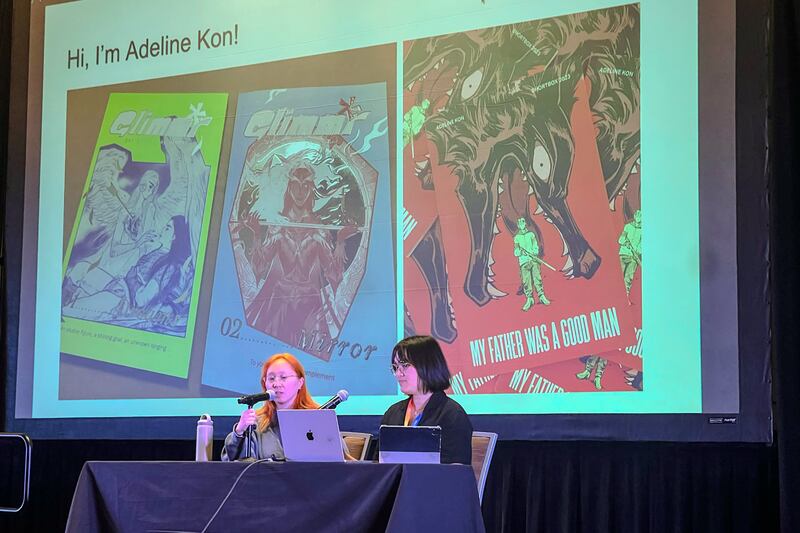
Kon spoke about the inspirations and development behind the story of “Just Between Us” and how she wanted to explore yuri dynamics. It was a story that was conceptualized in 2018, and it took eight years for the story to come to life.
Kon loved figure skating and wanted to see more Yuri with complex female characters. She said she had to trust there was an audience for what she wanted to write and encouraged others to do the same with their personal passions.

The panels and even some artists that tabled highlighted many projects that are original and explicitly gay, but many of the shows and written work enjoyed by gay anime fans are not explicitly LGBTQ+ themselves. A large part of the fandom culture is driven by the queer lens of the community, who may interpret characters as gay, lesbian or transgender through subtext or simply by relating to the characters.
“One of my favorite things is that, as queer people, we don’t always have representation, and especially a lot of popular media, but that has never stopped us from finding a way to represent ourselves regardless,” said Charles Ashby, a guest in the artist alley.