
It is not every day that you catch the culprit at the scene of the crime. Ken Gonzales-Day is crouched on the floor, cradling a rotten, decapitated head while mopping a pool of blood in the middle of fluffy snow.
Gonzales-Day is adjusting one of his art pieces for his new exhibition, “History’s Nevermade” at the USC Fisher Museum. The exhibition is a kaleidoscopic exploration of 30 years worth of multimedia, ranging from photography, videos, sketches and paintings, curated by USC professor Amelia Jones. It is open until Mar. 14, 2026.
His early works were arranged in a salon-style hang. Among them was a precocious pencil sketch of a hand surrounded by nearly naked men sprawled across the composition, like early prototypes of the “Martyrdom of Saint Sebastian” (1525). It’s a mature experiment in technique– especially for a piece he created at just 14 years old.
From a young age, Gonzales-Day made something out of nothing. He coined the term “nevermade” to describe historical documents of events that never occurred– an aggressive probe into the fickle nature of history and arbitrary meanings we assign to things. In a Duchampian style, this challenges rationality through an image that ceases to exist within the established order.
That image is himself. Gonzales-Day explores the alienation of the brown body, where race and sexuality intersect as mutual victims of systemic violence. “Imaging Bodies (Portraits)” is a two-part photographic series captured from 2001 to 2024. Both projects echo his earlier installation, Bone-Grass Boy– a compilation of photographs, mixed media, including a fake 1892 memoir, “The Bone-Grass Boy: The Secret Banks of the Conejos River,” written by him, and, of course, the striking wax head that tells the story of his lineage as a queer Chicanx artist amid the AIDS crisis in the 1990s. These are historic queer images Gonzales-Day longed to see.

“One day, one of my friends and deepest crushes, the man who taught me how to spackle, paint walls, and neatly wrap a valuable piece of artwork, borrowed a friend’s gun and shot himself in the head when he found out he had AIDS. I was heartbroken,” he writes in the preface. “He was beautiful. Every time I think of him, I wonder, what if he had just waited?”
After all these years, Gonzeles-Day is still haunted by his past, writing about them as though his memories whisper his history through his delicate ears.
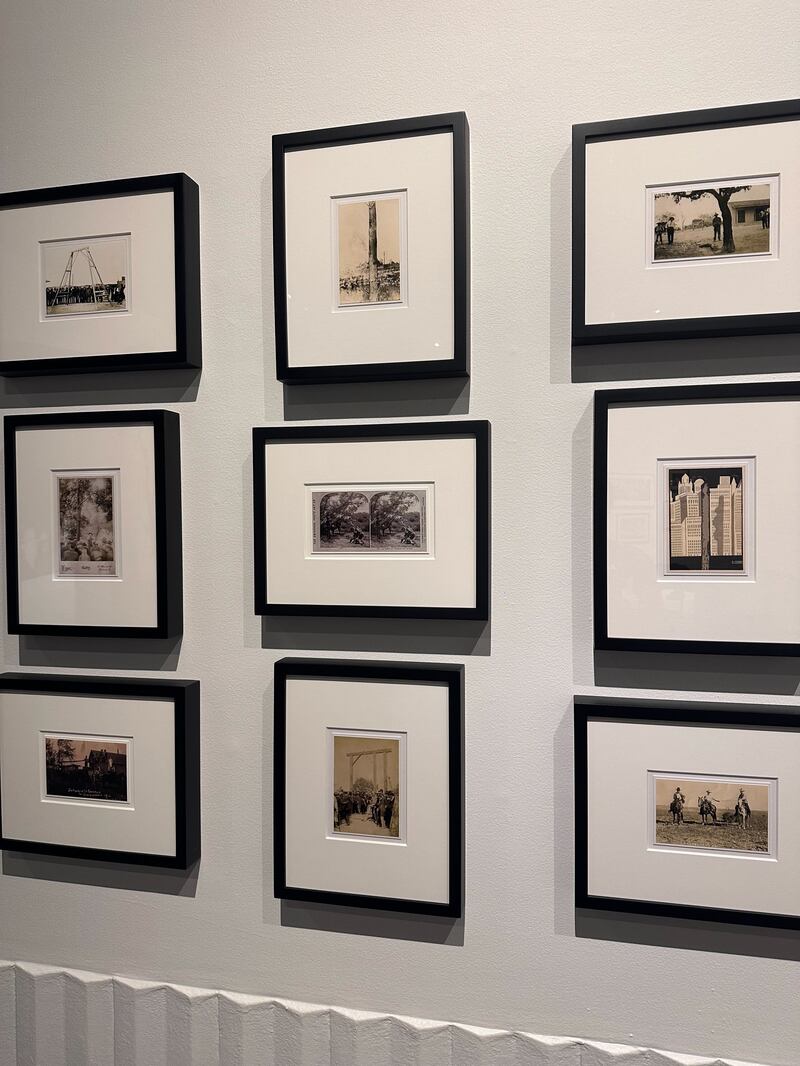
Gonzales-Day thinks about history all the time. He developed an interest in the visual histories of lynching in the United States through a multi-part project dating around 2000 including a series of photographic works such as “Erased Lynching” and “Searching for California Hang Trees,” as well as the memoir, “Lynching in the West: 1850-1935,” published in 2006. His focus stemmed from internalized anger, a desire to correct the historical erasure of Latinx lynchings in California. One hundred forty-three Latinos were lynched in California alone from 1849 to 1928.
The photographs, many of which were distributed as postcards, erase the lynched bodies using digital photo-editing tools. The exhibition includes 21 postcard-sized images clustered on one wall, emphasizing the banality of the subject matter, which becomes an isolated tree; a site of nature vandalised by hatred, standing still, as though no rotten history salted its earth. He also keeps the white mob-spectators, allowing the viewer to take in their expressions. The series is harrowing and demonstrates the role of the artist as a conveyor of narrative: Gonzales-Day removed death, but left an imaginary stain on the viewer, who envisions a limp body without ever having to see it.
Gonzeles-Day’s art and scholarship address the power of imagery to both create and expose stereotypes and belief systems. He is not afraid to defend himself, his sexuality and more importantly, his heritage from the hatred emitted by white American institutions that have desperately sought to disregard him as invisible.
His art is urgent. His work prompts the questions we fail to ask ourselves. The “nevermade” asks us to debate and analyze historical formations, including visual photographs and imaginative documentation; it is an opportunity to interrogate what happened in the past.
As he mops the fake blood from the floor, it becomes clear that Ken Gonzales-Day is unapologetically himself, and his manipulation of technique, as a severed head lies beside him, transforms into an archival practice of queer representation, offering him a solidified place in history— something he has been searching for all along.