
Theater and marijuana — they share many of the same traits. Both are intimate, communal and grown from the ground up. They can make you laugh, and they can make you cry.
The only difference: Everyone in L.A. smokes weed. Hardly anyone in L.A. watches live theater.
But, squeezed between a pizza cafe and a jewelry boutique store in Studio City, three aspiring young actors fill the tiny 48-seat Two Roads Theater with monologues about crippling adolescence, arguments over stolen cash and smoke from fake joints.
For three weekends from May 1 to 17, these local artists are self-producing a staging of Kenneth Lonergan’s “This Is Our Youth,” a play set in 1982 that follows 48 hours in the lives of three extremely privileged but extremely lost young souls in New York City.
“We kind of just threw it together,” said 20-year-old co-producer and co-star Paul Zenas. The set — a cluttered Upper West Side apartment — was built by a friend of his mother, who designs sets as a side gig. The costumes are an amalgamation of pieces pulled from parents’ and friends’ closets, assembled to evoke the ’80s. The team is a small group of creatives brought together from workshops, classes and past collaborations.
“We asked for a lot of favors,” Zenas, who plays Dennis Ziegler, said, as he and his castmates lay across the set after a full run-through before opening night.
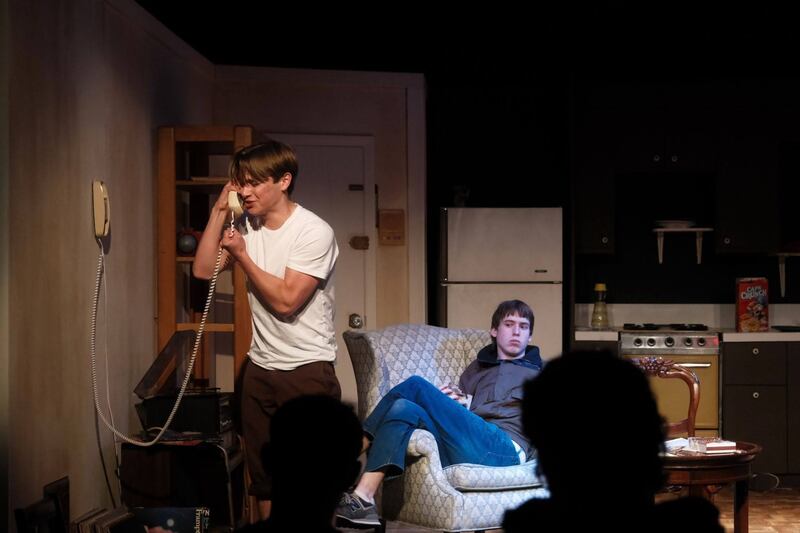
It hasn’t been easy — or cheap — but it was a project that Zenas and his co-producer and co-star, Henry McLaughlin, said they had planned since they performed for the first time together in high school. Since then, the two have collided at acting classes around the city, but their onstage chemistry stuck with them, and the play lingered at the back of their minds.
“We always knew we were gonna do it,” McLaughlin, 21, who plays Warren Straub, said.
The pair met while attending Los Angeles County High School for the Arts, but parted ways after graduating. Zenas moved east for a year to study acting at Boston University before dropping out to pursue it full-time. Now, he lives alone in a studio apartment in Pasadena and works five days a week at Mike & Anne’s, a cafe known for its lemon ricotta pancakes and elderly neighborhood regulars.
Meanwhile, McLaughlin spent a year at the Stella Adler Academy of Acting in Hollywood. Now, he works at McDonald’s during the week and auditions for commercials.

In February, they put together a team, bringing on actor Taylor Thompson, 23, to complete their cast, and Canadian-born journalist-turned-screenwriter Avi Sol, 25, to direct.
With little experience producing theater, it was learn-as-you-go. They began by rehearsing out of Zenas’ apartment a couple of times a week. “We just tore it apart, moved all the couches and furniture to get as much space as we could,” Zenas said.
Like many before them, they get by working retail, restaurants and fast food jobs while submitting self-tapes and attending auditions whenever they can. But Thompson, who plays Jessica Goldman, said it’s especially hard to be motivated in a city like L.A.
“Everyone’s a struggling actor, in both L.A. and New York. But, in New York, people take pride in that, and people here just pretend that they’re not,” Thompson said. “Here, it’s just Hollywood, and it’s movies.”
She attended NYU Tisch, where trying to make it in the theater meant being supported by a huge community of artists. Not to her surprise, after graduating in 2023, she came home to a post-pandemic L.A. to find boarded-up box offices and a much quieter scene that has yet to recover.
Amid vacant theaters, these young adults are doing their best to help preserve live performance today.
“We’re in a detrimental time of terribly short attention spans. And it’s awful,” Zenas said of art consumption today. “Plays, especially fully spoken word plays, have a weird veneer of judgment. People think it’s stuffy or boring.”
To Zenas, in a city of movies and TV and an age of digital disconnect, live performance is especially valuable because it makes us uncomfortable.
“Everything that you’re seeing is literally right in front of you,” he said. “You could go up and touch them on the nose.”
He added, “You see somebody using their entire instrument in all its capacities. You hear the reverberance of their voice, you see how their feet are on the ground and how one can live as another person in their entire body, not just from their chest up.”
The characters in the play share a joint as a means of connection. McLaughlin hopes that bringing people to the theater forces them to leave behind their distractions and share something, too.
“It practices being in the moment, looking around and being present with the people around you, which no one does anymore,” McLaughlin added.

Lonergan’s play may have been a product of the Reagan era, garbage strike and – as Zenas put it – “disgusting-looking” time. But between political uncertainty, the fear of artificial intelligence, and entering an unstable job market, the emotional struggles of coming of age today look very similar. To Zenas, that is exactly why “This Is Our Youth” needed to be staged as written, in all its foul-mouthed glory.
“This play specifically shows people, our parents’ generation, things that irk them. We didn’t take anything out,” he said. “Let us irk them.”
Even if it’s just his mother in the audience, Zenas will perform as if it’s a sold-out show, because, put simply, it’s all he knows.
“This is the only thing that makes sense to my brain,” Zenas said. “And, I like working in a restaurant.”
Director Avi Sol started out as a sports journalist. He covered the trials and tribulations of the Toronto Raptors before switching paths to pursue screenwriting and directing.
“We didn’t choose this business because it’s lucrative or rewarding. We love it too much not to,” Sol said. “It’s what I came to this city to do.”
For Thompson, being in the industry is a constant turbulence of emotions. “I could have four auditions in a week and one callback and be on top of the world, and then I won’t hear anything for two months,” she said. “Sometimes it can feel a little out of reach.”
“But if you love acting, you love acting,” she added. “And this play for me is doing it. It’s acting.”
“10 years from now, some director is gonna be like, ‘I saw Paul, Henry and Taylor when there were two people in the theater.’ In freaking Studio City,” Thompson said.
What is the future of our youth? Is it really as bleak and doomed as these characters, or we ourselves, make it out to seem? What do we do if it is? Maybe we can light a joint. Or maybe we find a craft, something that we believe we truly know how to do, hone it, and make something of it ourselves. Or maybe we just spare a night and go to the theater.
Tickets are on sale for $24 and will run at Two Roads Theatre in Studio City until May 17.