
“Carmen” is a timeless story about a free-spirited woman whose charm ends in a deadly obsession. The 19th-century composition by Georges Bizet has been created in every possible rendition, from the traditional to hyper-modern takes. In 2026, the Los Angeles Opera looked at the play from a new perspective again. Conducted by the newly appointed music director Domingo Hindoyan and reimagined by the director and scenic designer Thaddeus Strassberger, L.A. got to meet the famous femme fatale in a never-seen-before gothic, dark and mesmerizingly beautiful production of the classic.
The opera, set in Spanish Seville, has some of the most recognisable scores, which Hindoyan brought to L.A.’s audience. His expressive musical reading was packed with emotion and energy. The rhythm, the tempo and the staccato of flamenco shoes worked together in perfect dynamic harmony. He made Bizet’s scores feel fresh and alive again in his masterful interpretation.

The conductor was not the only one who did a stellar job in conveying emotions. The cast matched Hindoyan’s energy, pairing vocal power with acting that made every character feel vivid. While Carmen’s arias sung by Rihab Chaieb were truly show-stopping, I found myself appreciating the duets the most, especially the duet of the male lead Don José (played by Joshua Guerrero) and his hometown love Micaëla (played by Kathleen O’Mara).
Albeit less dynamic than other scores, it was full of longing, nostalgia, and had a dreamy quality that truly connected the audience to these two characters. The scenes with few people, albeit less bursting with spectacle (which this “Carmen” was definitely not in short supply of), were actually the most pleasant. In these parts, one could sit with the music and appreciate the applause-worthy orchestra most.
When talking about spectacle, it’s not possible to do so without mentioning the biggest showman of the play. Liam James Karai, who became the charming matador Escamillo, was made for the role. During his debut at L.A. Opera, he fully leaned into the magnetically hypnotic persona of the Spanish matador - brimming with energy and filling the whole stage with his presence. His acting fit the character perfectly. I tend not to really remember the “Escamillos” of “Carmen” for long, but his standout performance will definitely stick with me for a long time.

The music and the acting in this opera were strong enough to carry the show on their own, but the director and designer Strassberger decided to push the production’s imaginative reach even further and exceeded expectations with the visuals. They not only held their own to complement the sound, but brought completely new layers of meaning to the play.
The opera is set in Spain, but the designer decided to walk away from direct references to the country. Instead, he turned the scenography into a symbolic space that reflected the psyche of Carmen. He described the set as a “darkly occult magic-realism” which was heavily inspired by Cristina García Rodero’s “España Oculta” body of work.
The production was fully original, starkly different from what was done before and from what one would think when thinking about “Carmen.”
And yet, it worked.
The scenography could be best described as uncanny, monochromatic and monumental - something more akin to a church than sunny Seville. Every set was carefully constructed and vividly detailed. Even though the space was fictional, as if suspended between the world of the living and the dead, it was rendered as a hyper-realistic city. From the towering gates and fountains, through the half-open houses, to the smallest props like television sets, cupboards, bottles or napkins, everything added up to curate an immersive experience.

The worldbuilding of “Carmen” in the L.A. Opera was masterful. What added to its quality as much as the curated objects were the people. The simple townsfolk running errands, soldiers on break and children preparing for the festival scurrying around the stage made the space very lively and breathed life into the darkly magical world.
Conversely, that same abundance made the scenes appear messy and crowded at times.
Another aspect that did not hold up under the Spanish-gothic vision was scenes where the scenography did not make sense for the places of the plot. This was the case with the bullfight coliseum, for which the church-altar-like scenery seemed to be mismatched. The story did not stretch to accommodate the design choices at times like these. Thankfully, it was a rare occurrence, and most of the opera balanced the original worldbuilding with the place of action seamlessly.
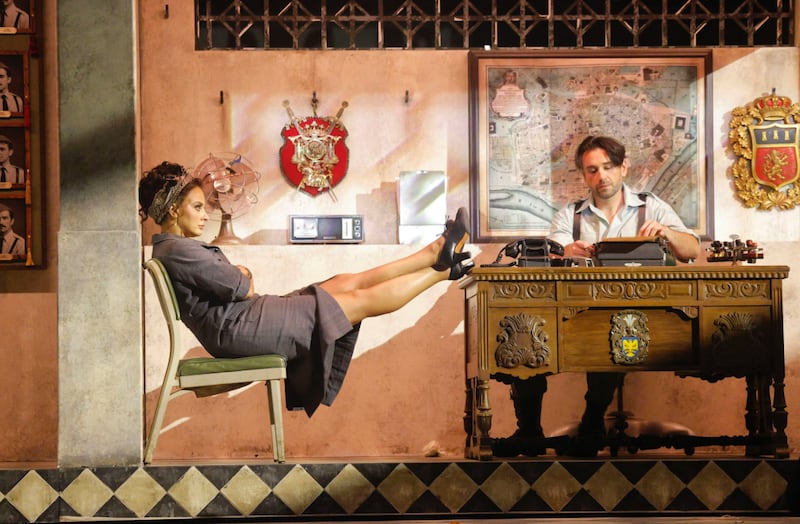
The storytelling and richly visual scenography allowed for deep symbolism, which was embedded throughout the play. In a place that’s neither fully Seville nor a dreamscape, spirits appear amongst the common folk. The audience walks step by step with Carmen and omnipresent Death, who prophesies the impending doom destined to befall the characters.
The apparent and recurring motif was the division between the sacred and the profane in a clash between what’s holy and what’s devilish. The tension was depicted through religious themes, with lighting and colors playing the biggest role. The production leaned into bold chiaroscuro set by candlelit landscapes and utilized a mainly black-and-white palette for costumes and scenic design. This was contrasted with sudden, almost aggressive bursts of crimson or violet, which appeared in climactic moments of “Carmen.”

The symbolic interpretations centered on the main character, Carmen, who, as the true femme fatale, weaves the spell of love, desire and demise for her and her lover. But the division between who is virtuous and who deserves condemnation was anything but simple. Unlike the set, the lines of interpretation were not black and white. Instead, they lingered in a thought-provoking grey area. Every single character, with Carmen at the helm, was an intricately complex individual whose actions the viewer could both understand and question. In the 2026 L.A. Opera production, Carmen herself was shown, at least in my impression, not as a simple villain but rather a free-spirited, deeply feeling woman who refused to be put into a mold the society set for her.
“Carmen” was hypnotizing, haunting and simply beautiful. The scenic design and the music reflected the title character perfectly. It was her world, her life and her unwavering resolve that the audience experienced. Carmen invited the viewers to step inside and live her story alongside her in this touching and resonant spectacle.
