
Most USC students and professors know Tomo Chien as the voice and founder behind Morning, Trojan, the newsletter that changed the way campus news was communicated over his four years at USC.
Originally from the Bay Area, Chien said he came to USC with a background in journalism and a clear ambition to work in the field, choosing USC Annenberg School of Communication and Journalism in part because of its strong program and a merit scholarship.
Associate Director of the Journalism (BA) Program and Journalism Professor Rebecca Haggerty recalled meeting Chien before he began at USC.
“I was part of a committee interviewing people as potential students for potential scholarships, and I really remember speaking to Tomo because we had an interesting conversation about the future of journalism. So he stood out to me at that time,” she said.
According to Haggerty, Chien was really interested in trying to help students keep up with the news.
In 2022, when Chien was a freshman, he noticed established student outlets did not have the same reach on Instagram they do today, raising a fundamental question he wanted to help address: “Who’s actually reading them?”
His thought was that an email newsletter offered a way to reach members of the USC community directly and consistently, according to Chien.
Chien founded the newsletter Morning, Trojan during his second week of freshman year as a roundup of stories from existing campus outlets. The vision was concise: engaging campus news. He spent four years adjusting it based on how readers responded, he said.
Some of the early promotional material, according to Haggerty, was, “Here’s an email,” “This will make you smarter,” “We’re going to bring you a few interesting stories about Los Angeles and about USC that you need to know,” which she thought was a great idea.
“One of the things that I thought was so interesting about Morning, Trojan was how it changed over the years to emphasize more original reporting,” Haggerty said.
By his junior year, he had begun reporting his own scoops, after identifying what he saw as both a distribution gap and an editorial gap.
“There was a sort of death of insider reporting about the university,” he said. “There was a niche to be filled.”
He started addressing that deficit, breaking stories about the university he still attended and writing them for the USC audience that included him.
“It’s all about how you implement it,” Chien said. “I had a very particular vision for what I wanted that product to be.”
Chien kept the design minimal, with no images and short entries. He wrote the daily briefs with a tone that was sarcastic and palatable for students. On any given morning, the email might include “like five F-bombs,” Tomo said, while the original reporting was played straight.
When readers screenshotted the newsletter and posted it on Sidechat, USC’s anonymous social media and messaging app, Chien knew his idea was working.
“You don’t just want to be reacting to the culture,” Chien said. “You actually want to be informing how people think and talk about it.”
As his reporting gained traction, Morning, Trojan’s audience expanded from roughly 1,100 subscribers during its first two years to more than 12,000 by the end of his senior year.
Among the biggest stories he broke was news of USC’s layoffs in summer 2025. Reporting on his own university never seemed to worry him much. Chien said his parents were afraid he’d be expelled.
“I would have welcomed it if they kicked me out,” Chien said. “It would have been the best possible benefit to my career.”
He said he never had to issue a correction, though some stories he had ready to publish never ran. For the most sensitive ones, he said he was “quadruple, quintuple fact-checking everything.”
To pay for the newsletter, he sold advertising and created a paid membership. Subscribers could join a “MT Off Record” Signal chat, where he shared smaller reporting discoveries, details that were interesting but did not warrant a full story. The group consisted mostly of USC faculty and staff, giving him a more direct relationship with readers who were deeply connected to the institution.
At one point, Chien tried to take the model beyond USC. He launched a nonprofit called College Brief, with near-identical newsletters at UC Berkeley and Cal Poly San Luis Obispo: Morning, Cal and Morning, Mustang.
The project ran for about 10 months and raised around $20,000, but to Chien, “the quality control ended up being too hard, and the turnover was too difficult to deal with.”
He called it “kind of a failed experiment,” but it taught him something.
The format, he said, was only part of Morning, Trojan’s success. Chien said what mattered just as much was the voice of it and the new original reporting that he was actually giving people.
Writing Morning, Trojan often took more of his time than school itself. In the process, he learned how to build an audience, cultivate sources, identify gaps in coverage and turn an independent publication into a sustainable product. However, the newsletter was not his only extracurricular activity.
After interning at The San Francisco Standard following his sophomore year, Chien was offered a full-time position. Taking it would have meant dropping out, and his parents weren’t on board.
Rather than leave USC, he negotiated a part-time role that required an unusual weekly commute to San Francisco.
Chien spent Mondays and Tuesdays in the San Francisco newsroom. After work on Tuesdays, he drove 45 minutes home to the Bay Area, ate dinner and then drove to Los Angeles, often arriving around 2 a.m. He attended classes Wednesday through Friday before heading back north.
“The opportunity to work in a professional newsroom was just too good to pass up,” Chien said. The Standard, then a relatively new digital publication, particularly appealed to him.
“The chance to be in a newsroom that was kind of still experimenting and figuring itself out and was flexible and willing to do things that were sort of different and maybe even innovative, that in particular was exciting to me,” he said.
His newsroom work and Morning, Trojan unfolded side by side, with lessons from one informing the other. Since graduating, Chien has joined L.A. Material full time. He came to USC skeptical of L.A. and spent half of college away from it, but covering the city alongside “extremely knowledgeable Angelenos” has changed that.
“I learned a ton of skills in J-school that I wouldn’t have been able to learn just walking into a newsroom,” he said. “But ultimately, journalism is very much a learn-by-doing thing. You have to have that professional experience.”
That philosophy also shaped his approach to technology.
Chien developed some of his data skills through academic coursework, including JOUR 322: Introduction to Investigative and Data Journalism, but described much of his technical knowledge as self-taught. He now uses large language models to help code software applications for his newsroom, build scripts for data reporting and scrape information from the web.
Chien draws a firm distinction between using artificial intelligence to produce journalism and using it to support the reporting process.
At L.A. Material, he said AI may be used for tasks such as proofreading or brainstorming headlines, but not to write or substantively edit published work. For him, its most consequential use is expanding what journalists can investigate.

He pointed to an investigation in which data analysis assisted by AI-supported computer programming revealed that L.A. had issued roughly $1 million in street-sweeping tickets on days when streets were not swept, with many of the citations concentrated in the city’s poorest neighborhoods.
The investigation had real consequences, which is his goal. According to the article, a L.A. Department of Transportation spokesperson, Colin Sweeney, said that “the department is conducting an audit of sweeping citations and will reimburse any paid citations determined to have been issued in error.”
“It’s great when your reporting has a practical effect,” Chien said. He was even invited to KTLA 5 to speak about his reporting.
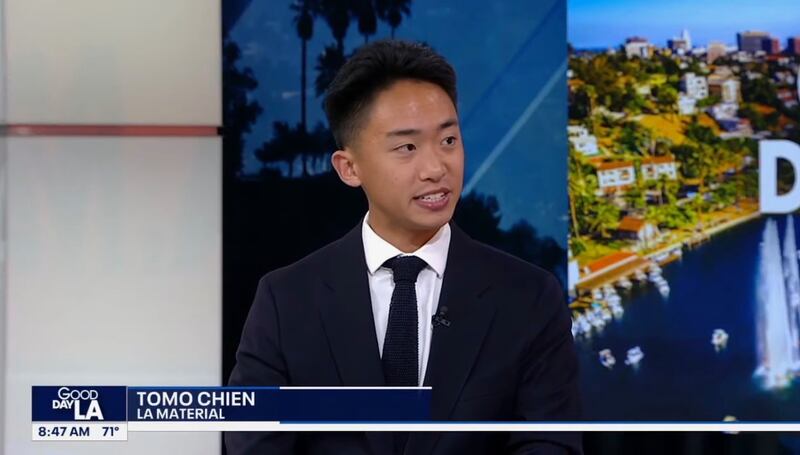
Other projects have included an interactive map of Yelp reviews left by local politicians and an investigation into the man behind an anti-Sigma Chi Instagram account, who Chien found through court records “had been accused of cyberstalking and harassing people across the country for the better part of a decade.”
“I used to think I wanted to be in San Francisco, but I’m happy how things turned out,” he said.
According to Chien, he sees outlets like his as the industry’s future. In L.A., he said, " It’s the Times, and then everybody else is basically a startup. I guess LAist has been around for a while, but it’s a local startup … so is the LA Public Press, you know, L.A. Material. I think that reality is here.”
Whether independent journalism holds up, he said, “depends on the independent journalist.”
Institutions, even small ones, have “systems and processes” that hold work to a standard. Morning, Trojan had no editor, only a computer science student named Anna Hsu who proofread it each morning.
Whether testing a newsletter format, developing a source network or writing code to examine public data, Chien approaches journalism as something built through iteration: learning what readers need, identifying information they are missing and finding new tools to bring it to them.
“The job is to build relationships,” Chien said. “Your relationships with sources are everything.”