
A dark room is utterly filled with unsettling and disturbing sounds. Beyond its obscurity is a long corridor. Behind each door is a collection of curiosities and worse, terrifying characters. Even the final room is covered wall to wall with blood and gore.
This is not a description of a haunted house or horror film. It is the Academy Museum of Motion Pictures’ “The Horror Show.” The installation is a blend of informative museum exhibition and eerie immersive experience. This new exhibit opened on September 26, just in time for the Halloween season, and will be on view through July 25, 2027.

It is curated to answer the question: why do horror films matter so deeply to so many? Not only is it a look into the behind-the-scenes of many horror classics, ranging in time period and popularity, the exhibit also thematically unpacks horror’s cultural significance and enduring influence.
The Horror Sounds Installation showcases the important role of audio in horror cinema. The Hallway features a brief introduction to the exhibit at large, alongside dozens of vintage posters for iconic horror films and even a poster for The Horror Show itself.
Throughout the passageway is a series of six themed chambers, each of which explores important subgenres of horror: gothic, psychological, science, slasher, religion and ghosts. Each chamber is intricately immersive and completely individual. The exhibit’s demonstration of horror’s multifaceted nature is one of its most enlightening elements as to why such a wide variety of people feel drawn to the genre.
The first chamber is gothic, particularly focused on vampiric cinema, described as “rooted in an atmosphere of decay and the tension between desire and dread, Gothic horror explores the darker edges of the human experience.” This room was filled with ornate and spectacular costumes from “Blade” (1998), “Bram Stoker’s Dracula” (1992) and “Interview with the Vampire” (1990), to name a few.

The next chamber, psychological, was a sharp contrast to the last, relying on minimalism and a stark white color scheme to convey its thesis that “psychological horror turns inward, exploring the mind in all its complexity.” Under fluorescent lighting and between medically sterile curtains were a handful of stalls featuring memorabilia from “The Shining” (1980), “American Psycho” (2000) and “The Silence of the Lambs” (1991).

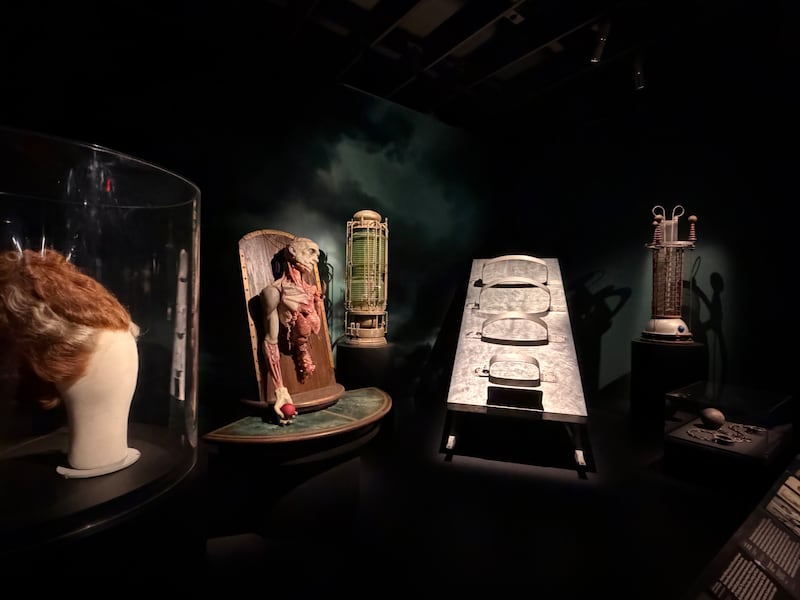
The exhibit explains that scientific horror “confronts the dangers of unchecked ambition, technological overreach, and humanity’s unsettling urge to engineer and manipulate life.” This chamber combined a variety of visual elements, from sterile steel to slimy aliens to macabre 19th-century aesthetics. Notable pieces include the Xenomorph from “Alien” (1979), the activator and Monstro Elisasue from “The Substance” (2024) and props and set pieces from “Frankenstein” (2025).
The walls of the slasher chamber were covered with water-stained yellow wallpaper and rotted wooden details, transporting the audience straight into a Southern gothic environment, similar to “The Texas Chainsaw Massacre” (1974). It was also one of the most densely populated, with the masks and costumes of the most legendary killers, most notably “Nightmare on Elm Street” (1984), “Halloween” (1978) and “Scream” (1996).

The religion chamber focused on witches, which created a natural and folksy aesthetic. Inside, there were costumes for some of the most famous modern on-screen witches like Madame Blanc of “Suspiria” (2018), Aunt Gladys of “Weapons” (2025), and Dani of “Midsommar” (2019). The exhibit highlighted that heretical women, “were demonized, their bodies made vessels for anxieties about autonomy, desire, and ancient wisdom.”

The exhibition did a fantastic job in exploring horror’s ties to representation of prejudices, especially concerning misogyny. This is seen in the female focus of both the slasher room, with the “final girl” projection series, and in the religion chamber with the witch slant.
The ghost chamber begins with a disturbing optical illusion, a dark wall with claw-like hands pressing through. As the signage notes, “Ghost stories have existed for as long as people have confronted the fear of death.” The room features the Annabelle Doll and Crooked Man music box from “The Conjuring” universe, the phone from “The Black Phone” series, and the stick figure from “The Blair Witch Project” (1999).
The exit, or Blood Room, contains projections of various horror films, and walls covered in gory and hyper-realistic resin blood and plastic curtains.
Horror is frequently misunderstood and dismissed. In reality, it is a powerful tool to unearth what society fears most. For instance, the exhibition explains how gothic horror has deep roots in Gothic Literature. This literary movement was a response to shifting Victorian morals and immigration, informing the genre’s themes of dangerous desire and marginality.
As explained by The Hollywood Reporter and History, almost two centuries later, the golden age of slashers in the 1970s and 80s addressed new societal apprehensions. The sub-genre was heavily informed by the aftermath of the Vietnam War, youth counterculture, and rising conservatism. This is seen in the fear of ethically contaminated and deteriorating ordinary America, from the rural countryside to the suburbs. The final girl is often spared for her propriety, reflecting society’s fear of teenage corruption.
“Depending on when it came out… [horror] normally shows a lot of what society or people are dealing with or struggling with. It highlights broader issues… Life can be horrifying. And also how do we deal with that? [Horror] does it through film,” museum attendee Marissa Gsoell said.
Beginning in the mid-2010s, a genre coined by mainstream media as “elevated horror” emerged with films like “It Follows” (2015), “Get Out” (2017), “The Witch” (2015), and “Hereditary” (2018). This genre is closely associated with the company A24 due to its championing of experimental directors such as Robert Eggers and Ari Aster. This movement is defined by their art-house filmmaking, thematic depth, psychological focus, and social commentary. These filmmakers redefined how horror was perceived, from gory entertainment to prestigious cinema.
Recently, films such as “Weapons” (2025) and “Sinners” (2025), the latter directed by USC alum Ryan Coogler, are gaining more and more critical recognition, as seen in their award show success. “Obsession” (2025) and “Backrooms” (2026) have gained massive online popularity for their individuality and shattered box office records with relatively small budgets. As tracked by Box Office Mojo and reported on by The Guardian and Collider, “Obsession” earned $500 million worldwide on a budget of under $1 million and “Backrooms” earned $400 million worldwide on a budget of $10 million. Much of the online discourse centers around hope that these two films are the beginning of a new trend in Hollywood.
Learning about the genre’s history provides important context to their influences and deepens appreciation for modern horror. Not only do audiences get the chance to view the very items used in some of these modern elevated horror films, but they also get to see a comprehensive and educational archive of horror.
Because horror has frequently been made with smaller budgets with less commercial supervision, therefore it has often had the ability to both be extremely weird and raw, while often performing well financially and therefore reaching a large audience. This includes the ability to address challenging political topics and include diverse perspectives.
This sentiment was echoed by other horror fans in attendance.
“Horror has always been… one of the few media representations … where they’re trying to explore queerness in really interesting ways, not just in derogatory ways … [The exhibit] did a really good job of showing a lot of different movies that are seminal in what they are talking about for society,” horror fan Danice Gsoell said.
Another visitor Mickey Martins reinforces this idea with his statement that, “Horror allows us to tackle concepts that you may not be able to tackle in any other instance. Like the concepts of evil or intangibles… Horror allows you to capture that on film, and see it, because otherwise you wouldn’t be able to.”
“You can tackle some things to a degree in other genres, but if you want to shout about something, you do it best in horror… It means so much because it’s always people taking a chance, talking about something uncomfortable,” Adea Biederwolf said.
However, while many agreed that horror’s future is bright, multiple visitors also pointed out a rising fear within the horror genre and film industry at large: the use of Artificial Intelligence. Audiences are cautious of AI’s role as a procedural shortcut, and its propensity to limit originality and creativity.
Denice Gsoell and Marissa Gsoell clarified that AI has the ability to alienate core audiences. Generative AI seems to be the exact opposite of horror’s traditional values of practical ingenuity and human craft. Most importantly, AI appears antithetical to horror’s mainstay themes of antiexploitation and inclusivity.
In a time when horror seems like the “final girl” of individualized genre cinema, it is more important than ever to appreciate the genre’s history of profound artistic and cultural impact.
Edited by Camille Culbertson, Sammie Yen and Andriana Yatsyshyn