
From the Beverly Hills Hotel to homes owned by Denzel Washington and Bob Iger, the designs of African American architect Paul Revere Williams are integral to Los Angeles’s visual identity.
Williams’s work has been invisible in plain sight for years, but almost 50 years after his death, a flurry of renewed interest is bringing new life to his prolific career.
This newfound public appreciation is largely due to the USC School of Architecture and the Getty Research Institute’s joint acquisition of Williams’s archives in 2020. A requirement of this agreement, made with his granddaughter Karen Elyse Hudson, was to make the archives available to the public.
USC Fisher Museum of Art’s “An Architect Considered” is one of three L.A. exhibitions honoring Williams this year. LACMA and the Getty’s Research Institute’s iterations will open later this Winter, and will respectively cover Williams’s contributions to Black L.A. and the greater L.A. cultural landscape.

“The consummate L.A. architect”
Paul R. Williams is “the consummate L.A. architect,” according to Valéry Augustin, founding principal at DNA Architecture + Design, Inc.. Williams’ nearly 3,000 designs, from modern bachelor pads to iconic landmarks like the Theme Building (LAX’s spider-like, futuristic centerpiece), often featured grand staircases and graceful curves; design motifs that became synonymous with the mid-century L.A. style.
Despite this, systemic racism and failure to celebrate Black contributions to society have prevented him from being fully recognized. It’s hard to overstate the bizarreness of a man designing some of the world’s most recognizable buildings but somehow remaining invisible — unseen by the city he helped shape with his vision.
Augustin, an associate professor at the USC School of Architecture and himself a Black architect, wasn’t aware of Williams until after college. Now he’s one of the curators of USC Fisher Museum of Art’s exhibition.
When planning the Fisher exhibition, Augustin and co-curators Amy Murphy and Milton S.F. Curry decided to explore an underrecognized facet of Williams’ already underrecognized career: the multi-family housing projects he built for the community.
Williams has a reputation as “architect to the stars” due to homes he designed for celebrities like Frank Sinatra, Lucille Ball and Groucho Marx. But he was also deeply committed to public service, designing countless multi-family homes, single-family housing developments, community spaces and civic buildings as well.
Architecture is often understood to be “a product of the elite,” with designs only being available to those who can afford them. Williams’s public housing projects defy that assumption and point to architecture’s populist applications.
Augustin, who devotes a significant part of his practice to community-based work like interim housing, knows this well.
“We can build a five-million dollar house that will benefit one person or one family, [or] we can do a five-million dollar interim housing project where hundreds, maybe thousands of people will cycle through and get the benefit of that,” he says. “We, I think, have the responsibility to use our skills to benefit the greatest number possible.”
For Williams, multi-unit projects were an affordable alternative to single-family housing, which was out of reach for many in the Black community or those in lower economic brackets. The five-room exhibition features never-before-seen design sketches from Williams’ archive, including sketches of the Pueblo del Rio and Nickerson Gardens housing projects, both of which can still be seen in L.A. today.
His designs can even be seen across the country. The exhibition also features sketches from projects in San Diego, Las Vegas and Washington, D.C., where he was invited to build the city’s first federally-funded housing project in 1935.
“He saw home ownership as a vehicle — as upward mobility,” Augustin says. “He was not just about designing things. [He was asking]: ‘How do we create an infrastructure that allows and benefits our communities? What are all the different resources we need to pull to create opportunities for them?’”
Outside of his studio, Williams created pathways to support community members seeking financial support, particularly for housing. He co-founded the Broadway Federal Savings and Loan, the only Black-owned bank in the West, designed its building and served on its board of directors.
Creating the bank generated community spending power, as it provided loans to Black renters and homebuyers often turned away by racist bankers. He also advocated for the community in a number of high–powered political forums, being appointed to California’s redevelopment agency and serving on L.A.’s planning, housing and municipal arts commissions.


“He was inevitable”
The impact of Williams’ community work is particularly poignant because his six-decade career, which started in the 1920s, took place when many felt it was inconceivable to be a Black architect.
When Williams expressed his interest in architecture to a high school teacher, he was told, “Don’t butt your head futilely against the stone wall of race prejudice,” according to Vanity Fair. But he wouldn’t be limited by anyone’s perceptions of his — or his race’s — abilities.
A bright pink sign in the Fisher exhibition notes his reply, which he wrote about in a 1963 edition of “Ebony.” It reads: “I think I told him that I had heard of only one Negro architect and I was sure this country could use at least one more.”
He anticipated racism but built solutions into his practice, as exemplified by his oft-remarked skill of sketching upside down to avoid making white clients sitting across from him uncomfortable.
“I think he refused to ever think of any ‘obstacles’ or challenges as something that would stop him,” Augustin says. “In some ways it almost seemed inevitable that he would go on to have the career that he had. He was extraordinarily relentless in his pursuit to create a place for himself in the world.”
Looks of surprise at the mention of Black architects still aren’t uncommon. Today, only 2% of licensed architects are Black, according to the National Council of Architectural Registration Boards.
“Many people say ‘you need to see one to be one.’ Strangely enough, I never had that growing up or studying architecture,” Augustin says. “I think the knee-jerk answer is that, of course, it’s easier now. But in many ways I do think there’s a different set of challenges. I look forward to a world where somebody says ‘Black architect’ and people won’t blink about it. You truly have progress when those things are not surprising.”
Containers of stories
The profundity of Williams’s designs isn’t solely due to their shaping of L.A.’s cultural landscape; it’s also due to the vast impacts on the lives of the millions (yes, millions) who interact with them. Buildings are the settings for people’s lives; where they laugh, cry, work and love.
In this vein, Augustin thinks about buildings as stories —containers of memories in constant conversation with their inhabitants and environments.
“Every time someone goes to the Beverly Hills Hotel, for example, whether or not they know Paul Revere Williams designed it, they will experience it. I would almost call it a micro-legacy — the way he continues to shape somebody’s experience long after he’s dead,” Augustin says.
A portion of the exhibition explores Williams’ legacy through seven artworks commissioned from a group of Black contemporary artists.
Artist Edgar Arceneaux’s abstract painting “Was A Church Now An Abandoned Theater” is a response to the state of a church Williams designed in Reno, Nevada, and how buildings and their uses transform over time. In the Enfold Collective’s “You/Us in the Interstice,” a sculpture is paired with an audiovisual collage of Williams’ residential designs across class lines.
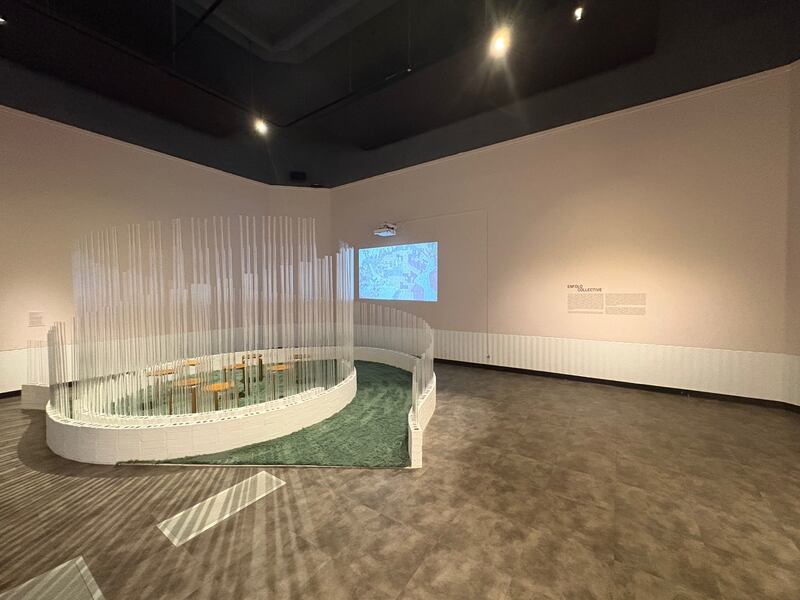
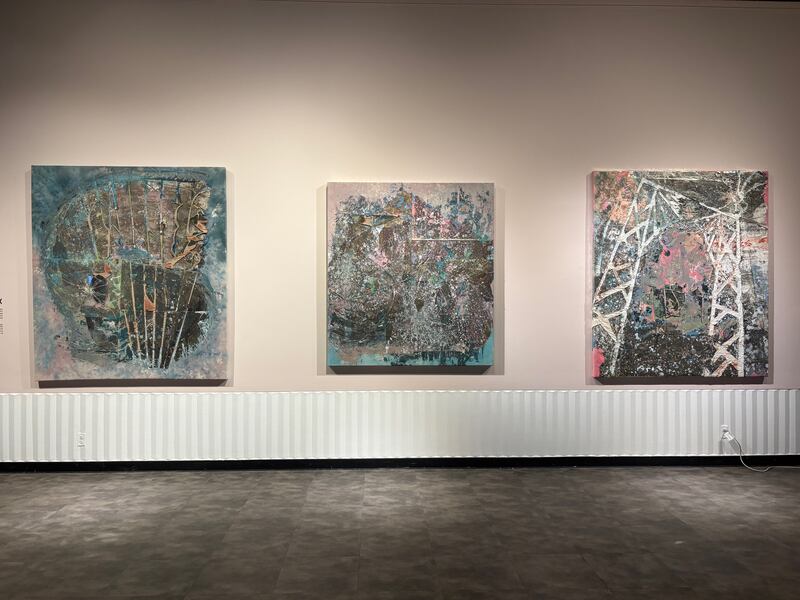
These works emphasize Williams’ continued relevance, bringing his legacy to the present — though it’s always been right in front of us.
Systemic racism prevented Williams’ wider recognition for years. But given the undoubted impact of his work, one could say that this newfound appreciation was inevitable, just as his success was during his career. It was just a matter of time.
“An Architect Considered” is on view at USC Fisher Museum of Art through March 13, 2027. LACMA’s “Paul R. Williams: Architect for Living” will open November 15 and “Paul R. Williams: Architecture Across the Color Line” at the Getty’s Research Institute on December 15.