
On Saturday evening, amongst the Downtown Los Angeles skyline, the Los Angeles Theatre Center opened its doors for opening night of “Speaking in Tongues.”
Inside the cement-columned building operated by the Latino Theater Company (LTC), theatergoers pass giant papier-mâché puppets — also known as traditional Mexican mojigangas — before descending a spiral staircase towards the theater.
A Pentecostal church, at the edge of a cornfield, is lit up on stage and adorned with dried corn husks. The audience is transported to Earlimart, a California farming town in Tulare County.
The theater then becomes vibrant with a bright and warm speech from Artistic Director of the LTC, José Luis Valenzuela, as he welcomes the audience and introduces them to Chicano playwright Luis Alfaro. Alfaro watches quietly from the corner of the room, blending in with the crowd.
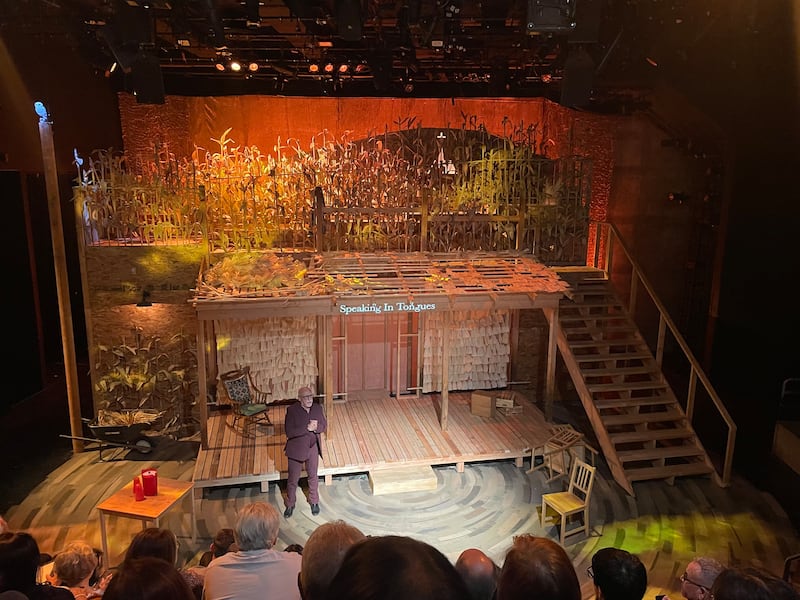
Valenzuela speaks about the importance of giving Latino artists, directors, musicians and actors in L.A. the space to tell their stories before the play begins.
“All writers need to be able to tell their stories,” Valenzuela said as he encourages the audience to embrace the spirit of the opening night. “Whenever you feel the spirit, go for it.”
That spirit carries through “Speaking in Tongues,” which follows a family of migrant farmworkers as they grapple with a dwindling congregation, shifting beliefs and the uncertainty of change.
Through humor and familial bickering, the play explores a question that extends beyond religion: What happens when the places that once gave us a sense of belonging no longer feel like home?
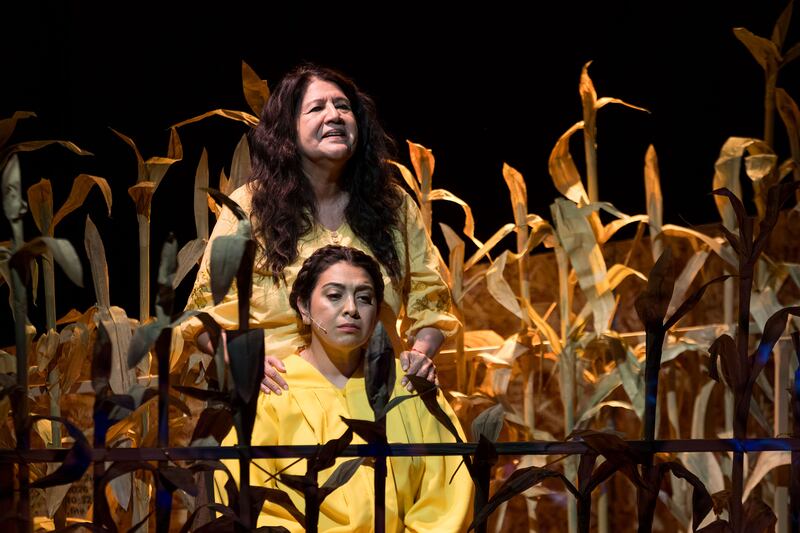
The opening scene sets the tone with a hymn sung by a woman in what appears to be a yellow choir robe. Her yearning voice fills the theater as she sings: “Oh happy day / When Jesus washed my sins away.” The moment establishes the church as more than a place of worship, but a space for gathering where people seek comfort, connection and purpose.
That sense of familiarity quickly gives way to comedy when Hermano Mando (Sal Lopez) and Hermano Tico (Geoffrey Rivas) begin exchanging chisme, or gossip, and confessing their troubles to one another.
Mando reveals that his wife is filing for divorce — a painful prospect when religious expectations can make the end of a marriage feel like a public spiritual failure. But rather than allowing the conversation to sink into despair, Mando leans into the kind of humor one would find at a family gathering. He talks about his love for “First 48” and sheepishly admits that he cannot cook and relies on chicken nuggets from “el McDonald’s.”
Meanwhile, Tico confesses to his own shortcomings. He worries about his anger, admitting that watching videos of people getting what they deserve brings him an unsettling sense of satisfaction — like a Karen getting Karen’d.
But with all the gossip and laughter, the congregation begins to unravel.
Mando, Tico and Hermana Cubby (Lucy Rodriguez) question the disappearance of their pastor and the increasingly troubling behavior of his wife, Hermana Romie (Evelina Fernández). With fewer people filling the pews, the remaining congregants struggle to understand why their church is losing its place and why Romie, in particular, seems unable or willing to restore it.

Cubby expresses her frustration as she reflects on the generational divide, scoffing at the idea of abandoning faith for pursuits like self-care, treating changing priorities as evidence that younger generations have lost their way. The younger generation of Latinos can view these issues as inevitable and painfully human, but not as a sin. Her complaints evoke the familiar arguments that surface between mothers, aunts and younger relatives, where differences in belief can become disagreements over what it means to live a good life.
Yet, the play does not simply frame older generations as resistant to progress or younger generations as eager to abandon tradition. Instead, it reveals how both sides are trying to make sense of a world that no longer looks the way they expected it to.
That conflict intensifies when Romie’s daughter Sister Tiri (Esperanza América), visits the church and tells her family that religious life is not the path she wants for herself. She much rather pursue a path of her own, even as her relatives attempt to persuade her to take responsibility for their church. Their efforts expose the difficulty of preserving a tradition when the next generation no longer feels obligated to carry it forward.
As the play unfolds, Romie reconsiders her own understanding of faith and the forces that have shaped her community. Her reflection complicates the idea that a declining community is simply the result of people losing their beliefs. It raises a more difficult possibility: what happens when the conditions that once made a community depend on its church begin to change?
The question carries particular weight in a play centered on migrant farmworkers, whose lives are shaped by labor, displacement and uncertainty. Against the backdrop of immigration raids threatening the community, the church’s decline becomes part of a broader struggle over security and belonging.
Alfaro, a L.A. Chicano whose parents were farmworkers from the San Joaquin Valley, draws on the relationship between people and the land in his geographically inspired body of work. In “Speaking in Tongues,” the cornfield is more than a backdrop. It connects the characters to the labor that sustains them and to the changing circumstances that shape their beliefs.
Ultimately, the play’s greatest tension lies in its refusal to offer an easy answer. Preserving a community does not necessarily mean preserving every tradition, just as embracing change does not require abandoning everything that came before. The characters must confront what their church has meant to them and whether its spirit can survive beyond its walls.
Through its blend of humor, family conflict and spiritual questioning, “Speaking in Tongues” invites audiences to reflect on the institutions that raise them and the communities they may one day have to rebuild.
The play’s questions linger beyond the final scene: when the places that once gave us a home begin to disappear, what are we willing to do to keep their spirit alive?
“Speaking in Tongues” runs at the LATC through November 15, with performances every Thursday through Saturday at 8 p.m. and Sundays at 2 p.m.
Edited by Camila Echevarria and Nia Crichelle Robertson.