
“Diva Manifestation Ritual,” an exhibition by USC Roski fine arts student Alden Kisner, opened on Thursday, September 24, 2026 at the Gayle and Ed Roski Gallery. Through large figurative paintings and self-portraits, Kisner explores femininity, performance and identity. She also examines consent and the power to decide how both the female body and “she” are perceived.
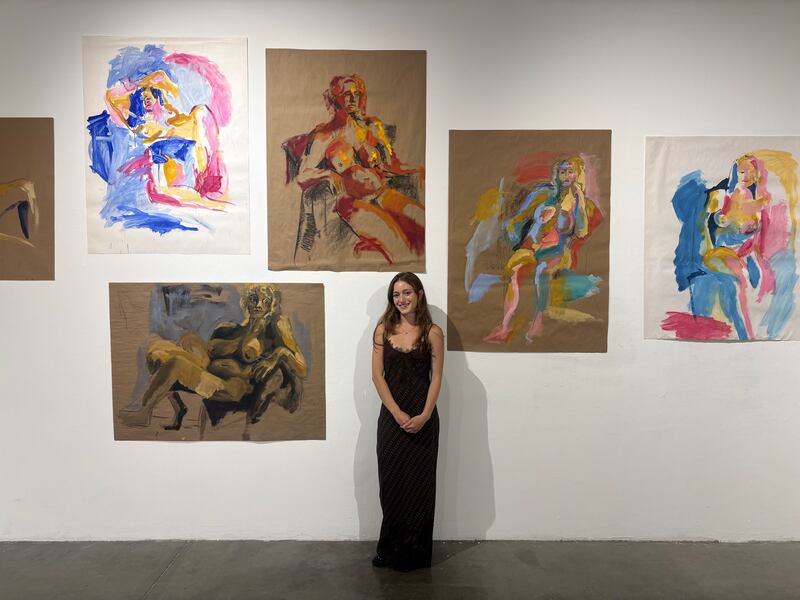
The exhibition brings together seven figure drawings, selected from roughly 150 Kisner had made with live models and self portrait paintings. Across the works, she moves from observing other women to examining her own position as both the subject and the artist.
In an interview with Annenberg Media, Kisner spoke about the inspiration behind the body of work and her artistic evolution through the ritual of drawing nude women.
Kisner began painting in high school, where figure drawing classes introduced her to the female body as a powerful and complex subject. She was initially inspired by artists like Dutch painter Willem de Kooning, whose depictions of women she perceived at the time as “fun and spontaneous.”
“I was really naive at the time and didn’t understand where their work was coming from,” she said. “I started looking back and understanding the work I was looking at. De Kooning, for example, was quite misogynist. And that shifted how I think about my work.”
She found a different approach in Lisa Yuskavage and Cindy Sherman’s art. Kisner was struck by the exaggerated, sexualized female figures Yuskavage painted. She also liked Sherman’s approach, where the artist photographed herself in an intimate setting. For Kisner, witnessing women artists control how to portray female bodies changed the meaning of the images.
In “Diva Manifestation Ritual,” Kisner bears the question: who controls the image?
“I got into self portraiture and the idea of putting the frame around myself because if I were painting another woman, there’s less authority I can have over the space” she said. “If I’m putting the frame around my own body, the consent is completely there.”
Kisner recalls feeling envious of the women she painted as a teenager. While she felt the impulse to cover her body, the models commanded the attention of an entire room. Kisner began projecting herself onto models who resembled her and whose confidence she admired.
“I saw my own body as a site of power,” she said.
Kisner drew the models quickly in order to capture the spontaneity of each live session. The more she came back to this figure drawing, the more she began to imagine putting herself in their place.
Kisner’s first self-portrait was “Algorithm,” depicting herself upside down on her bed looking at her phone. She took the source photo herself, yet painted the scene as though she were unaware of being watched. “That was the first time I ever painted myself, and that felt really radical,” she said.
Looking back, Kisner sees vulnerability in that decision. She had chosen to show herself, but had not yet found the commanding presence she would give herself in “Stranger on the Hillside.”

In “Stranger on the Hillside,” Kisner presents herself differently. The 63″ by 72″ green self-portrait shows Kisner in a field with exaggerated breasts, looking up to the viewer as she pulls down her dress. She holds an empty cup as an invitation for the viewer to join her and have desire. The painting draws on familiar Western art images of women in pastoral scenes, this time recalibrating the balance of power via the scale of her work.
“I’m dictating the space that people enter and I’m more in power than the viewer looking at me,” she said. “I think every single woman in the show is looking down at you.”

“Mystery Work” further complicates the relationship between artist, subject and viewer. Kisner depicts herself painting a model, her reflection appearing in a mirror while a drawing of the model hangs behind her. That same drawing is displayed separately in the exhibition, allowing visitors to find the image both inside and outside the painting.
“I wanted the viewer to feel like they’re standing in between the moment between me and the model,” Kisner said. From that position, visitors encounter the model’s gaze and Kisner’s own, while also seeing who made the image.
Kisner being present as both the painter directing the image and a figure reflected within it, complicates the confidence she first admired in her models. Being seen can be powerful, but the person making the image ultimately controls the subject.

For Kisner, “diva” names a persona that is unapologetically feminine and unafraid to demand attention. The word is playful and culturally relevant, but it also comes from her fear of being judged as a woman who is “too much.”
She knows some visitors may be uncomfortable with the sexualized figures. She hopes they will pause to consider why a woman’s body taking up space might provoke that response.
Edgar Arceneaux, Kisner’s faculty mentor at Roski, helped her think through how the works would relate to one another in the gallery. He described Kisner as someone with plentiful “deep thinking and power in the work that she makes.”
“She’s put herself in a bunch of different scenarios. One is the artist. One as the figure that the artist observes. One as the woman in the male gaze,” he said. “I think in some ways, she’s trying to understand how she sits in this crazy art world, both as an individual and how to make sense of herself as a woman within this society.”
Meanwhile, Kisner is already imagining her next body of work including multiple versions of herself interacting in the same scene. After learning what one figure can do at a large scale, she wants to explore how far that presence can extend.
“How much more can I take up space?” she asked.
Diva Manifestation Ritual is on view through October 13, 2026 at the Gayle and Ed Roski Gallery, 3001 S. Flower St. Admission is free. Visits are by appointment only Monday through Friday, 9 a.m. to 4:30 p.m.
To book a time, contact Alden Kisner at akisner@usc.edu or message her on Instagram @AldenKisnerArt.
Edited by Andriana Yatsyshyn and Sammie Yen.