
Nearly 60 years after George Lucas graduated from USC’s School of Cinematic Arts, the filmmaker is bringing his vision for a museum of narrative art to Exposition Park — just across the street from where he received his diploma.
The museum, which opens to the public on Sept. 22, houses more than 40,000 works spanning illustration, comics, photography, animation, film and fine art.
“It has been a long haul,” Lucas said at the preview. “I don’t like to do things people think can be done. I’m fascinated by doing things people say can’t be done . . . I’m used to doing the impossible.”

The Lucas Museum is no exception.
Surrounded by the Natural History Museum, the California Science Center and the Los Angeles Memorial Coliseum, the Lucas Museum occupies one of Exposition Park’s most striking locations.
Visible from the intersection of freeways and marked by a unique grassy roofscape, it is both grounded and ethereal.

From the outside, the museum is a silver screen vision. It’s a spaceship, a capsule or a futuristic canopy. It’s meant to be whatever a visitor makes of it.
Head architect Ma Yansong’s design philosophy is rooted in the relationship between architecture and nature, and that buildings themselves have a narrative quality.
“It’s all curved,” he said while guiding a tour of the museum. “In nature, you never see straight lines. So, you can discover the building from any angle.”

Since founding MAD Architects in 2004, Yansong has routinely masterminded projects that combine the natural world (the “context,” as he calls it) and his creativity. His 2011 Ordos Art & City Museum — a building that looks like it descended from above onto sand dunes — caught George Lucas’s attention and became the reason Yansong was chosen for this intergalactic undertaking.
Filmmaking was Yansong’s first professional passion, and he revealed that his design was unconsciously inspired by a “Star Wars” scene.

While Yansong sees the museum as a link between humans and the world around them, Lucas sees it as a “temple of peoples.”
Exhibitions diverge from the conventional time period that most museums offer. Instead, stories are arranged around the shapes of ordinary life: love, family, community, play, work, sports, childhood and adventure.
“Stories are how we’ve always made sense of who we are,” CEO Tracy Bates said in the opening press conference. “People have always needed images to carry their stories to remind us what we have in common with each other.”
A dedicated cinema gallery opens with “Star Wars in Motion,” built from archives of the first six Star Wars films.

Concept art, props and costumes follow the evolution of the Star Wars universe, from Luke Skywalker’s landspeeder in “A New Hope” to General Grievous’s wheel bike in ”Revenge of the Sith.”

As much as Lucas’s name is synonymous with his franchise creations, the museum is a reflection of his other interests and passions. Illustrations and other hand-drawn creations are the priority. It’s a turning point from traditional art museums that have historically excluded such artwork.
“For a long time, however, much of that storytelling, illustration, comics, advertising, animation didn’t get treated with the same respect as painting or sculpture,” Bates said.
The collection’s scope shows up gallery to gallery: comic art, mural painting, children’s book illustration, science fiction art and photography all get their own space.
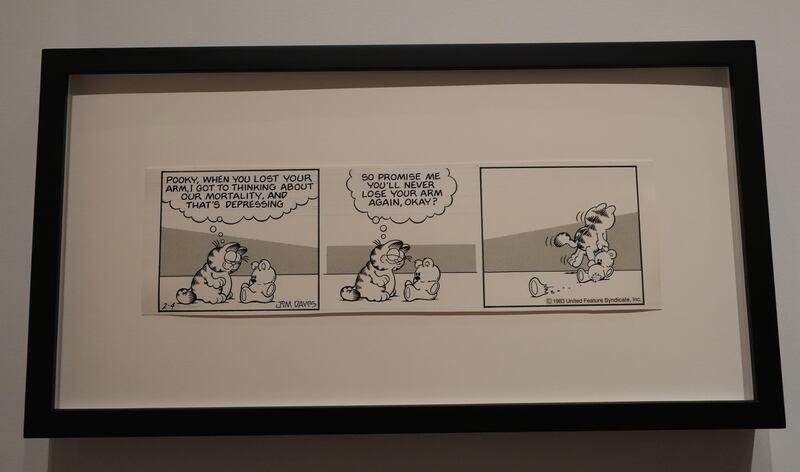
In the comic art galleries, nostalgia is a part of the experience. Garfield and a top-hat Snoopy bring childhood favorites off the page and into the museum.

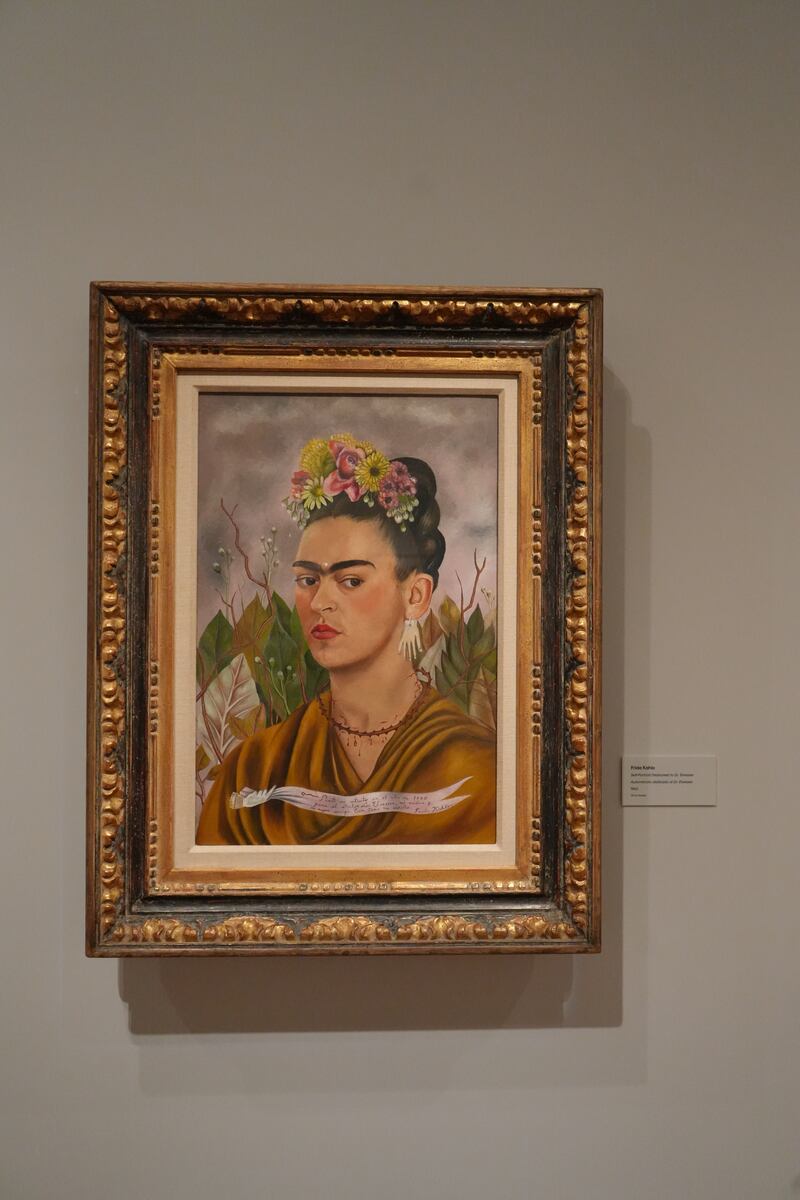
Works by Frida Kahlo, Norman Rockwell, Carrie Mae Weems and Maxfield Parrish sit nearby, challenging the idea that popular and fine art belong in separate worlds.
Even British street artist Banksy got to leave his mark. Remnants of splashed paint have since dried into the floors near his work on the fifth floor.

The Lucas Museum will also have a daily film program. The Robert Flaherty Theater will showcase works of documentary filmmakers from Richard Averson to Robin Dashwood, while the Slavko Vorkapich Theater plans to screen short films that “explore the essence of cinema — editing, light, motion, color and sound.”
The library located on the second floor is free for all visitors, regardless of whether they have a museum ticket. Inside, visitors will find a collection of art publications, as well as a Steve Martin collection of donated books and archival materials available for research.

For a museum built around storytelling, perhaps its most important collection isn’t what hangs on its walls. It’s the imagination visitors bring with them.
As Tracy Bates said, “If this museum sparks that same imagination in even one young mind that George felt 50 years ago, it will have been well worth it.”
Tickets are available online now. Admission is free for visitors under 18 years of age or for residents of all ages within the 90037 zip code area.