
The weekend of June 5-7 saw Angelenos flock to the Walt Disney Concert Hall to witness Gustavo Dudamel’s final concert series as the music and artistic director of the Los Angeles Philharmonic.
On the evening of June 6, the audience members rose before the final notes had fully dissolved into the hall’s celebrated acoustics. It was a long standing ovation. Some wiped away tears. Others stood motionless, reluctant to acknowledge that a chapter of Los Angeles’ cultural history was drawing to a close. Although it won’t be Dudamel’s last time performing in Los Angeles since he will be performing at the Hollywood Bowl in fall, the weekend marked his farewell to the concert hall he called home for nearly two decades.

At the podium stood Dudamel, conducting one of his final performances after 17 transformative years. The concert, part of the orchestra’s “Celebrating 17 Years” series, marked the culmination of a relationship that permanently altered both the institution and the city around it.
Lee Werbel, 75, who lost her house in the Eaton Fires in 2025, shared that it was a tough time for her. Yet, she bought tickets because she was committed to attending Dudamel’s last series of concerts.
“The reason I am here tonight is because Dudamel is a magnificent conductor, and what he has done with this orchestra has really brought it alive. It’s beautiful to be here, we did not want to miss it,” Werbel said. She added, “I think it was historic when he came on board because it was just a big pivot, where someone is so engaging, someone who brought LA along, and was about LA.”

The emotional power of the evening also stemmed from timing. The concert arrived during Dudamel’s final season with the LA Phil before his move to the New York Philharmonic. Weeks earlier, the orchestra had announced that British conductor Daniel Harding would become its next music director.
Tom Stempel, 84, who has been a subscriber of LA Phil for the last 30 years, said, “I have seen and heard great music here. I am a huge Dudamel fan and we are going to miss him terribly, but I am also curious as to who the conductor coming in is going to be.”
When Dudamel arrived from Venezuela in 2009, he inherited an orchestra already admired internationally. Under predecessors such as Esa-Pekka Salonen, the LA Phil had developed a reputation for innovation and adventurous programming. Yet Dudamel expanded that vision into something broader: an orchestra deeply intertwined with the civic identity of Los Angeles.
Over nearly two decades, he became one of the city’s most recognizable cultural ambassadors. His image appeared on billboards, magazines and television broadcasts. More importantly, he introduced classical music to audiences who often felt excluded from it. Through community programs, free performances and his passionate advocacy for music education, Dudamel helped dismantle the perception of classical music as an art form reserved for elites.
Helen Ziskind, 82, a long-time LA Phil subscriber who visits at least seven concerts a year, said, “I think this is a historic moment because he changed the way the orchestra functioned. He changed the way music was presented. He brought young people as well.”
For many younger Angelenos, Dudamel became the face of orchestral music. His exuberant conducting style and visible joy challenged stereotypes about classical music’s rigidity. He made the art form appear alive and accessible.
Mary Bugbee, 25, a singer attending an LA Phil concert for the first time, said, “He was very charismatic, exactly what I expected. A friend of mine told me that I have to go see Gustavo before he retires, and I agree. I was very satisfied with the performance.”

Dudamel’s vision was rooted in his own upbringing within Venezuela’s El Sistema, the revolutionary music education movement that transformed the lives of countless young musicians. In Los Angeles, Dudamel championed the Youth Orchestra Los Angeles, or YOLA, a program that has provided free instruments and intensive musical training to thousands of children from underserved communities. The initiative became one of the defining achievements of his tenure, extending the orchestra’s influence far beyond Disney Hall’s stainless-steel walls.
Six young members of YOLA – Jade Alfaro, Pablo Fernández, Alondra Herrera Lopez, Camila Higueros, Catalina Mihok and Greyson Session – performed Guillermo Arriaga’s “América.” Rather than constructing a farewell around familiar European masterpieces, Dudamel chose a program that spoke to the multicultural realities of Los Angeles.
Larry Gurewitz, 80, a member from the audience said, “Having the kids talk about America was very emotional, especially in this day and age, and the singers are wonderful.”
The main performances featured John Adams’ “Harmonium”, alongside Antonio Estévez’s “Cantata Criolla,” featuring performances by Anthony León and Eleomar Cuello, bringing together contemporary American music and a landmark Venezuelan composition. The works employed large choral forces and explored themes of identity, spirituality and collective experience.
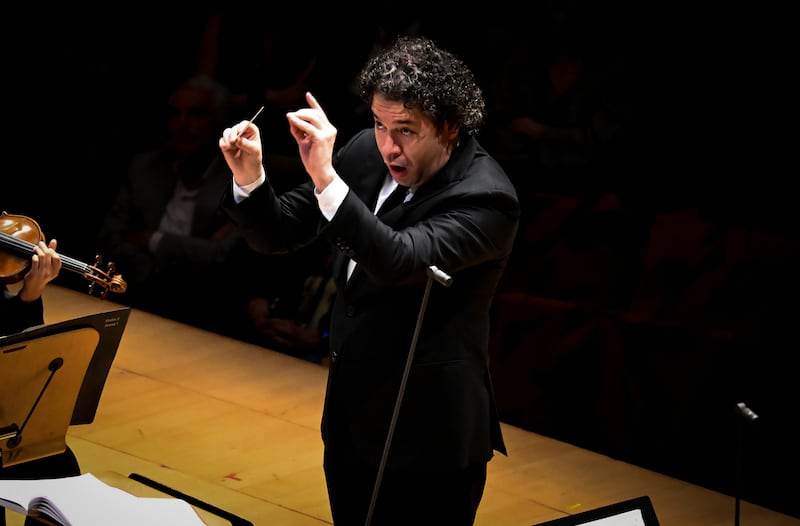
Throughout his tenure, he consistently broadened the orchestra’s repertoire, elevating Latin American composers and introducing audiences to music that had historically occupied the margins of classical programming. Long before institutions across the country began discussing diversity in earnest, Dudamel was reshaping concert stages through artistic choices.
Los Angeles has long struggled with narratives of impermanence. Stars arrive and leave. Industries reinvent themselves. Neighborhoods evolve at dizzying speed. Institutions often feel transient. Dudamel’s 17-year tenure offered a rare counterexample: a sustained cultural relationship that matured alongside the city itself.
Gurewitz said, “He really changed the way I listen to music. I began to look at each of the musicians, focusing on how they played, how they affected the orchestra, and the music.”
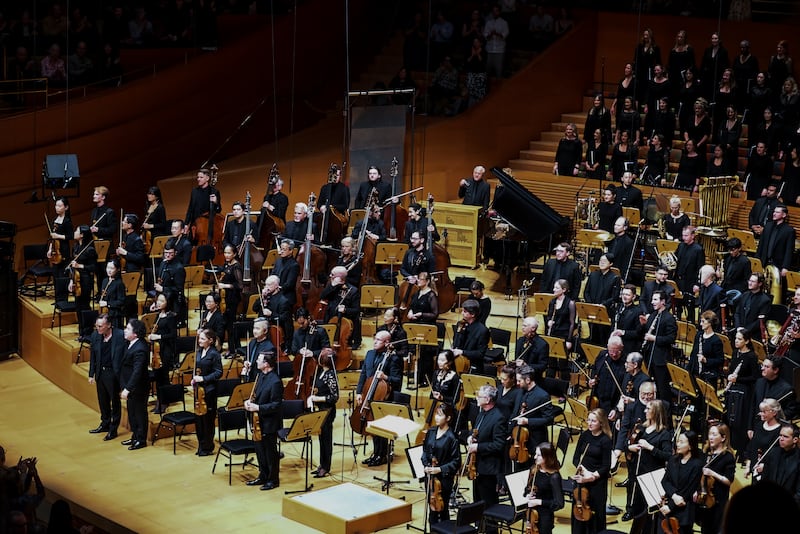
During his years in Los Angeles, Dudamel conducted performances that ranged from Mahler symphonies to film music. International observers increasingly looked to Los Angeles not merely as an entertainment capital but as a serious center for contemporary classical music. The orchestra’s global prestige grew substantially during his leadership.
Elena Echavarria, 29, who was born and raised in Los Angeles, said, “I usually feel very somber when I listen to classical music, but this felt a lot more different than what I usually feel. I felt very lively. I felt airy. It was euphoric.”

Even though it’s a sentimental farewell, it is not the end of Dudamel’s relationship with Los Angeles as he will remain connected to the orchestra as its artistic and cultural laureate. It is the conclusion of an era that redefined what cultural leadership could look like in the 21st century.
Dudamel’s final concert with the LA Phil will be at the Hollywood Bowl in August.