
On March 27 at the Novo in Downtown Los Angeles, the line outside the intimate venue felt less like the queue for a concert and more like the gathering of a community preparing for a ritual. Something about this particular crowd felt different. Women arrived in goddess draping: flowing silks, bold prints, headdresses, flowers in hair, gold jewelry catching the streetlight.
Yasmina Mejdoub from Morocco showed up with a big yellow flower in her hair. “I just love her (Naïka) divine feminine energy. Her connection to the ocean, to the water, makes me feel so seen,” Mejdoub said.

Many attendees were already dancing before they reached the door. It was not just a concert crowd. It looked, and felt, like a congregation. That word “congregation” is not an accident when discussing Naïka.
Her debut album, ECLESIA, released just five weeks before her homecoming show in Los Angeles, takes its name from the ancient Greek ekklesia, meaning a gathering of people. That night at the Novo, the 31-year-old French-Haitian singer made that etymology breathe. What unfolded over nearly two hours was more a spiritual reclamation as opposed to a performance.
The atmosphere transformed into something increasingly rare in contemporary pop culture: a celebration of femininity that was neither performative nor commercialized, but communal.
Halima Othman, a registered nurse in LA who mentioned she is of Arab origin, said, “I love Naïka because she is a baddie. She is independent, authentic and represents all of us out here. I just love when a girl is herself.”

Naïka was raised across Guadeloupe, Kenya, France, South Africa, and the United States, and has spent her career defying easy categorization. Her father is of French origin and mother is of Haitian origin with Arabic roots. Her music braids pop, neo-soul, R&B, Haitian Konpa, and Afro-Caribbean rhythms together with a fluency that can only come from someone who grew up in between multiple worlds, absorbing each one wholly. She sings in English, French, and Haitian Creole, sometimes all within a single song.
Diba Iravan, a Persian woman who has been in LA for thirteen years, said, “Naïka is the child of the world. I love her mixing languages like French, Haitian Creole and English.”

The set opened with “Welcome to Eclesia”, the album’s ceremonial first track. Naïka arrived onstage draped in white and yellow, arms open, as if receiving everyone into something larger than a concert. What followed was a masterclass in what it means to hold a room not through force, but through presence. Women around the floor closed their eyes, raised their arms, and mouthed the words back at the stage.
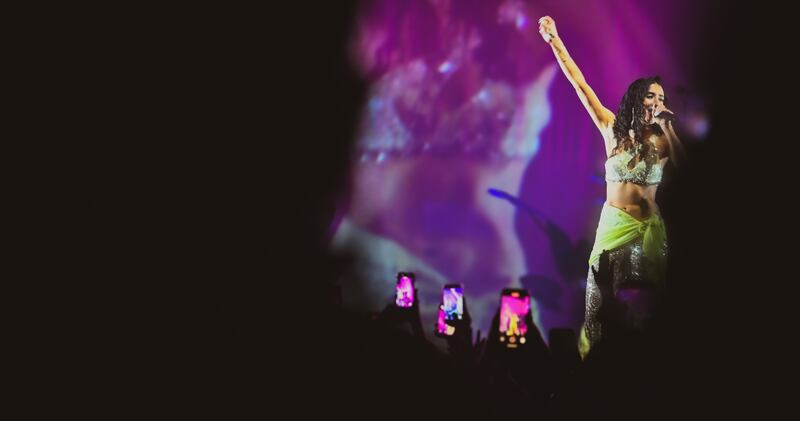
Naïka shared an anecdote about her song “For Gerard”, where her uncle’s whistling played a huge part in the composition. “His whistling was so popular that he came to be known as the Whistling Man of Haiti,” Naïka said.

It was worth pausing to admire the outfits of the women in the room, because it symbolized something deeper. It was deliberately feminine clothing including flowing skirts, lace dresses, silk tops and carefully chosen jewelry; not the uniform of a nightclub, but something more intentional, more ceremonial. It was the kind of clothing Naïka herself would wear.
“Naïka’s songs remind me to connect with my ancestors, have gratitude that I am here at her show today. I love everything about her vibe, so I just threw on everything in my closet that I thought she would wear,” Mejdoub said.
It was a space where sensuality was not performance, where moving your body freely was not an invitation but a declaration. Naïka did not manufacture this atmosphere by accident. She has been cultivating it, song by song, for years.

At a time when much of popular culture rewards irony and detachment, Naïka’s performance encouraged something different: vulnerability, softness, emotional openness and unapologetic joy.
The audience responded in kind.
Elissa Wartoukian, a Pasadena resident with Armenian heritage, said, “Naïka is a girls’ girl! Her energy is for everybody, no matter what age you are, you can always listen to her.”

Throughout the night, women danced without concern for how they appeared to others. Strangers complimented one another’s outfits, fixed each other’s hair, held hands and swayed in unison.
As Naïka spoke of community and healing together, the crowd cheered in agreement.
“We are all unique in our own way. We are all layered,” Naïka said.
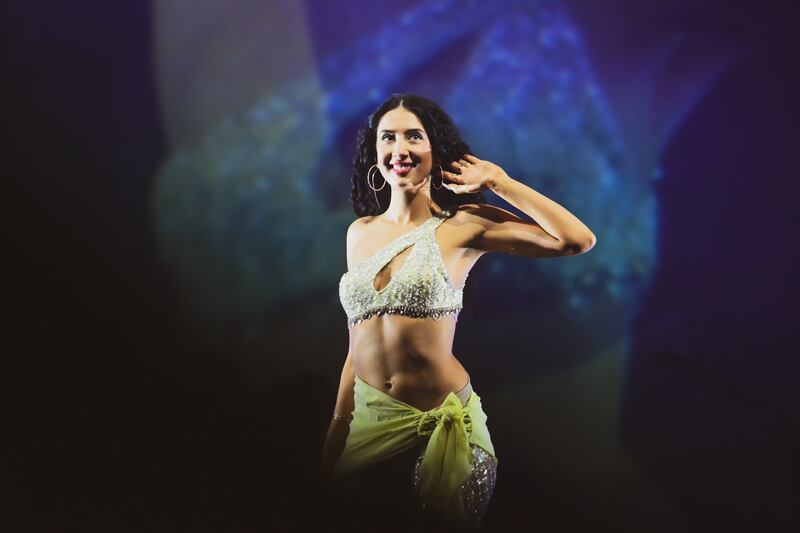
Sharis Ghazeri, a pharmacist of Iranian descent, from Glendale, said, “Naïka is so uplifting, she just never lets you feel down. Her feminine energy is just so happy, she is such a goddess.”
Naïka provided a reminder that femininity can be expansive, joyful and deeply communal. Her performance transformed a downtown concert venue into a sanctuary of self-expression, where women could celebrate themselves and one another without any apology.