
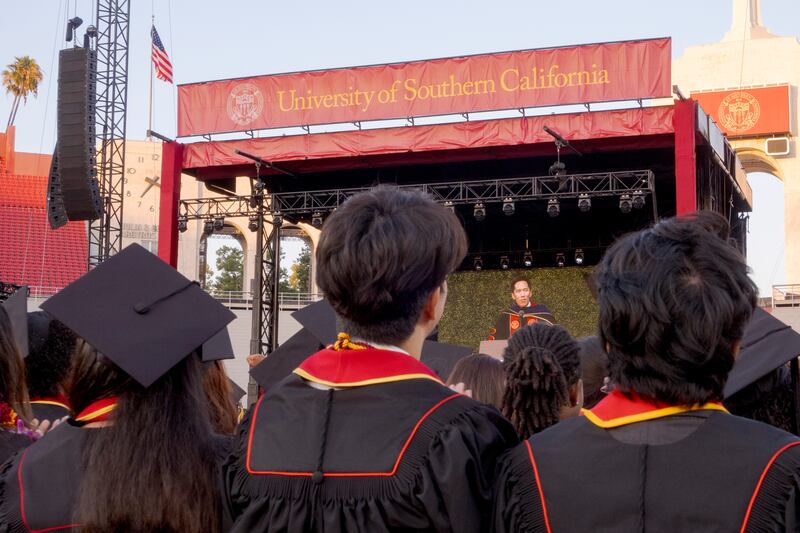
USC’s 143rd commencement ceremony, held at the Los Angeles Memorial Coliseum, celebrated the Class of 2026, while also offering guidance for the next chapter of their lives.
The Coliseum itself was packed, with approximately 46,000 friends and family in attendance. For the families of the graduates, it was a particularly momentous occasion.
Mia Cornejo was excited to see her older brother, Marcos Cornejo, graduate with a business administration degree.
“Since he’s first generation, we’ve never seen someone graduate in our family,” Mia said. “So I would say this is a very special moment for our family.”
The significance of the occasion was not lost on Marcos either.
“I feel like there’s a lot of pressure that comes with it,” Marcos said. “But it’s also a big achievement and it’s something I’m very proud of and it’s going to stay with me for the rest of my life.”
Around the Coliseum, parents called to their children on the field and waved in the air, trying to get their attention before the ceremony began.

While the ceremony’s production value was unmatched, the evening did have its occasional hiccups.
“Did it go on?” USC President Beong-Soo Kim asked, referring to the Olympic torch behind him. It lit seconds later, interrupting his speech.
This was Kim’s first commencement speech since becoming USC president, something he worked into his speech early on.
“I do feel a very special connection to the Class of 2026,” Kim said. “Not just because I’ve gotten to know so many of you, but because we’re always going to have something in common. For most of you, this is your very first USC commencement. And as president, this is my very first commencement with you as well.”
Kim’s speech was warm and optimistic, injected with humor and heart.
“Doing something for the first time can be exciting,” Kim said. “But I have to admit that as I thought about what to say tonight, I’ve also experienced some self-doubt. What could I tell you that you don’t already know?”
That insight paved the way for the theme of Kim’s speech: What’s the difference between coming in first, and going first?
First, Kim cited Allyson Felix’s intention to return to Olympic competition in her 40s.
“Her goal is to become the first woman and mother in their 40s to win a track and field medal in the Olympic Games. Think about that,” he said. “Here is someone who has already secured her place among Olympic legends, who has nothing left to prove…And why?...Because the goal isn’t to win another medal, but to expand what’s possible for herself and for mothers across the world.”
Kim also had praise for 2026 graduate Lucy Westlake, the youngest woman to summit all fifty U.S. peaks.
“The great thing about going first is that you don’t even have to wait until you’ve reached the pinnacle of achievement, like Allyson [Felix],” Kim said. “A few years ago, a young woman made news for being the first woman to climb the highest mountain in all 50 states by the time she was only 17 years old. And the next year, she made news again as the youngest American woman to summit Mount Everest. What I love about this story is that it’s not just pulled from a newspaper. It’s the story of someone in the Coliseum tonight.”
Kim wrapped his speech up by wishing the best for the first class to graduate during his tenure.
“We at USC hope you come in first many times. We hope you win and win big. But there’s something we wish for you even more than that,” Kim said. “Not just that you come in first, but that you’re willing to go first by believing in yourself…by carving your own path through uncertainty and doubt and by winning on your own terms, not those of someone else.”
In lieu of a valedictorian speech, seniors in good academic standing are encouraged to apply to be the student commencement speaker. This year’s student speaker was Annenberg’s own Kash Amos.
Amos, the first Black man to deliver USC’s student commencement speech, graduated with a communication degree and played defensive tackle for the USC football team.
Amos began quickly, with his insight on faith, followed by a laugh.
“When I look back, I see God’s hands in places I didn’t understand at the time, shaping me through trials and tribulations that built who I am today,” Amos said. “I learned that your level of exposure will determine your level of success. And with me being so blessed and highly favored, President Kim, Provost, deans, senior leadership, the trustees, members of the audience…Does anyone want to hire me?”
The entire Coliseum erupted in laughter.
“I’m serious,” Amos followed up.
But he also delivered moments of reflection.
“Today isn’t about one story. It’s about a collective becoming,” Amos said. “If there’s one theme that defines us, we didn’t just survive USC. It became a testament to our legacy.”
With his speech, Amos demonstrated his skills as a seasoned storyteller, using honesty and playfulness with moments of wisdom sprinkled between.
“The world we are walking into is not stable, but we are steady,” he added, before taking a selfie with the Coliseum crowd behind him.
Amos also shouted out the veterans, transfers and international students in his graduating cohort.
“This isn’t the finish line. Transformation does not end with graduation,” Amos said. “Rejection doesn’t exist. Only redirection. Once you find your success, share it with as many as you can and your success will never be forgotten.”

Following Amos’ speech, President Kim awarded three honorary degrees: Doctor of Humane Letters to author Joyce Carol Oates, Doctor of Science to geophysicist Maria McNutt and Doctor of Music to the night’s keynote speaker, the music director and conductor for the Los Angeles Philharmonic, Gustavo Dudamel.
“Music, art and beauty are universal rights,” Dudamel said.
His speech was rooted in his love of music and the importance of finding harmony in a noisy world.
“To create harmony, the essential thing is that we must listen to one another. It doesn’t matter how immensely talented you are,” Dudamel said. “And I don’t know how you feel, my dear friends, but I believe we all feel that we are living in a world full of noise, full of confusion, a world that never stops shouting. And in the middle of all that shouting, we begin to lose ourselves.”
Dudamel went on to say that true harmony requires that one pauses and listens.
“Everyone wants to be heard, but no one is listening,” he said. “And without listening, hearing only our voices, other people around us begin to disappear.”
Dudamel also spoke about the importance of diversity, as well as his connection to Los Angeles.
“I am Venezuelan, I am Latino,” he said to massive applause. “I am very, very proud. I am also an Angeleno. And a Lakers fan.”
By nightfall, many graduates and guests had grown restless, with some milling on the field and others chatting in the stands.
USC recaptured their attention in full with one final act: a drone show, which itself was capped off with fireworks.

The drones, glowing above the Coliseum, formed images, like Tommy Trojan driving his sword into the ground, as well as messages that simply read “Congratulations, Class of 2026.”
Many guests whipped their phones out to capture the spectacle. The fireworks provided a loud and colorful button on the evening. The newly minted alumni then rushed out to meet their families for hugs and photos.
“It was surreal, the experience was amazing,” said computer science graduate Divya Rajput. “All the speeches and everything were really motivational…it’ll help us get forward to the next stage of our lives.”
