
After months of stalled negotiations and a February strike involving more than 2,000 nurses, Keck Medicine of USC and the California Nurses Association reached a tentative agreement Wednesday. Union members are voting whether to ratify the deal.
The agreement includes a 4.4-4.6% annual wage increase and a no-premium USC Exclusive Provider Organization (EPO) Select plan.
The February strike was the culmination of intermittent bargaining for a return to status quo benefits since changes last May. Yet, some nurses said negotiations prior to last week showed little visible progress.
USC hospital administration provided few public updates during that time. Despite their remonstrances and attempts to contact Keck, nurse strike leaders said they had seen little to no progress from the hospital in negotiations, according to a flyer posted in the nurse break room by the California Nurses Association (CNA).
On April 17, after months of inaction, the executive nurse leaders of Keck announced they had resumed negotiations with the CNA, with a federal mediator supporting the talks.
In early 2025, Keck proposed nurses’ healthcare plans requiring registered nurses (RNs) to use exclusively USC-networked facilities, in the form of a USC EPO plan. Beyond placing strain on an already overburdened system, RNs would now face significant out-of-pocket expenses, long wait times and a reduction to previously broader coverage.
In an address to the university, Keck Medicine’s CEO Rod Hanners cited a $33 million shortfall in 2024 to counter CNA’s claim over a purported $500 million surplus that they argued should have been paid towards healthcare workers. Additionally, Hanners argued his 2025 layoffs and budget cuts were the result of industry pressures to keep Keck financially sustainable and emphasized his commitment to patients to “continue to receive the same excellent care.”
An infusion nurse at Norris expressed dismay at the upheaval in the healthcare system. The nurse requested to be identified only by the initials SW due to concerns about potential retaliation from hospital administration. The nurses interviewed for this story spoke with Annenberg Media before the tentative agreement materialized.
“Am I even going to be able to see a doctor and have my annual assessments done?” she said. She added that on top of rising costs, she has to pay for extra coverage to maintain access to services she once had.
Within USC’s network, services that treat women’s health are especially affected. Michael Simonton, a Keck registered nurse, highlighted how “[USC] has scaled down to two OB-GYNs…for tens of thousands” of employees and their families. This creates uncertainty around access to preventive care, including screenings for cervical and breast cancer, as they’re forced to turn to USC’s limited in-network systems.
In an increasingly strained healthcare environment, some of USC’s nurses felt understaffed.
SW explained how they felt they were “being stretched to the point where nurses can’t even take their breaks…the expectations don’t match the reality of patient flow.”
Some nurses struggled to find time to feed or relieve themselves during the day, often foregoing basic needs to care for their patients.
“We just want to pee every now and then,” Simonton said. “We just want to eat.”
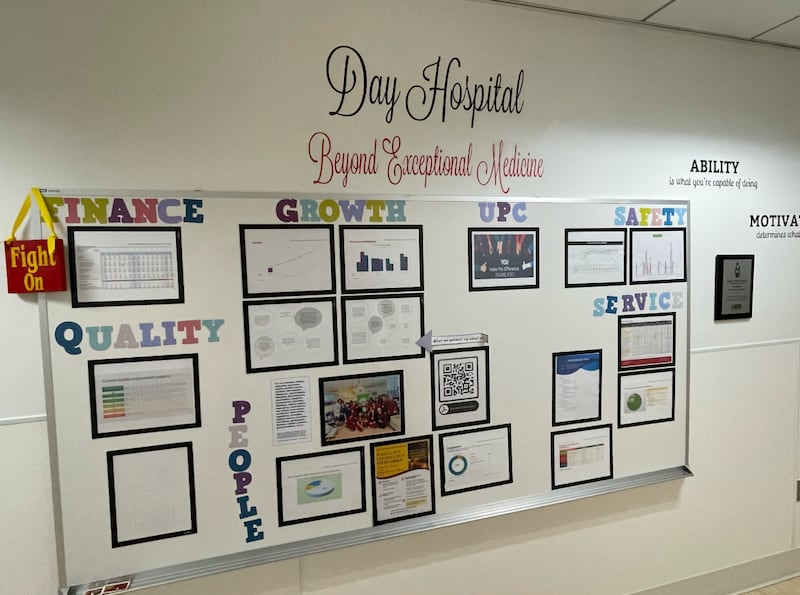
A bulletin board by the hospital administration, displaying kudos that read “YOU make the difference,” is surrounded by graphs showing hospital quality metrics and patient intake statistics. It sits outside the Norris Day Hospital.
An infusion nurse, who also asked to be identified by their initials due to concerns about potential repercussions, said the hospital’s appreciation shouldn’t be in the form of motivational posters, but rather in something that can put food on their table.
“I don’t need you to give these cookies and have a sign and say heroes work here,” said the nurse, identified as JR. “I need you to provide us with the wage we deserve… equitable for the amount that we do for the company.”
JR lamented, “That’s something USC has done in the past, and it feels like a betrayal that they’re no longer doing.”
The recent pattern of stalled negotiations before reaching their current agreement isn’t unique to Keck. This year, 31,000 healthcare workers went on a strike after Kaiser Permanente stalled and left negotiations over labor contracts, according to CalMatters. Kaiser had to fill thousands of vacant nursing positions with traveling nurses, who are typically paid far higher rates compared to their counterparts. Only after four weeks of striking did Kaiser relent.
Today, Keck faces the effects of the aforementioned financial pressures. According to the American Hospital Association, American hospitals are increasingly navigating narrowing operating margins, forced into making cost-containment decisions that often prioritize short-term financial sustainability over long-term workforce investment.
For nurses, the strike and what some say were limited concessions felt like a sign of something bigger: a shift in institutional priorities away from patients.
Simonton said the hospital’s subsequent approach after the strikes felt “punitive,” punishing RNs by rejecting their extra-shift requests to continue patient care throughout their day. They gave preference for nurse registries that lack the experience Keck/Norris RNs can provide.
“It feels like they’re trying to run the hospital like a business, not like an endeavor to help people,” JR said. In response to this accusation, USC referred Annenberg Media to a statement on its website regarding the nurses’ strike.
Going on strike isn’t an easy decision. Some nurses said they felt the acute responsibility and emotional burden that comes from stepping away from patients who rely on them. JR said he felt his patients kept him at the hospital. It takes deep trust for long-term patients to entrust their care to nurses.
For instance, nurses at Norris build connections with their patients over months.
“We don’t just know their illness,” he explained. “We know who they are, where they’re from, what they’ve done, their lives.”
While outsiders might see a simple solution in handing off care to travel nurses, the resulting care discontinuity leads to inevitable issues. During the strike, longer wait times, mistakes and interruptions in patient care were common as replacements struggled to adapt to a new system.
Simonton discussed how the nurses’ learned skills can’t be simply replicated by travel nurses, because “they don’t have the requisite background to take care of some of the sickest people in the nation.”
He lamented how it affected his patient’s safety.
“The data supports that,” Simonton said. “There’s countless studies that back that claim.”
Simonton’s claim is substantiated. In a 2025 study by researchers at the Milken Institute of Public Health, increased use of nurses hired from external agencies was associated with a higher incidence of pressure ulcers among patients. The paper cites pressure ulcers as a widely acknowledged measure of patient safety, indicating that a longer-term reliance on travel nurses strongly risks a patient’s general health.
Some patients even opted to reject care altogether rather than be treated by someone they didn’t know. Even as RNs returned, they faced temporary hour-long system lockouts.
With the aforementioned consequences of strikes on their mind, nurses struggled to get Keck to meet their demands. For many nurses, however, one conclusion was certain: meaningful progress began only after they were willing to walk out.
Nurses are now deciding if they will ratify the tentative agreement from last week’s negotiations. Whether they will or not is unclear. A USC representative told Annenberg Media that a vote is being conducted Sunday through Tuesday, with requests from CNA for nurses to ratify the contract.
“The nurses are always the patient’s advocate,” said MB, a USC nurse who asked to be identified only by initials for the same reasons cited previously. “No matter what’s happening, they’re always going to be taken care of.”
Editor’s note: This story was updated on May 18 with major changes following the tentative agreement, which was reached after the initial story was reported and written. On May 20, Keck Medicine of USC confirmed the tentative agreement and said the contract runs through June 30, 2029 and takes effect immediately.