
Alex Gray was a 17-year-old senior at Peninsula High School when his older brother Chris, then 20, died of a heroin overdose. Chris was the one who had introduced him to surfing. As younger siblings usually do, Gray followed him into the water – and eventually into a professional career.

“Of course, it still affects me to this day,” Gray said. “There are still the unknowns that I’ll never have answers to.”
After Chris’ death, Gray quit surfing. But the ocean — and his love for his brother — pulled him back. In the years since, Gray has transformed his grief into one of the South Bay’s most unlikely mental health movements.

Gray spent more than two decades on the professional surf circuit sponsored by Volcom and Body Glove. He picked up his first sponsor at twelve, skipped college for the World Qualifying Series and traveled to contests across England, Brazil, Portugal and Australia. He made the cover of major surf magazines, rode some of the biggest waves on the planet and was inducted into the Los Angeles Sportswalk of Fame — only the second surfer after legendary big wave rider Greg Noll to receive the honor.
From the outside, his life looked like a dream. Internally, he was struggling.
“I can definitely say I deal with depression and anxiety because my personality is really extreme,” Gray said. “I look back at videos of me as a little kid, and I’m really happy, screaming, or just throwing a fit, crying, and I feel like I’m still that kid. I’ve learned how to manage it better, but that’s just me.”
For years after Chris’s death, the pattern was the same: bury the grief, perform for the industry, punish himself for anything short of perfection.
“I was terrible at losing. Nobody told me that failing was okay,” he said. “I remember making finals and getting third and not being able to sleep for two weeks because I didn’t win.”
Gray left the country the day after his high school graduation and barely looked back, spending months at a time chasing swells and contests on the other side of the world. It took nearly a decade before he recognized what had been keeping him afloat all along.
“It dawned on me — oh my god, surfing is basically what’s pulling me through this,” he said. “It’s like this reset button. You have to be extremely focused, and you cannot be in your mind. You have to be out of your own way.”
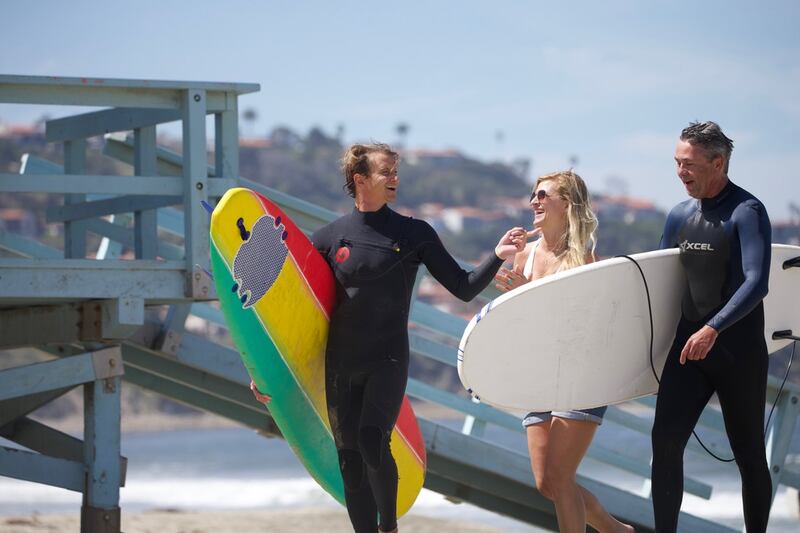
Gray spent years trying to figure out how to turn that realization into something bigger than himself.
His first school speech came not long after Chris’ death, when he himself was only months out of high school. Gray has since spoken at more than two dozen schools across the South Bay.
The appeal of Gray’s school talks, according to those who have seen them, is the contradiction between his appearance and his reality.: a professional athlete with magazine covers and global fame who steps off the pedestal to speak with unguarded honesty about grief, depression and the brother he lost. “When we speak to them, they take it as a lecture,” said Michelle Kaloper-Bersin, Dean of Students at Torrance High School. “When Alex spoke to them, it’s just talking.”
At an assembly in Torrance in 2019, Gray addressed his stigma head-on, telling students that his family had been shocked to realize the consequences of addiction could reach anyone — that he needed to break the assumption that drug use only happened to bad people.
“I emotionally stand in front of you today because it still hurts to not have him here,” Gray told the students. “But what can I do to honor the gift? And that was to continue to move forward with everything he gave me.”
His message centers on what he calls “ownership of self” — the idea that confronting your pain, rather than burying it, is the only real path forward. He frames it for teenagers not as an anti-drug slogan, but as something simpler and harder: face yourself and talk about it.
“When I tell people, ‘What am I most scared of?’ — my answer is always myself,” Gray said. “It’s my crap. It’s my skeletons in the closet. It’s the loss of my brother, it’s the grief, it’s everything.”
He knows the cost of avoiding that confrontation. He lived it.
“I just buried so much stuff for so long, and when I finally got to face it and let it out, it just felt like life was so light,” Gray said. “The clouds are gone. I mean, not really — but they were.”
Gray called it surf therapy, though surfing was only part of it. He posted on social media inviting anyone who had lost a loved one to meet at Torrance Beach — the same stretch of sand where he and Chris first learned to surf. He expected two people. Around 35 showed up: kids, spouses, grandparents. They surfed if they wanted to, but the real center of each session was opening up to each other about their grief.
“That day changed my life forever, as a human,” he said. “I got to be Alex the human, not Alex the professional surfer.”
What he expected to be a one-time gathering became monthly. Over the next eighteen months, the volunteer-run sessions grew into a community of roughly 700 people. Gray is now building a travel-oriented version of the program.
Sometimes, as Gray sits on his board in the middle of the ocean and a dolphin passes by, he finds himself talking to his brother.
“Hey Chris, how’s it going? Nice to see you today.”