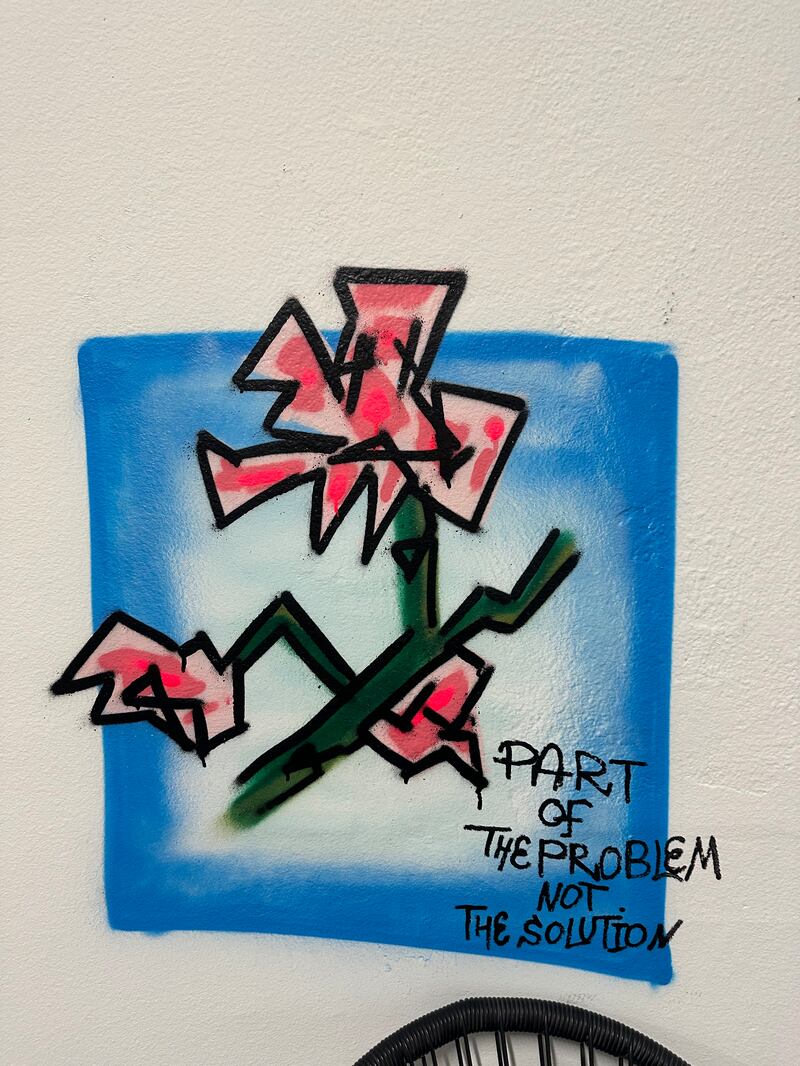
Like an onion, every story has its layers. For Shadi Sheeha, his creative inspiration comes from his identity. As a Palestinian graffiti artist and founder of Palette962, his clothing brand, he’s integrated his story into the details of his work.
You can find Sheeha at Graff Lab most weeks, a place where graffiti artists pay a $10 flat rate to use the walls of the space as their canvas. The walls re-primed and painted over each week, giving artists a fresh canvas to work on. But even in graffiti there are rules: no painting over another artist’s work unless you are at the same level or higher skilled than them, don’t touch a mural for the recently deceased and no painting on houses.
“There is a difference between graffiti and vandalism,” says Sheeha. To him, vandalism is random words or streaks with no art style behind a piece. Sheeha has been spray painting on the walls of Graff Lab since 2023, improving his skills, but he occasionally will tag on the streets as well, which he refers to as “getting up”.
According to Sheeha, there are three ways to judge how skilled a graffiti artist is: “their style, how quick they are, and if they don’t get caught.” He’s inspired by graffiti artists who have succeeded in keeping their identity a secret. His favorite artist is Banksy, but he also speaks about HOPES, an LA-based artist. “He uses 9 ft rollers to paint on the walls,” says Sheeha. “But no one has ever seen his face.”
Ironically, even if Sheeha is disguised while creating his art work, his identity is integrated in every piece he creates. “I did not draw until I was thirty,” says Sheeha. “I once drew a flower when I was a kid and got made fun of so I thought, ‘yeah this drawing isn’t for me.’”
But one day while coming across a wood sculpture in Fullerton, he was astonished by how someone could take a piece of wood, remove layers from it and reveal a sculpture buried underneath. It was that day he realized he had no evidence that he could not be an artist. He wondered if he also had this artistic part of him buried under all of his layers.
Before becoming a full time artist, Sheeha graduated from Al Khawarizmi College in Jordan with a bachelor’s in engineering. For his final project, he installed water pipes in a remote desert region in Azraq, Jordan, because he believed everyone should have access to water. His father’s side is Bedouin, known to be desert-dwellers, so his work always reflected the community he was a part of. After graduation, Sheeha wanted to visit his motherland so he continued his studies in Palestine at the Arava Institute and pursued an AA in Environmental Studies. On his way to Palestine he met Maheer Alazzeh, who is one of his best friends to this day.
“How I have known and experienced Palestine is from culture and art,” says Alazzeh. He expresses how Sheeha’s current artistry is a representation of their shared culture and showcases their people and heritage. It keeps him hopeful that they can still exist, even in this form. “He’s super energetic, funny, and always coming up with something new. What I love most about his work is how effortlessly he brings culture into it; you can always feel that sense of identity in everything he creates.”
Similar to the water pipes in Jordan, Sheeha puts intention behind the work he engineers even in his art forms, connecting it back to his identity. Sheeha was offered a role with a dialogue program led by Arava Institute which took place in the U.S. His main responsibility would be to share his college experiences with multiple organizations across states in hopes of helping his institute receive grants. There was no hesitation on Sheeha’s side to take on the opportunity, and he has been living in the states ever since.
But Sheeha’s artistry did not begin in the U.S. or with him.
Sheeha’s father had once owned a print shop in Kuwait and was an excellent calligraphy artist despite not being formally educated beyond middle school. After the Gulf War forced him to migrate to Jordan, where Sheeha would later be born, Sheeha’s father lost his business and began from scratch in his new surroundings by opening a bakery. Sheeha shared that his father would also drive a taxi as a means of earning additional income. Regardless of his job and title, he was always “suited up,” which was uncommon for men in Jordan at the time unless they held high professions.
“I learned how to dress up from my dad. He was always hella sharp — on point,” says Sheeha. He also shared how, in Jordan, he would trade clothes and shoes with his neighbors to suit his style. “If I liked my neighbor’s pants, I would trade him to make the perfect outfit.”
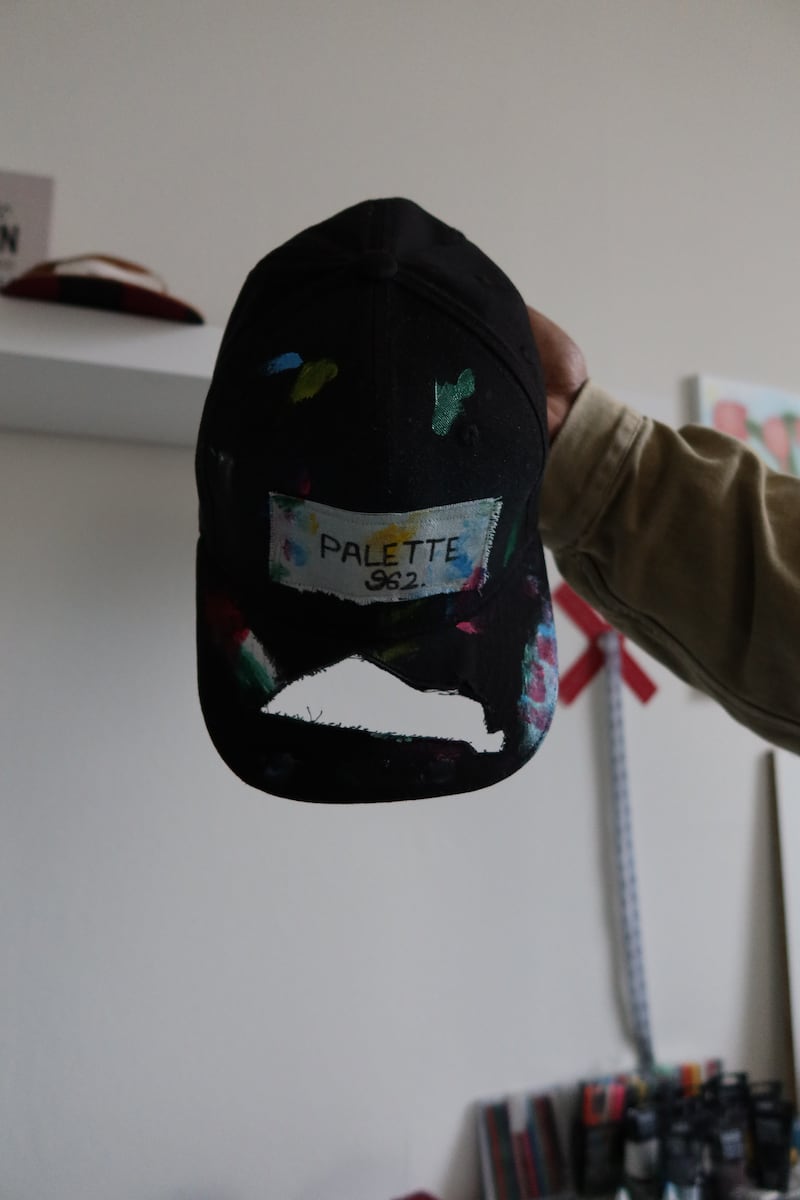
Despite, clothing, expression and identity always having been an interest, it wasn’t until three years ago that Sheeha began creating Palette962. His line is a collection of clothing covered in paint splatters and spray paint, mixed with Eastern graphics and Islamic symbols to connect to his identity. While working in the studio, Sheeha would get paint all over his clothes and shamelessly walk out in public with his freshly designed outfit. He noticed people recognizing him as an artist when dressed as such, covered in his paint, and they would ask him how they could buy his clothing.
“If I could look like them, I could feel like them,” says Sheeha referring to Stüssy, a brand he felt powerful wearing. It’s a mindset he shares with those now interested in his style — if his customers could look like him, they could step into his world. Most of his clothing has words referring to the genocide in Gaza or images representing the resilience of his people. The inspiration for the name of his brand came from his upbringing. 962 was the area code for Amman, Jordan, where Sheeha grew up.

Sheeha never makes the same design twice; every piece is his unique art. He takes his spray can and will recycle symbols onto his clothing that hold meaning to him, but they will always be placed in a different spot or integrated with other images or colors to make every item he sells “one of one.” He uses Alif, the first arabic letter, as a symbol to represent a straight path in most of his designs. He also sprays a tulip in most of his pieces, representing the Jordanian tulip that grows and thrives in the desert without much water. He shares how for most people flowers are seen as feminine but to him, flowers can be sharp. They can survive in even the harshest conditions.
Referring to his own resilience, “That’s Sheeha.”