
The afternoon light spilled across the patio at La Rochelle, a small café in North Hollywood, painted the color of peach ice cream. I arrived first and set two coffees on the metal table outside. A few minutes later, a man walked in dressed in black from head to toe, a Just Jesus cap pulled low, moving with the kind of quiet confidence that makes people pay attention without quite knowing why.
He spots me, smiles, and takes the seat across from mine. We’ve barely settled in when the barista, Emmy, passes by with a tray in her hands. She gives me a sweet hello, then does a double take, her whole face lighting up.
“Hey, Jared!” she says, warm and familiar, like she’s greeting a regular she genuinely likes.
Outside, the sound of cups clinking mixes with the hum of traffic. As he leans back, I catch a glimpse of ink along his arms, one tattoo in Hebrew, the other just the shape of letters I can’t yet make out—a question to tuck away for later.
“So,” I ask him, “where should we start?”
He grins. “Back in school,” he says. “People used to call me the Black Troy Bolton from High School Musical.”
He laughs, remembering. “I was on the basketball team, but I was always sneaking off to dance rehearsals. I was that kid.”
Roots
Dancer Jared Smith grew up in Winston-Salem, North Carolina, raised in a home shaped by faith, family and structure. His mother, Brenda Smith, remembers the early signs of the artist he would become. In third grade, he wrote something that startled even his teacher. “She was like, how can a third grader write so descriptive and creative like this?” his mother told me. A few years later, a poem he wrote for a Harriet Tubman assignment was published in a young poets’ anthology.

His childhood was full of sweetness and motion. He spent hours with his grandmother, running around her house in a mix of games, jokes, and dance moves. “That was a favorite of mine,” his mother said. “Observing the time he got to spend with my mom and how much fun he had with her.”

He was also, by all accounts, the kid who filled a room without meaning to. “Even young, it was like lights, action, camera all the time,” his mom said. “He is very extroverted.”
But the root of everything, dance, humor, confidence, play, was church.
“I grew up dancing in church all the time,” Jared told me. “I was always the one that was always moving. I was the only child. So super hyper.”
He danced in the church’s dance and drama ministries, performing in Christmas shows and holiday productions as early as 5 years old.

At school, he was the class clown. At church ,he was the one trying to blend sacred choreography with whatever was happening on MTV. “I was always adding in a little swag,” he said. “Sometimes they’d have me freestyle, and I would just literally go crazy, like on some Chris Brown stuff, for the Lord, of course.”
The First Sparks
His first real obsession began in a neighbor’s living room.
“My friend had Michael Jackson VCR tapes of his live shows,” he said. “I remember I was like seven, and I saw this guy doing the coolest moves on the TV screen. I’m like, Whoa. What is that?”
He and his friend Cameron started learning the moves every day after school. Soon, Jared wanted to practice longer than anyone. “He was like, ‘You want to come outside? And I’m like, No, I want to practice these dances. I gotta get these down.”
Then came the moment that made dance feel modern — reachable.
“It was Chris Brown,” he said. “Eighth grade, Run It came out… and I was like, Nah, this is crazy.”
He laughs, remembering how everything felt dramatic and exciting at that age.“Honestly, I saw he had all the ladies back in the day. So, you know, I was in sixth grade. I was jealous.”
He mimics his younger self studying every Chris Brown move like it was scripture.
“After that, I was like, I’m gonna do Chris Brown moves. I’m gonna just study Chris Brown.”
Between Michael, Chris Brown, and later Justin Timberlake, dance became more than movement. It became identity.
The way he worshipped.
The way he showed off.
The way he understood himself.
“A language,” he said, “that just made sense to me.”
The Turning Point
Basketball, though, was his first love. His father put a football and a basketball in his hands early, and he played competitively all the way through high school.

But one day, when he was fifteen or sixteen, everything shifted. He and his cousins were play-fighting on the way to church when his shoulder popped out of place.
In the ER he kept thinking, Basketball. Basketball. Basketball.
“That was supposed to be the year,” he said quietly.
His mom knew instantly that something would have to fill the void. “I was like, you’re good at dancing,” she told him.
It was the first time he considered dance not as a pastime but as a path.
The Push He Needed
He auditioned for his high school’s talent show and freestyled to a song he’d listened to “a hundred times.” When he finished, the room erupted. In the foyer afterward, a guidance counselor named David Naff pushed through the crowd just to reach him.
“He was like, ‘yo Jared, I didn’t know this was in you,’” Jared told me. “He was throwing questions at me. And then he was like, meet with me next week.”
That counselor changed his life. He helped Jared apply to the University of North Carolina School of the Arts (UNCSA), convinced another counselor to give up his spot so he could mentor him, and literally rewrote Jared’s senior year schedule so he could take dance classes instead of P.E.
Four days after his UNCSA audition, Jared received a full-ride acceptance.
No ballet training.No formal background.Just a raw gift.
“It felt like everything was flowing,” he said.
His mom remembered that moment, too. “I think he just needed someone else to see how good he was,” she said. “And then he believed it.”
Growing Into His Gift
At the School of the Arts, he felt himself finally expand into his whole identity.
“Jared is not only this basketball cool guy,” he told me. “I’m very quirky and silly and all that. And at the School of the Arts, I felt like I could be all of it.”
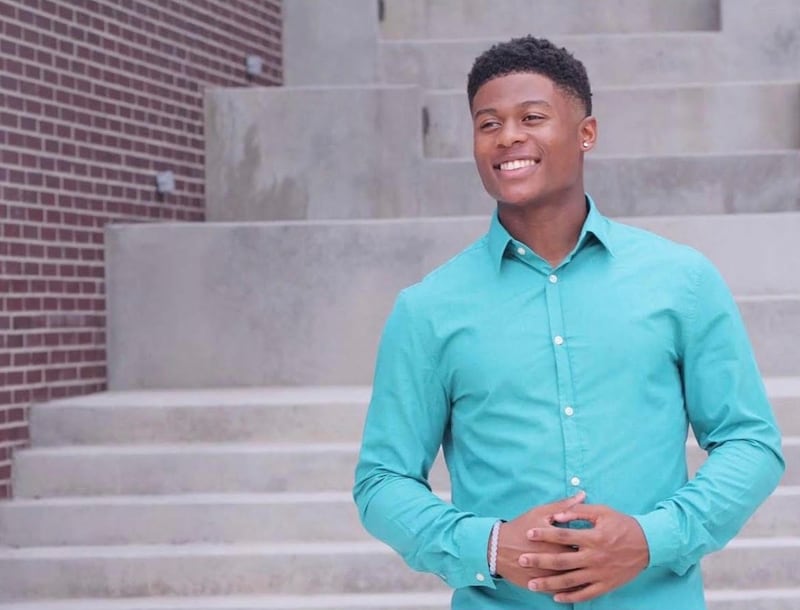
He learned ballet, contemporary, African, and hip-hop. He learned how to stretch (“I never stretched in basketball — I would catch cramps”). He learned how to talk to designers, musicians, actors, and filmmakers. His friends danced for Hamilton, Lion King, and Alvin Ailey. He learned how productions worked from the inside.
And he gained the mentors who still shape him to today.
Through His Mother’s Eyes
Before the story carried him forward, I needed to understand the roots that carried him this far, which meant meeting the woman who shaped every part of him.
Brenda Smith met me on Zoom one evening, the screen glowing softly around her face. Even through pixels, her warmth filled the room — steady, grounded, unmistakably maternal. Within minutes, it became clear that understanding Jared meant understanding the woman who raised him.
Brenda’s journey began long before Jared ever stepped onto a stage.

She grew up one of seven children, the daughter of sharecroppers in North Carolina — athletic from trying to keep up with five brothers, always ready to dance.
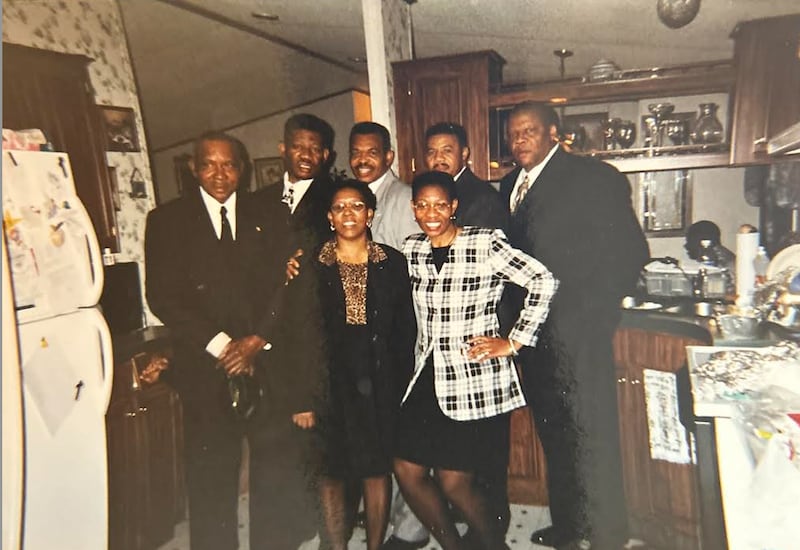
In college, she picked up new moves faster than anyone on her floor, and girls from other dorms would find her in the hallway to learn whatever dance she’d mastered that week. She was the only sibling who went on to college, always pushing for something beyond what she had known.
Her adult life carried that same rhythm of strength. She spent 28 years in corporate America, building a stable career with the same persistence she’d watched in her father, who worked in a textile factory, ran a landscaping business on the side, and managed a gospel singing group. When Jared was three, she was suddenly laid off — a moment that forced her to reassess everything.

During the recession that followed, she nearly lost her home.
But instead of breaking, she rebuilt.
Piece by piece, prayer by prayer, she forged a new path — becoming a personal trainer, yoga instructor, and well-being coach. Reinvention was not a detour for her. It was obedience. A choice to trust that what God had placed in her was enough to carry her into the next season.

That same quiet courage is the foundation Jared grew up on.
“I was a single mom,” she told me plainly. “And God carried us.”
She says it without drama, without embellishment — just truth. The kind of truth that reveals itself in the way her son moves through the world.
What she remembers most about raising him is not the talent, though she always recognized it, but the light.
“When he left for college,” she said softly, “I sat on the edge of his bed and cried. I realized the house would be so still. No more energy. No more noise.”
For a woman who had spent years describing her son as lights, action, camera all the time, the sudden quiet felt like a shift in gravity.
“I missed him the minute he left the driveway.”
As she spoke about him — the boy who played piano with no lessons, who filled every room, who adored his grandmother, who tried every sport, who worked hard jobs, who taught himself to dance — it became clear where his resilience comes from.

Brenda’s own life is a blueprint for stepping into the unknown with faith: leaving a 28-year career, risking everything in a recession, raising a Black son in America, rebuilding her purpose, anchoring herself in prayer.
“I started praying for Jared when he was in my belly,” she said. “And I’ve prayed every day since. I want him to be happy. I want him to be safe. I want him to fulfill whatever God wrote for him.”
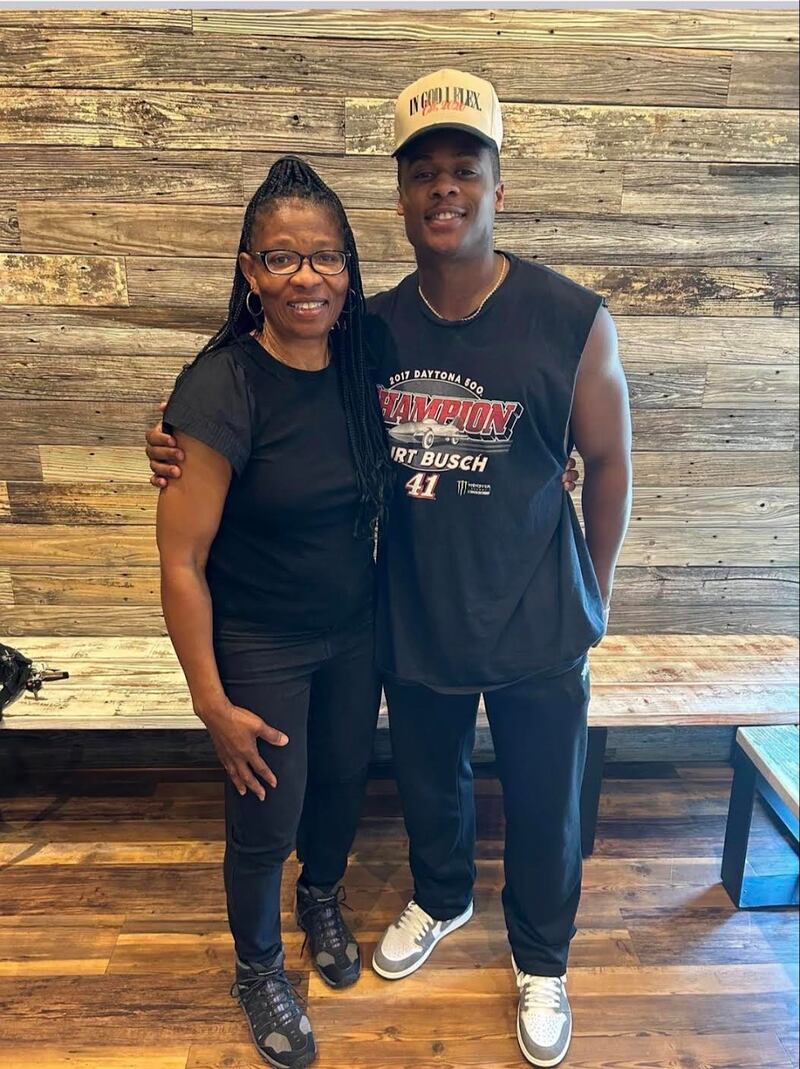
Then — with a softness that felt like love made visible — she added:
“I always knew he was special. But now, watching him out there, doing what he was created to do… I see it clearer. He’s walking in his purpose.”
In that moment, she wasn’t the wellness coach, the entrepreneur, or the woman who survived reinvention after reinvention.
She was simply a mother in awe of her son — the man who carries her heart forward.
Understanding Brenda didn’t just fill in the gaps of Jared’s story; it reframed the entire arc.
Before he ever boarded a plane or stepped into a studio or dared to believe he belonged in rooms far beyond the ones he grew up in, she was already showing him what faith looked like in motion.
Her strength, her perseverance, her prayers — they became the ground beneath his feet.
And it was that ground he stood on when he left home for the first time, stepping into the world not just as a dancer, but as a young man carrying everything she poured into him.
After Graduating: The Cruise Ship
Two weeks after graduation — almost unheard of — Jared booked his first professional job: dancing on a Royal Caribbean cruise ship.
For eight months, he traveled to Jamaica, Barbados, and St. Martin. “My room was so small,” he said. “You had to pull the bed down from the wall.” But it opened his world. “A lot of my family had never been out of the country,” he said. “It was huge for me.”
Eventually, though, he felt himself plateau. The ship wasn’t the audience he was meant for.
“Some people didn’t even clap,” he said, still half-offended, half-laughing. “I’m over here dancing my butt off.”
He decided he wanted more.
So Maybe New York?
After eight months at sea, Jared came home knowing only one thing with certainty: the cruise ship wasn’t where he wanted to stay. So when he got the chance to go to New York and see what doors might open there, he booked the flight and went.
New York greeted him with a blizzard the day he needed clarity most.
The agency meeting he flew in for was canceled, the city slowing under the weight of snow. Most people would have stayed in. Jared could not sit still.
“I was young and hungry,” he told me. “I did not care. I was like, I am gonna figure this out.”
So he walked through the storm toward Broadway Dance Center, snow soaking his jeans, breath sharp in the cold. When he stepped inside, the building felt warm and alive. Music drifted from a studio upstairs. Then, as if placed there on purpose, he saw a choreographer he’d admired from home, Antoine Troupe, someone whose videos he studied in his room in Winston.
“I was freaking out,” he said, laughing.
He was not dressed for class. He had jeans on. He was tired and freezing. But he texted his friend Shaq Famous, who happened to be there, and Shaq said the words he needed to hear.
“Bro, come take class.”
Not “think about it.”Not “maybe next time.”
Come take class.
So he did.
He danced in jeans. He danced like the cold did not exist.
“And after class, I walked right up to him (Antoine),” Jared said. “I was like, I need to introduce myself.”
The choreographer told him he had talent. Told him he had a good look. Told him he should be in Los Angeles.
“It felt like God spoke through him,” Jared said. “I knew exactly what I needed to do.”
One week later, Jared bought a one-way ticket to Los Angeles. He boarded the plane with two bags, a small savings, and the kind of faith that makes strangers shake their heads in disbelief.
The City of Angels
What followed was the kind of grind that builds legends:
Buffalo Wild Wings shifts from 11 to 5.
Six-hour hip-hop classes three nights a week.
Sleeping on a couch for $300 a month.
Running to auditions.
Dancing through soreness and fear and hope.
But every time he stepped into a studio, something unlocked. The music hit. The room shifted. And people noticed. His foundation in church, the swag from childhood freestyles, and the work ethic he carried from basketball all converged.
A year later, the momentum broke open.Hailee Steinfeld. The Grammys. BET Awards. Latin AMAs. Rosalía’s video.Justin Bieber’s Justice Tour. The Super Bowl. Paris.A stadium full of strangers screaming in sync with the movement of his body.
He danced for the world.
But when I asked who he dances for, he did not hesitate.
“Oh, I dance for my mom.”
It was said gently, almost offhand, but it landed with the weight of someone who has never forgotten the person who made believing possible.
Why He Pivoted
Success did not blind him to reality. By thirty, his body began telling him the truth.
“My back hurts,” he joked. “I can’t be dancing forever. I’m tired.”
But the deeper truth was not physical. It was the life he imagined.
“I want to be a husband and a father,” he said. “And being a dancer… you can’t raise a family off that alone.”
Acting offered something dance could not. A future with room to grow older. A craft that did not depend on youth or stamina. And a way to channel everything that already lived in him, the expressiveness, the humor, the emotional intelligence that shows up even when he is quiet.
So he started studying. He cut his hair on the advice of his agent. He signed with a top commercial agency. He booked a national commercial almost immediately.
Acting became the next expression of his faith in motion. Not a departure from who he is, but an expansion.
Back at La Rochelle
As the sun slipped lower behind the café windows, I finally asked about the tattoos I had noticed when he sat down.
The one in Hebrew, he told me, is Psalm 91, the protection scripture. “A thousand may fall at your side… but it will not come near you.”
The other, etched across his arm, is from 2 Samuel.
“And David danced for the Lord.”
He smiled, almost shyly. “I’m David,” he said. “When it comes to dance… I’m David. Every time I dance, I do dance for the Lord.”
There was no performance in his voice. No need to impress. Just conviction. The kind that is lived, not recited. The kind that survives blizzards, long shifts, closed doors, new beginnings.
Sitting there at La Rochelle, the light fading around him, Jared felt less like a man switching careers and more like someone stepping deeper into the purpose he has carried since childhood.
“Storms come and they always pass,” he told me. “There’s always something to learn.”
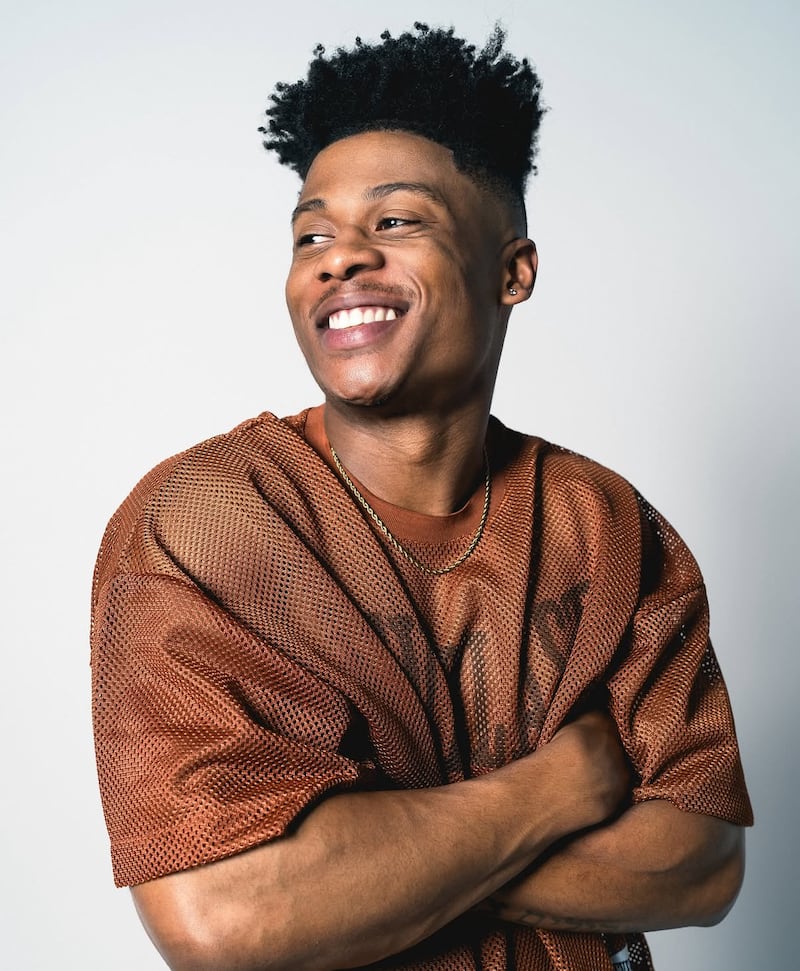
He said it like someone who has walked through storms and kept dancing anyway.
Like someone who knows exactly who raised him, who guides him, and who he dances for.
And like someone who is not done becoming.