
Struggling to put on sparkly tights in her car, Cara Bender is preparing for her late night showgirl gig on Fremont Street in Las Vegas, Nevada. Parked in Binion’s garage she scans the area while getting into costume to ensure her safety from the leering eyes of strange men, and steps out to put on her feathers before making her way down to what used to be one of the most famous streets in America.
Bender began showgirling when her friend Evelyn introduced her to Carly’s Angels, the company she now works for. Carly’s Angels is run by one woman, Carly Evans who contracts costumes out to showgirls for a flat fee rate of $25 per night. Showgirls pick up the costume from Carly’s garage - a space full of sequins, feathers, and every other accessory imaginable. By the end of the night they are required to return the outfits so other performers can use them the next day. On some nights, Bender works independently, using her own costumes.
The entrance to Las Vegas features a famous diamond-shaped sign that says, “Welcome to Fabulous Las Vegas, Nevada.” Las Vegas owes its “fabulous” reputation to showgirls: The desert city became known as the most popular gambling hub for tourists in the 1950s, and used showgirls as a way to compete with other casinos, providing performers with lavish costuming with huge feathers and headdresses to bring in tourism. Center stage in grand productions like Jubilee! and Folies Bergère, the showgirl became an icon of performance and femininity, shaping how the world saw Las Vegas.
Today, showgirls are all the rave - appearing in pop culture through references like Taylor Swifts The Life of a Showgirl. Fans now dress in feathers and rhinestones to celebrate their favorite artist, reviving the look and spirit once synonymous with Las Vegas glamour. Yet beneath this renewed fascination lies a very different reality for the city’s own showgirls. While they remain one of Vegas’s most recognizable symbols, showgirls face the daily challenge of taking up space in a city that profits from their image but rarely supports their presence.
It has been seven years since Bender first strutted down the streets of Vegas with her feathers. With time, Bender has come to know the work beyond the glamour, shaped by the unspoken rules that guide every showgirl.
Rule #1: Never step out of your circle.
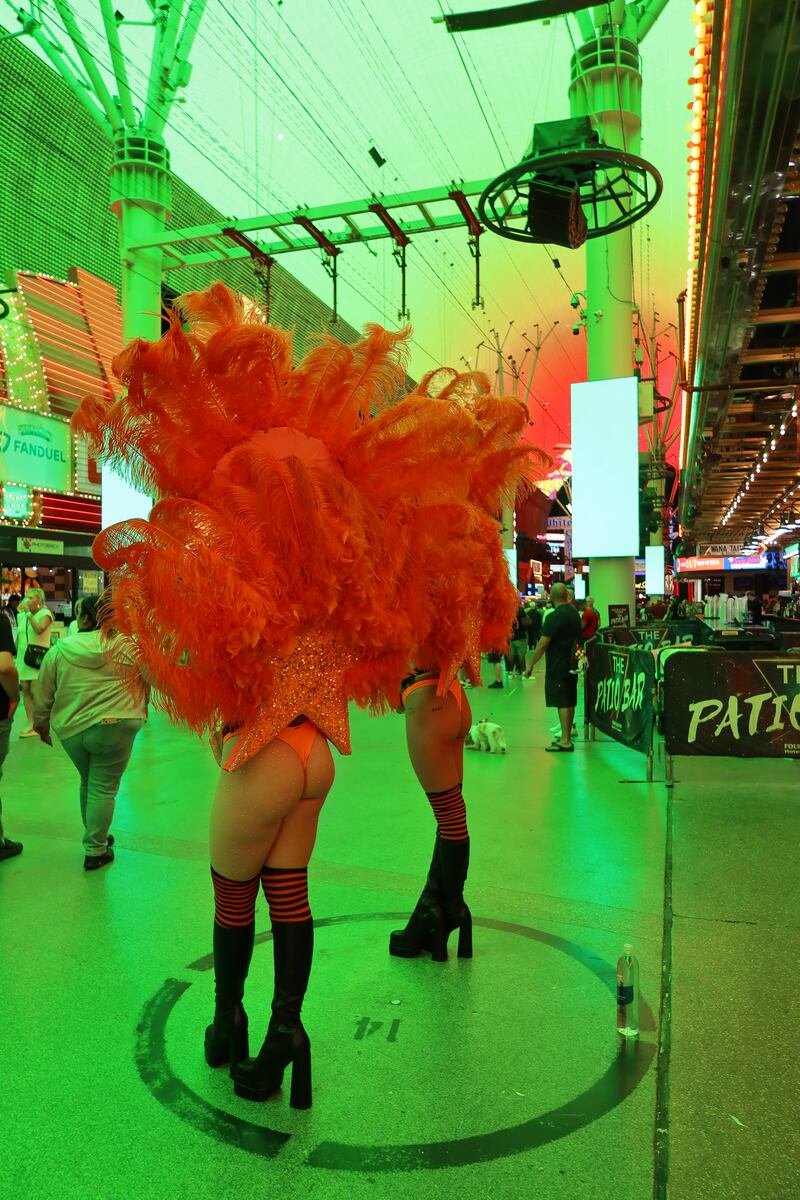
“I’m not sure yet exactly where I’ll be and if I have a 9-11 spot to work,” says Bender. Bender typically arrives to Fremont one to two hours earlier to scout out a “circle”. On Fremont, every performer is confined to a painted circle on the street - their own stage. It is crucial for street performers to book a circle a day in advance and print out a physical copy of their QR code to show to the security when arriving to Fremont Street. The QR code reveals the performer’s circle number and time slot, confirming their two-hour window and helping security ensure that each space is properly assigned for the night. If they do not have the physical copy, they will not be given their circle even if they booked it in advance and once in their circle risk being given a citation if they step out of it. The only option when arriving without a reservation is to bribe a palm weaver or homeless person $20-$40 for their circle, Bender says, which has been a popular way for other people on Fremont Street to make money off of performers.
Rule #2: Showgirls never work alone.
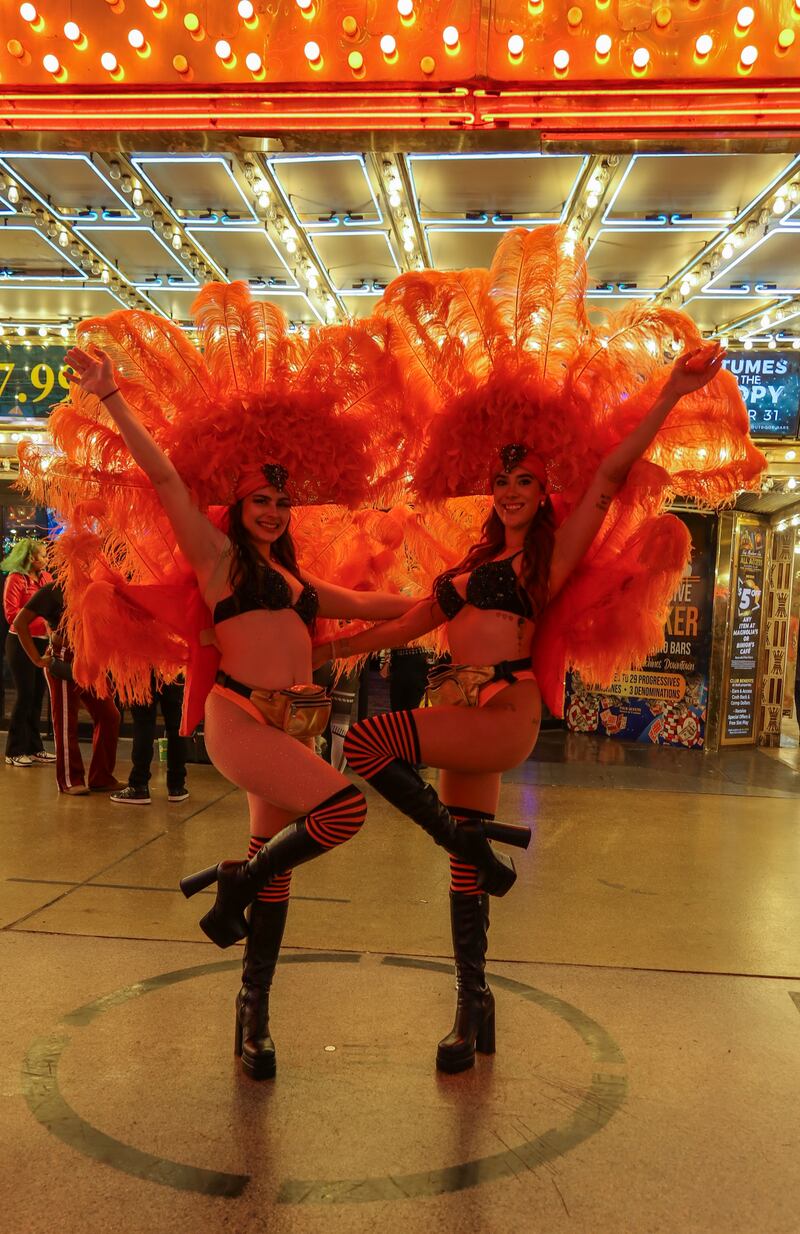
Showgirls always work in pairs, mainly for safety reasons. Bender explains that having another set of eyes helps when performing in a crowded environment, where anything can happen. Walking to their cars after a long night feels safer too; she’s heard of people breaking into or even stealing showgirls’ cars. It’s one of the reasons she prefers working with a company rather than independently. For most street performers, the job is competitive. For showgirls, it’s collaborative. Showgirls from the same company look out for one another, making sure everyone gets a spot to perform and trading off circles after the two-hour limit. They work as a team, supporting one another through long nights and unpredictable crowds. While rivalries may exist between different showgirl companies, the girls rely on their partners for safety and solidarity. Bender typically works four to six hours per night, at least three nights a week, depending on whether Fremont Street is open. Sometimes they close the street down to city-wide events, which prohibits performers from accessing their circles. In the event that Fremont is closed, she either takes the night off or showgirls on the main Strip.
Rule #3: Showgirls aren’t just THE dream, they also have dreams—so tip them $20 to achieve them.
“Cara mia, she is my dream,” said a Paw Patrol performer when seeing Bender arrive at her circle. When first beginning to showgirl, Bender used to work every night. She says that her pay, which she receives in the form of tips, plummeted right before the pandemic. Money began to pick up during COVID, and so did Bender’s hours, because “people were spending their stimulus money on us a lot,” she says. After COVID, the crowds thinned a bit, but it never dropped back to what it was before.
Despite the inconsistent work, Bender refuses to get a 9-5 because she uses her daytime to be an artist. Showgirling is funding her art dreams. On most First Fridays - the monthly arts and culture festival held in downtown Las Vegas, where local artists, musicians, and performers come together to celebrate the city’s creative scene - you can find her in the downtown Arts District, selling her artwork out of her van. “You don’t want to get a normal job where you have to work so much, you know, especially for me, if I’m an artist,” Bender explains. “I want to dedicate my time to painting.”
There is a catch to being a showgirl: they never know how much they’ll actually make. It’s not just the inconsistent hours and struggles to find a circle, but performers on Fremont Street — including showgirls — are also technically not allowed to ask anyone for payment. Sometimes “undercovers” will go up to showgirls and see if they will force them to pay for photos; just using the wrong language can get them a citation. Bender says, “a good tip is $40 but it’s up to you” instead of “give me $40”, that could make the difference in her being fined or not. “That way I’ll still get the $40, but they feel like it’s their decision,” says Bender. If lucky, Bender can make a couple of hundred a night, but it’s never for certain how much she leaves with. So next time you see a showgirl, tip her.
Rule #4: Don’t be a weirdo and harass the showgirls — unless you like being pepper-sprayed.
When working in an atmosphere where majority of the crowd around is drunk, sometimes bad things are bound to happen. For showgirls, feeling unsafe amidst drunk and handsy men is an issue they confront every night. Once, Bender’s nightmare occurred when an older man harassed her and her co-worker after they told him he needed to leave, as they’d reserved the circle he was standing in for the night. Instead of accepting that he had to leave gracefully, he took a step out while yelling loudly and continued to get uncomfortably close to Bender and her partner. So Bender took matters into her own hands. “I pepper-sprayed him across his eyes, and he didn’t fucking move,” says Bender.
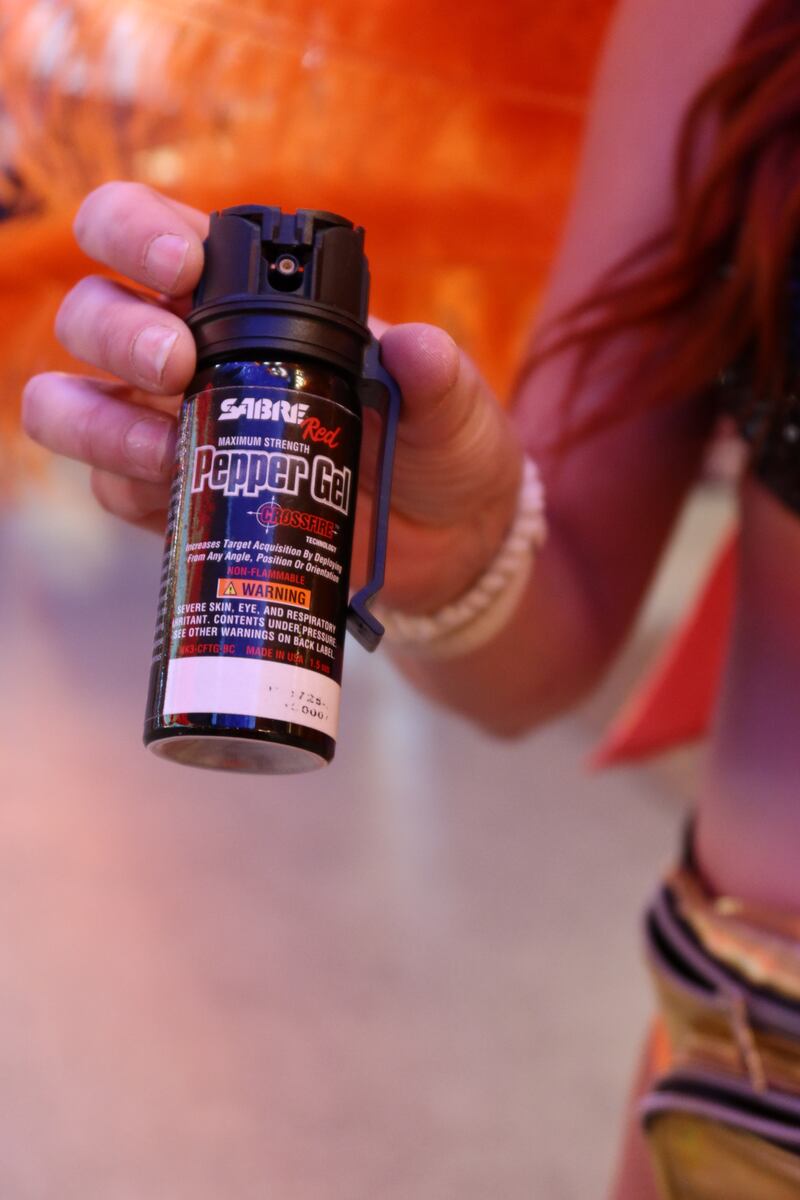
After the incident, Bender had to file a report and stressed how it takes a lot to respond, react, and take time from working for little or nothing to change. “It makes your day so much worse, and it makes you just not even want to work anymore,” she says of her experience.
Being a showgirl may look fabulous, but the reality is much more complicated. What once was the face of Las Vegas is now lurking in the shadows, struggling to continue to be part of the Vegas culture. When leaving Fremont you will see a sign with two showgirls on the side of a sign that says “Slotzilla”. It’s apparent that showgirls are used when selling the image of Vegas, but according to Bender’s experience, it’s not worth it some days. “Sometimes I do feel definitely taken advantage of,” she says, “because I feel like I’m giving so much and sometimes there’s days where I don’t get a lot out of it.”
Despite the struggles, harassment, and inconsistency that Bender routinely faces, there’s only one real reason she continues: the money. As a struggling artist, it’s her main way to continue to pursue her dream without giving all her time to a 9-5. Calling back to Taylor Swift’s latest lyrics in her own ode to the showgirl life, The Life of a Showgirl, Bender “wouldn’t have it any other way.”