
To kick off the fall semester, health systems management graduate students Sofia Cabrera and Paolo Bahrami set up two lawn chairs, a table and a cardboard sign with “free advice” written on it in the middle of a busy campus street.
Within a couple of hours, the pair reported having over 50 students stop by Trousdale Parkway to ask for their advice.
From concerns about neck pain to inquiries about orgies, nothing is off the table, according to Cabrera and Bahrami. While they said their credentials extend only from their lived experiences and welcoming energy, the pair said they aim to approach people with curiosity and a genuine desire to help.
“We’re just random people. I think that helps,” Cabrera said. “We’ve realized that some people just need someone to talk to. It’s nice being able to entertain and help those people out.”
Inspired by Netflix’s “Sex Education” and content creators’ man-on-the-street social media interviews, Cabrera and Bahrami said their goal was simply to spend more time on campus.
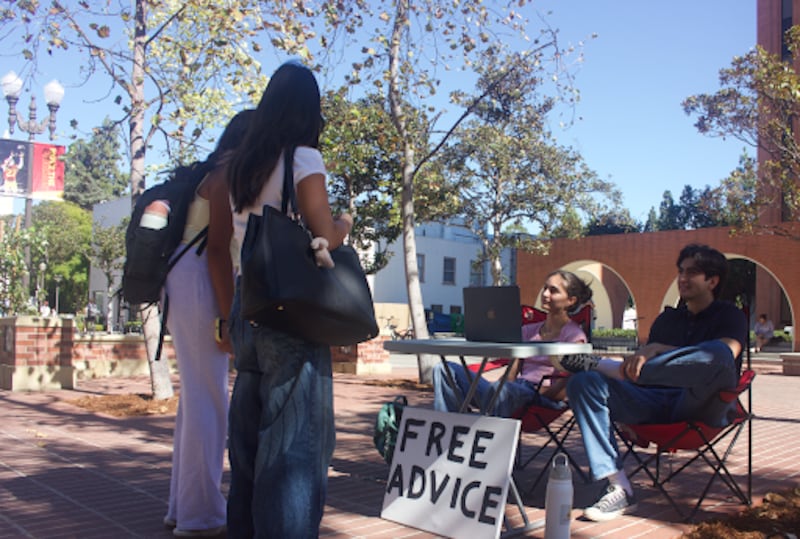
Between the hours of 11 a.m. and 4 p.m. on most Wednesdays, the duo receives questions ranging from roommate troubles to study hacks, relationship advice and even tips for overcoming kleptomania, what the Mayo Clinic describes as an impulse-control disorder characterized by an urge to steal objects.
According to Ramon Lopez, who has visited the stand, being able to confide in strangers with a question one might not feel comfortable posing to friends or family gives the stand appeal.
“There’s no strings attached. If you say something that’s pretty personal, how is it gonna get back to you?” said Lopez, a freshman studying business administration.
The pair’s stand brings an analog twist to the popular online advice dynamic posed by content creators, who record and post their content. Choosing not to record students or post online, the duo hopes to increase comfortability.
Inquiries don’t stop at students either; Cabrera and Bahrami said that they have received questions from professors, campus visitors and Department of Public Safety officers.
“Some people just come by not even for advice, just to chat,” Bahrami said.
The duo’s impact has expanded further than the weekly booth, as frequenters have started to rely on each other and build community around advice-giving, Bahrami said.
“There were a couple of people that came up for advice at once and realized that they could help each other,” Bahrami said. “I watched [them] exchange contact information.”
In the span of just one semester, Cabrera and Bahrami have managed to warm up to the students; some became friends, while others became recurring visitors.
Syra Hashmi, a freshman majoring in biological sciences who frequents the stand, said some of the students even offer advice back to Cabrera and Bahrami.
“There’s no stigma, and it’s really easy to talk to somebody when you know they want to listen to you,” Hashmi said. “If you ever think about something you’re unsure about sharing with a therapist, or you want to make a friend or something, it’s very easy to just turn to them.”
Edited by Sean Campbell and Miranda Huang.