
Three years after a speeding driver lost control on Pacific Coast Highway (PCH) and killed four Pepperdine University students, Malibu continues to grapple with the aftermath – in courtrooms, in city meetings, and on the highway long known for tragedy.
The horrific crash on Oct. 17, 2023, evolved into a larger reckoning for the city and state: How to make PCH safer, and how to honor the young women whose lives were cut short.
The crash claimed the lives of Pepperdine seniors Niamh Rolston, Peyton Stewart, Asha Weir and Deslyn Williams, all part of the Alpha Phi sorority. Authorities say Fraser Bohm was driving at 104 mph in a 45-mph zone when he lost control and slammed into parked vehicles, striking and killing the women as they stood along the roadway waiting to attend a sorority event.
The crash sparked outrage in Malibu, where for years residents have called for safety improvements along the stretch of PCH between Carbon Canyon and Las Flores Canyon, a section nicknamed “Dead Man’s Curve,” where the crash took place.
Since 2010, more than 60 people have been killed by cars on PCH, according to the city of Malibu.
Now, as Bohm’s trial approaches, Malibu is looking back on what’s changed — and what still needs to be done.
“Our Girls”
Rolston, Stewart, Weir, and Williams – affectionately called “Our Girls” – continue to inspire the Pepperdine and Malibu community. Annenberg Media asked their friends about their legacies.
Niamh Rolston was described as a source of joy and sunshine. She was a business administration major and planned to pursue a master’s degree in business analytics at the Pepperdine Graziadio Business School.
Peyton Stewart was described as selfless, who thought of others before herself. She was an international business major and was looking forward to a career in the tech industry after completing a summer working for TikTok.
Asha Weir was described as wise and gentle, a calming presence for those around her. She was an English writing and rhetoric major and planned to pursue a career as a writer, hoping to use her skills to heal and encourage others.
Deslyn Williams was described as loyal and unwavering in her support of her friends. She was a pre-med biology major who served as vice president of the pre-veterinary club at Pepperdine and had plans to apply to veterinary school.
Bridget Thompson spent countless hours with the four women not only as a best friend to the girls, but also as a roommate. Their friendship was more than just college camaraderie — it was a defining part of her life, and she shared how each girl shaped their tight-knit group and left a lasting mark on everyone who knew them.
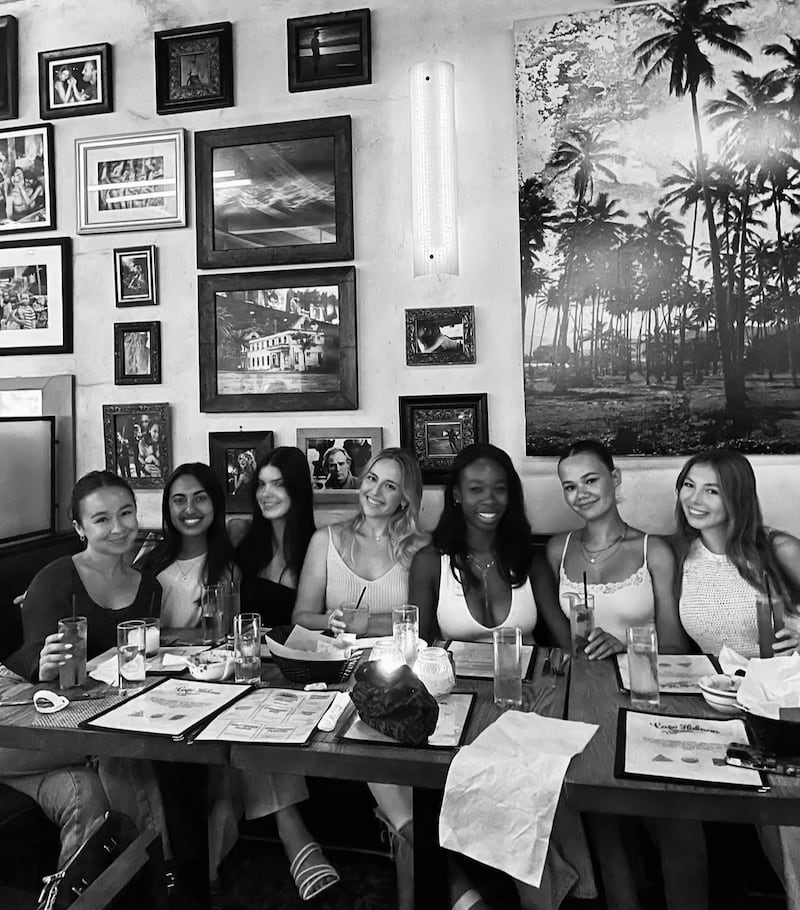
Thompson met Williams first during the pandemic in a Zoom class, and the two quickly became inseparable.
Hannah Allen, one of Williams’ closest friends and Alpha Phi sisters, still remembers every moment of the day of the accident. She had spent the afternoon with Williams, running errands and laughing as they often did. Moments before the crash, she was on the phone with her.
“She was just the life of every party. She’d make everyone feel comfortable,” Allen said. “She was the upperclassman who would follow you back on Instagram and make you feel seen. She just did those little things that are just acts of kindness, and they were just so genuine.”
Stweart and Thompson connected the following semester and “got along so well” and were known for never leaving one another’s side.
For Kelly Petersen, who became Stewart’s “little sister” in Alpha Phi, meaning Stewart acted as a mentor to her, the connection was instant.
“She was genuinely one of the purest people I’ve ever met,” Petersen said. “She would encourage other people to be happy and look on the bright side and just enjoy the present moment. ”
During her sophomore year, Thompson and Rolston became roommates, forming a dynamic, yin-and-yang friendship so close that if Niamh wasn’t by her side, people would immediately ask where she was.
“She was like my better half,” Thompson said.
Also being a member of Alpha Phi, Thompson found Weir’s kind and gentle soul and by their junior year, Thompson, Rolston, Stewart, and Weir were all living together in the same apartment – a space they called home up until the night of the accident.
“They were perfect in my eyes,” Thompson said. “Even when they were alive, I knew that they were different. They were just so amazing, so selfless.”
For Thompson, it wasn’t just the big events or trips that defined their friendship, it was the everyday rituals and small, quiet moments that she treasured most with her friends that made their bond so special.
“The quiet times are really my favorite, just when we would all sit on the couch and go over our days or cry or laugh. We called it ‘couch time,’ and it was what we looked forward to all day,” Thompson said.
Reflecting on the day of the crash, Thompson – who had planned to ride with Weir, Rolston, and Stewart to the event – recalled the horror of realizing her friends were involved.
After her cheer team bonding event for her cheer team ran long, she told them she would meet up with the girls, and described the surreal hours spent trying to reach them, the anguish of waiting and the devastating confirmation of their deaths.
She said the grief was all-consuming.
“I just kept repeating, ‘I’m not going back to Pepperdine, I can’t continue without them,’” Thompson said. “They were my whole entire life at Pepperdine.”
The accident occurred three days before Thompson’s birthday, a day each of the girls planned to fill with surprises for her. Their apartment, left with three empty spaces where her friends once were. Yet through her grief, Thompson emphasized the support of the Pepperdine community and her own faith as guiding forces.
“The school handled it so well. The community handled it so well. I felt so much love instantly,” Thompson said. “I was overwhelmed with the love I felt.”
The experience strengthened her relationships, deepened her faith, and instilled a determination to honor the memory of her friends.
“I know that the Lord is close to the brokenhearted, and I really, really felt that, and still do,” Thompson said.
The tragedy also reshaped how Thompson approaches life and relationships – aware of the fragility of each day.
“It makes me just be grateful for every day, because I know tomorrow’s not a promise,” Thompson said. “I just want to love on the people that are close to me, because I want them to know, if I do get taken soon, I want them to know how much I love them.”
For Allen, it completely changed her life.
“I’m very big on trying to not stress over things as much anymore,” Allen said. “When Deslyn was here, she would always remind me not to get caught up on stupid little things, so I try to be more intentional with my time and I try to do what makes me happy and what she would want.”
A city changed forever
Former Malibu Mayor Steve Uhring remembers the night vividly — the phone calls, the disbelief, and the sorrow that spread across the city.
“It was a solemn evening of everybody getting together and saying, this is not what we want our city to become,” Uhring said.
The tragedy, he said, was a turning point.
“The death of those four women and the way it occurred sent a message across the city that says, we really have to start doing something.”
For years, Malibu residents and local leaders had warned that PCH — with its blind turns, narrow shoulders and reckless speeding — was an accident waiting to happen. But Uhring said it often took loss to force momentum.
“We’re sending a message that says, if you do something wrong, there is a penalty, and the penalty is going to be severe,” Uhring said.
As the city prepared for the upcoming anniversary, Uhring said he hoped the moment would serve as both a remembrance and a call to accountability.
“He killed four people. You’ve got to pay for that — period,” he said of Bohm.
The push for reform
In the months following the crash, Malibu leaders joined with advocates and residents to demand change from Caltrans — the state agency responsible for maintaining the highway.
Among those leading the charge is Damian Kevitt, founder of the safety coalition Streets Are For Everyone (SAFE) and a co-organizer of Fix PCH, a movement pushing for structural and policy changes along the highway.
Kevitt himself knows the cost of dangerous roads.
In 2013, while cycling near Griffith Park, he was struck by a hit-and-run driver who dragged him more than a quarter of a mile beneath a vehicle before speeding away. He lost his leg but survived — and shortly after, he founded SAFE to advocate for safer streets and to prevent others from experiencing the same trauma.
That experience, Kevitt said, drives his commitment to push for change — even when the process feels painfully slow.
“Caltrans is a very slow-moving beast,” Kevitt said. “And it is very difficult to get Caltrans to do anything at any sort of speed. The fact that we’ve gotten anything done this fast is lightning speed for them.”
The pain of losing loved ones on PCH is not new to Malibu.
For Michel and Ellen Shane, the loss of their 13-year-old daughter Emily on PCH in 2010 ignited a lifelong mission for change. They founded the Emily Shane Foundation and have spent years pushing for safety reform along PCH — a fight they say feels heartbreakingly familiar each time another tragedy occurs.
“When Emily died, we reached out to Caltrans to give them some suggestions of how they could have saved her life,” Michel said. “They walked the site with us, they did measurements, and then they basically sent us a go away letter. So at that point, I realized that it was all an excuse and I felt that I couldn’t let another parent walk in our shoes.”
The Shanes continue to advocate for safer roads through the Emily Shane Foundation.
Kevitt said activists had been sounding alarms for years about the road’s dangers.
“We had been aware of PCH as a deadly corridor for many years,” Kevitt said. “But unfortunately, it oftentimes takes a tragedy to sort of make those very, very frozen wheels of change start moving.”
Yet despite years of pushing for reform, the Shanes say that progress has often felt “immovable.”
Kevitt spent years fighting what he calls “the broken system of traffic safety,” where local governments often have limited power over state roads.
“I had to literally change the law to let Caltrans lower the speed limit on PCH,” he said. “That’s just one example of how nuts the system is.”
Before the Pepperdine crash, even lowering speed limits on state highways involved a lengthy process — traffic studies, engineering reports and approval by multiple agencies. But since the deaths of Rolston, Stewart, Weir and Williams, Kevitt said, the urgency shifted.
Kevitt said since the four girls’ deaths Caltrans has deemed the unsafe road conditions on PCH “a priority and emergency situation”, allowing him to bypass some of the regulations and restrictions that come with demanding change.
“They are doing things faster, and that’s because there’s been so much pressure,” Kevitt said.
The Fix PCH coalition also unified Malibu residents, state leaders and transportation advocates — succeeding where past efforts to improve PCH safety struggled to stay active, Kevitt said.
“There have been advocacy groups like Fix PCH that have come and gone several times in the last 10 to 15 years,” Kevitt said. “And all of them have basically given up. They’ve given up because they don’t know what to do to push this forward.”
But this time, he said, feels different.
Kevitt and advocacy partners also pushed state lawmakers to pass Senate Bill 1297, which authorizes Malibu to install up to five automated speed cameras along the PCH corridor. The bill was signed into law by Gov. Gavin Newsom in 2024.
Malibu has now installed those cameras. Data collected from Sept. 16–24, 2026 recorded approximately 100,000 speeding violations across four camera locations, with about 86% in eastern Malibu. The city delayed its planned warning period to November to make installation adjustments and complete a traffic study.
The city also completed a signal synchronization project in February 2026, connecting the timing of 12 traffic signals between Topanga Canyon Boulevard and John Tyler Drive. The city reported $4.2 million in Caltrans safety upgrades and a 22% decline in injury collisions since the Oct. 17 crash.
Kevitt also championed Assembly Bill 1014, which would permit the California Department of Transportation to reduce speed limits by 5 mph on state highways under specified safety conditions, bypassing restrictions in existing law.
Thompson also works with these advocacy groups and city officials to push for safety changes along PCH, ensuring that the tragedy that took her friends prompts real action.
The City of Malibu has spent about $39 million on PCH safety improvement projects and dedicated $8 million more for future projects.
A trial for accountability
Three years later, the case against Bohm is moving toward trial — one that’s drawn renewed attention because of his new defense attorney, Alan Jackson, who recently represented Karen Read in another high-profile vehicular death case.
Read, a Massachusetts woman, was accused of striking and killing her boyfriend, Boston police officer John O’Keefe, with her SUV and leaving him outside during a snowstorm in 2022. Her trial gained national attention amid claims of a police cover-up. She was acquitted of all major charges earlier this year.
Bohm has pleaded not guilty to four counts of murder and four counts of vehicular manslaughter with gross negligence.
Bohm was originally charged with four counts of vehicular manslaughter with gross negligence on the night of the accident and later released from custody the next day. A week after the accident he was rearrested and charged with four counts of second-degree murder and was released from custody five days later on $4 million bail.
Bohm and his defense team claim he was going only about 70 mph and was fleeing a road rage incident after leaving a restaurant three miles from the crash.
In March 2025, Bohm’s motion to dismiss the murder charges was denied. In September, Judge Thomas Rubinson denied his motion to reduce bail from $4 million to $2 million at a pre-trial hearing. Upon Bohm’s initial arrest, his bail was set at $8 million, and later reduced to $4 million, according to CBS News.
Bohm tried again to get the charges dropped, but Judge Thomas Robinson denied the motion in a July 27 hearing.
Jackson argued that Bohm’s family assets shouldn’t be considered in the amount set for bail, as they’ve had to sell their home and drain their retirement funds to help pay for Bohm’s bail. He said the reduced bail would help Bohm’s family and would allow Bohm to better defend himself.
Judge Rubinson denied the motion, saying that if Bohm is unable to pay for Jackson’s services, he can be represented by a public defender or hire a different attorney.
A new development in the criminal case emerged this fall, as prosecutors introduced a theory involving a nitrous oxide canister found in Bohm’s car following the crash.
At a Sept. 2 pretrial hearing, Superior Court Judge Thomas Rubinson raised the prosecution’s theory involving the 10 to 12-pound canister. Prosecutors clarified that they were not pursuing a driving-under-the-influence theory, but rather one involving distracted driving related to the canister.
Bohm’s defense team said it needed additional time to prepare arguments related to the evidence. At an Oct. 1 hearing, the defense deferred discussion of the canister until a later hearing addressing evidence in the case.
Another pretrial conference is set for Nov. 4. The trial is currently set to begin on Dec. 1.
“Nothing will ever change how deeply they’re missed, but I hope this trial brings a measure of justice, accountability and peace to everyone who loves them,” Thompson said. “No verdict will ever bring back what was lost or the futures they should have had. No matter how this ends, that’s something so many of us will carry forever.”
Bohm’s attorney did not respond to questions or a request for an interview.
The upcoming proceedings, Uhring said, represent not just a legal reckoning but a symbolic one. He hopes the trial will remind the community why the push for reform must continue — and why complacency is dangerous.
“You can’t take young people’s lives away and let it go without doing something about it,” Uhring said.
Malibu residents and Pepperdine students said they are watching closely, with emotions still raw and the memory of the crash never far away. As the case moves toward trial, the pain of those left behind remains raw. For Petersen, the question lingers.
“Was it worth it?” Petersen said. “At the end of the day, was your enjoyment worth prioritizing over the lives of four beautiful women? It was such an easily avoidable accident that happened in such a careless way, and their lives are worth so much more than one person’s enjoyment, one person’s reckless driving.”
Each of the girl’s families as well as Carlos Solloa, a Pepperdine senior who was injured in the crash, have filed individual lawsuits, arguing that the state of California, Los Angeles County, the City of Malibu, Caltrans and the California Coastal Commission were negligent in the crash.
For Thompson, the trial is not only about seeing justice served in court, but wanting the world to know who they were.
“I want a guilty verdict,” Thompson said, “But I don’t want their names to get lost. That will mean nothing to me.”
Like many in the Pepperdine community, Petersen said the slow legal process has been difficult to watch.
“I think every time the trial is brought up, it’s a chance to fight and spread more awareness,” Petersen said. “At the end of the day, there were four lives lost, and that’s a huge reminder every time you step behind a wheel that that is your choice to drive, cautious, careful, slow.”
Allen said the whole thing is “just frustrating.”
“He ended four lives. Amazing, beautiful women that were really going to change the world. And he’s still living,” Allen said. “I just want justice for them. They mattered.”
Thompson emphasized that justice alone isn’t enough; their stories need to be seen and remembered.
“It’s just so important for me to feel like their stories have been heard, and people can see who they were, and have people love them the way I do, for people to feel the loss the way I do, and understand why their lives being taken was truly an act of recklessness and complete disregard,” Thompson said.
Honoring the four
In the months following the tragedy, Malibu and Pepperdine came together to memorialize the four young women whose lives were lost.
The four women were set to graduate with Pepperdine’s class of 2024, and received their degrees posthumously.
The Alpha Phi sorority at Pepperdine now holds a 5K race in Williams’ honor, called Deslyn’s 5K Memorial Run and Walk, as she was an avid runner and training for a half marathon at the time of the crash.
One of the most striking symbols of remembrance is the Four Lights Memorial on Pepperdine’s campus, where four beams illuminate the sky each night over the Pacific Ocean. The lights, installed shortly after the crash, have become a beacon for students, families,and community members to pause and reflect.
Four crosses also stand atop the Cross Hike trail at Pepperdine, built by members of the Sigma Chi fraternity — the same fraternity that co-hosted the mixer with Alpha Phi the night of the crash — as a lasting tribute to the girls.

Petersen said she often visits the four lights behind Pepperdine’s chapel whenever she needs to find clarity.
“It’s such a good spot for just thinking and reflecting,” Petersen said. “I hadn’t done the cross hike until I decided to a few months back and I remember finally making it to where Asha, Niamh, Deslyn, Peyton’s names are on the crosses, and it was just that feeling of comfort, like knowing that they are taken care of and they are really in a good place.”
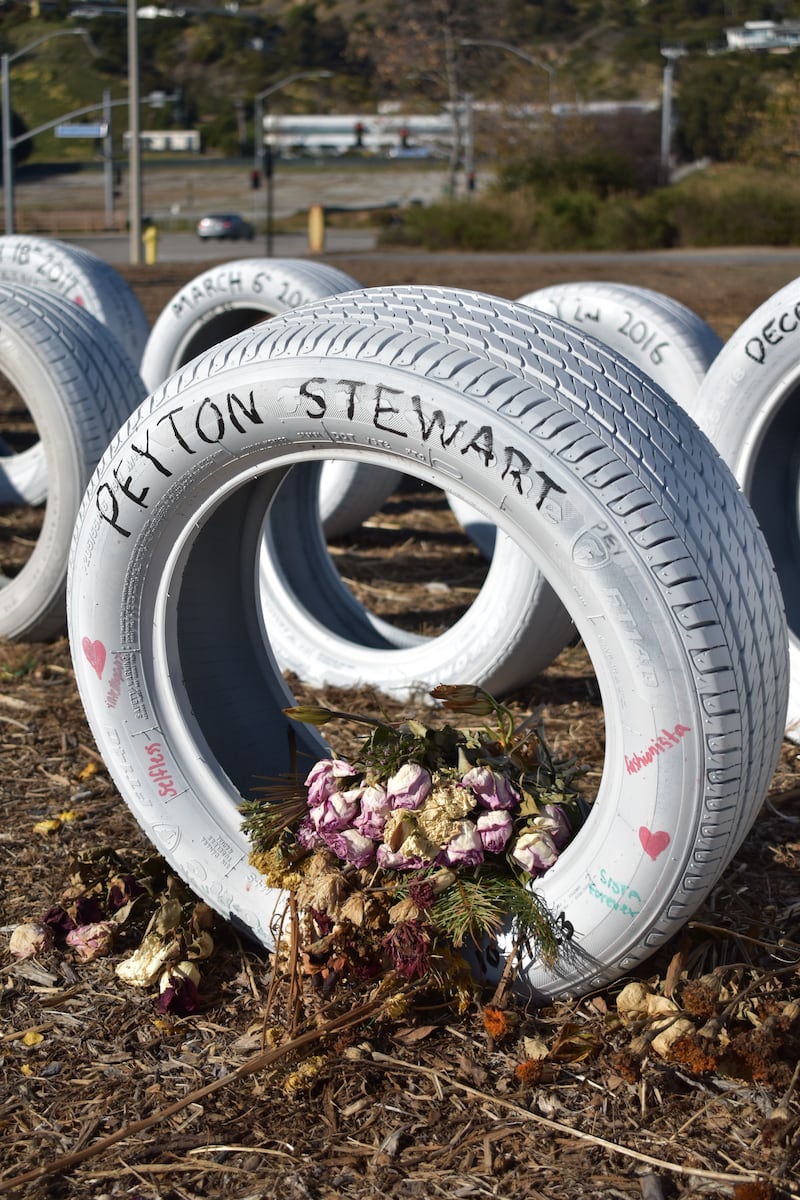
Along the highway itself, “ghost tires” stand as another reminder. Initiated by city officials and residents, the tire memorial along PCH bears handwritten messages, flowers, and photographs — a visible promise that their loss will not be forgotten.
0 of 5




Pepperdine also created the “Our Four Angels Endowed Scholsrship” to honor the spirit and friendship of the four girls. It supports undergraduates who embody their compassion, leadership and joy. Fundraisers for the scholarship have taken place over the past two years, including baseball games and pickleball tournaments.
A GoFundMe has also been created to raise funds to create a permanent memorial at Point Dume in Malibu – a place with deep meaning for Weir and her friends. Plans include two benches overlooking the bluffs and Pacific Ocean that once brought comfort to Weir and her friends. On the benches will be plaques with a QR code linking to a digital memorial honoring Rolston, Stewarts, Weir, and Williams, along with a poem written by Weir, titled “For a Moment of Peace.”
In addition to memorials and scholarships, the community created a Justice for 4 Angels Instagram page to honor the girls’ memory and share updates on the court proceedings as well as safety efforts, advocacy,and memorials.
On the two-year anniversary of the crash, community members, families and friends gathered to honor the four girls — releasing four white doves in their memory. One for each life lost.
On the three-year anniversary of the crash, today, Ollo in Malibu will offer a special menu called the “Rose Menu,” featuring a dish dedicated to each of the four women: Niamh Rolston, Peyton Stewart, Asha Weir and Deslyn Williams. The restaurant will donate 10% of all sales to Pepperdine’s Our Four Angels Endowed Scholarship, helping keep the women’s memories alive while supporting future students.
Three years after their deaths, the fight for safer roads continues — but so does the effort to celebrate the lives of four women remembered not only for how they died, but for who they were and the lasting impact they left behind.