
When Karen Gutierrez started keeping an eye on the underpass behind her sons’ elementary school, she could only describe what she saw as “not normal.”
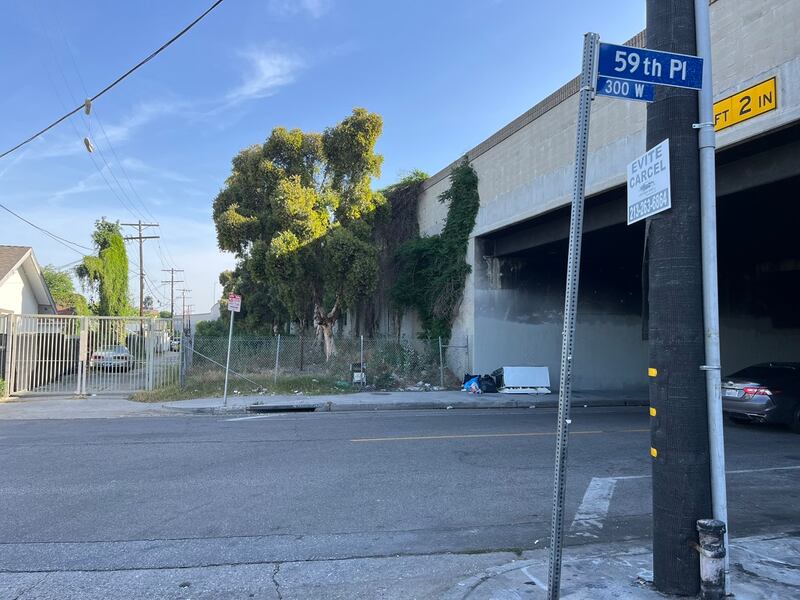
Every weekday morning for the past two years, Gutierrez has stood at the corner of 59th Place and Flower Street and watched fellow families of 61st Street Elementary pass beneath the freeway. Although it’s just a block away, she said, it’s one of their biggest obstacles to getting safely to school.
“Some kids have been yelled at,” Gutierrez said, recounting incidents she’s witnessed between families and unhoused individuals at the underpass. “A lot of these kids are late because of everything that’s going on.”
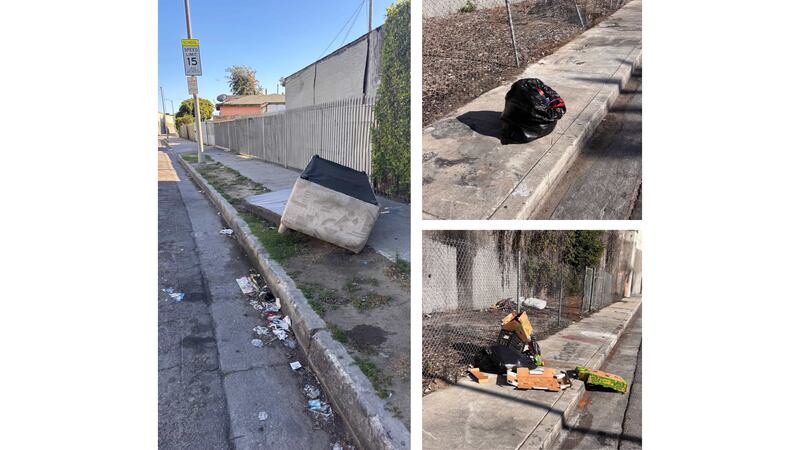
Even after getting through the underpass, the next turn onto Flower Street reveals a mix of old furniture, broken appliances and illegally dumped trash — piles of waste that keep coming back, residents say, even when cleaned up. There aren’t any security cameras there to catch dumping in the act and residents have also reported frequent streetlight outages behind the school.
“Why do we have to go through this? This is not a normal thing,” Gutierrez said.
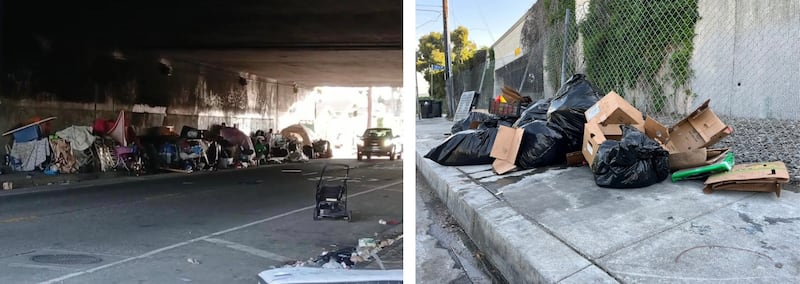
It’s no secret that Los Angeles has a troubled relationship with trash: reports of illegal dumping have reached their highest point since at least 2018. Much of that debris comes from external sources like businesses, construction and street vendors.
On streets like 59th Place, unsheltered homelessness further complicates the clutter. Over a similar time period in the city of L.A., the Los Angeles Homeless Services Authority reported relatively stagnant numbers of tents, counting 2,572 in 2025 as opposed to 2,679 in 2019.
In the area around 61st Street Elementary, the two issues persist alongside each other: with the possibility of displacing unhoused people, clearing a street gets more precarious. But for residents like Gutierrez, the stakes are greater when their children are involved.
“What’s brought us all here is the kids,” Gutierrez said at a recent volunteer cleanup behind the school. “This isn’t about getting credit. This is about focusing on the fact that as a community and as an elementary school, we need help.”
Today, with increasing attention from the city and community, the fight for clean streets is showing tentative signs of progress.
Five years in the making
Gutierrez has been documenting and pushing for better street conditions at the school for two years, but another resident, Omar Ramos, has been at it since 2021. Throughout that time, he said, the city has been reluctant to act.
“It’s a crisis,” he said. “It’s a sanitation, health and security crisis for the children.”
Ramos is the vice chair of Voices Neighborhood Council, which represents the area around the school. For five years, he’s voiced his concerns to city officials about encampments and illegal dumping impeding the kids’ walks to school.
“What they usually say is, ‘Hey, look, we’re cleaning,’ but that’s not a solution,” Ramos said. “That’s a consequence of them not implementing long-term solutions.”
L.A. Sanitation, which responds to street sanitation requests through its 311 service, has cleaned the underpass several times before and continues to do so today. But Ramos said that even after they clean, more trash quickly reaccumulates.
“It’s a reactive measure, not a preventative measure,” Ramos said.
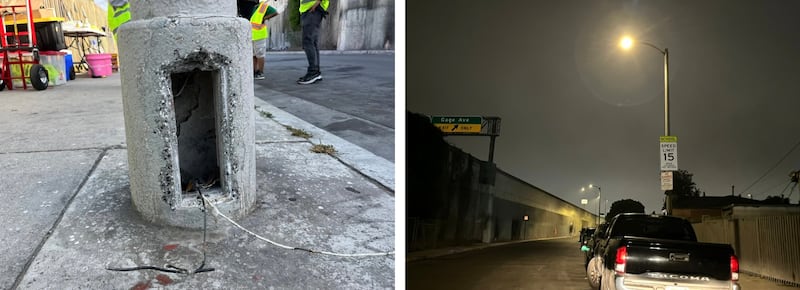
Until recently, almost none of the streetlights behind the school on Flower Street worked, leaving the street dark at night and making it significantly easier for people to get away with dumping trash without getting caught. Some lights were stripped of their copper wires recently, Ramos said, while others had been broken for years.
Gutierrez didn’t know Ramos when she originally got involved in 2024, but the two joined forces after another parent connected them.
“For a long time, we were patient, we were respectful and we were detailed in our advocacy for the community,” Ramos said of his communication with city officials. “But to a certain extent, this is a case of negligence, apathy and city and other officials outright ignoring this community.”
Towards the end of 2025, Gutierrez said she was running out of patience. “I was under desperation, having to see that nothing was changing,” she said.
Then she discovered Joe Shawver, a community volunteer who, under the name OneLAClean, had just begun cleaning streets on his own and posting his work to social media. Gutierrez decided to reach out to him for help.
“The next day, I went over and I cleaned the underpass,” Shawver said. “It took me six hours, and I gathered around 60 bags of trash, plus bulky stuff.”
His experience at the underpass that day opened his eyes to what many children encounter every morning, he said.
“Every day, they have to see the trash. The smell is really bad. I don’t mind the homeless trash like clothes or bulky items, but when you have leftover food from a food truck, that’s really bad. It turns into maggots and the smell is just so, so bad,” Shawver said. “These kids have to experience that daily.”
Most of the trash near the elementary school does not come from unhoused people, he said. Instead, the majority comes from street vendors who dump leftover food onto Flower Street. He’s also made an effort to speak with unhoused people at the underpass when he cleans.
“I always bring them some food or some drink and have a conversation,” Shawver said. “It’s important that we treat them like human beings.”
Some unhoused people he’s spoken to at the underpass have felt stuck due to a lack of resources despite wanting to leave, he said. “I always tell people, ‘Being homeless is not a choice.’”
However, other unhoused people at the underpass have operated more obtrusively, he said, taking bulky items dumped on Flower Street and cluttering the sidewalks that students use to walk to school.
“There’s the good and bad of everything, right?” Shawver said. “It’s the same thing with the unhoused.”
Still, Shawver stressed the need not to jump to the conclusion that unhoused people are the root cause of the mess near the school. He’s continued to clean since then, he said, because he wants to help the kids.

“The next thing I knew, I had more people wanting to join my group,” he said. In January, he organized his first community cleanup at 61st Street Elementary, and has continued to show up with a group of volunteers every other week since.
But despite his momentum, Shawver has run into a pesky problem: trash just keeps getting dumped on Flower Street, sometimes almost immediately after he cleans.
“I might clean today, and the next day there will be more illegal dumping,” Shawver said — though he also said that after consistently cleaning for a few months, the amount of trash he sees now is less than it used to be. Sanitation crews have also started showing up in the area more often, he said.
While Shawver’s cleanups started building momentum, Ramos got to work organizing a Feb. 27 meeting to gather school, city and state officials at the elementary school to present parents’ concerns about safety and illegal dumping in the area.
Ramos said the meeting was an overall success, even though it took some time to get off the ground — it brought together representatives on behalf of the LAUSD, City Council District 9, L.A. County Public Works, the Los Angeles Police Department and State Assemblymember Sade Elhawary, he said.
“Little by little, the different offices and officials started contacting me. I’ve been in constant communication with the mayor’s office, the city attorney’s office, the assemblymember and other officials,” Ramos said.
An LAUSD spokesperson provided the following statement: “Student safety remains our top priority. We share our families’ concerns about the broader community issues and will continue working with our city partners to address them.”
CD9 did not provide a statement after repeated requests for comment.
What’s happening now
While the community is still searching for permanent solutions to the dumping and encampments behind the school, their advocacy has slowly gathered more support from the city.
At Shawver’s cleanups, the LAPD sends an officer to block off traffic behind the school on Flower Street, and sanitation crews coordinate with the volunteers to pick up the trash they consolidate.

In an April letter addressed to parents of 61st Street Elementary, LAUSD officials encouraged parents to report streetlight outages in a survey for Mayor Karen Bass’s streetlight repair initiative. The letter said that doing so will help prioritize repairs behind the school on Flower Street.
Councilmember Curren D. Price, Jr. also passed a resolution last month designating the underpass at 59th Place for special enforcement against encampments. The change allows police to clear encampments at the underpass without an advance notice.
On April 18, the first community cleanup after the resolution passed, volunteers arrived at a far cleaner underpass than usual.
“I got these butterflies in my stomach,” said Alyxandria-Jamil Carter, a professional artist and write-in L.A. mayoral candidate who volunteers at the community cleanups. “They pressure-washed, they repainted, it looked amazing.”
But Carter, who has herself experienced homelessness, stressed the importance of moving the people who lived at the encampment into housing rather than pushing them off to another street.
“My immediate thought was, ‘What happened to the people there?’” Carter said. “Those individuals need not just long-term support, but they need comprehensive support as well.”
Two days earlier, on April 16, Gutierrez witnessed the encampment getting cleared. Officers told her that housing services, which include emergency housing vouchers, would be offered to people at the encampment, she said.
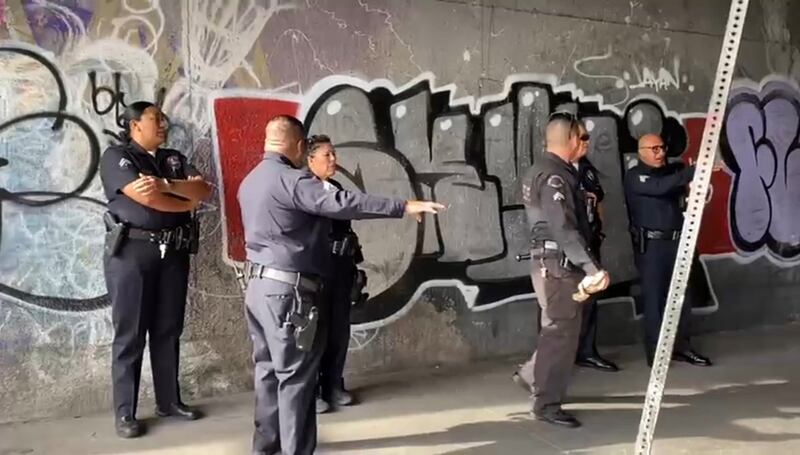
“It’s a fantastic start,” Carter said of the services. “That way, we’re not continuously clearing out encampments, and then they re-establish and then we just wash, rinse and repeat.”
From there, Carter said it’s the city and county’s responsibility to help those people make the transition back into sheltered living. Without doing so, the hostile habits they might learn from living on the street — like hoarding or stealing, she said — don’t go away.
Otherwise, “all you’re doing is just bringing houseless people indoors,” she said.
Even so, the change in enforcement at the underpass is significant — but Ramos said it doesn’t quite go far enough. He’d prefer to see the protection, which falls under section 41.18c of the Los Angeles Municipal Code, expand over an area covering the entire school and all nearby underpasses.
“That’s a more permanent and comprehensive solution,” he said, “rather than a very specific and small solution.”
And although the underpass at 59th Place recently saw improvements, residents have continued to find incidents of illegal dumping around the school, and encampments have still periodically cropped up as well.
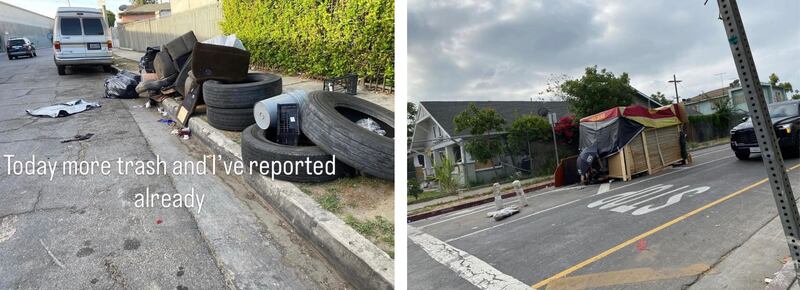
For Shawver, that continued need is what keeps him coming back.
“It has to be an all-around effort, right? The LAPD has to do more patrolling in that area, the city has to get the unhoused some help that they deserve, or remove them to wherever it needs to be,” Shawver said. “But it needs to be out of 59th.”
Gutierrez said that the progress so far is promising, but not permanent. “Everything that has happened is because of all the traction and because we’re persistent, we’re pushing and pushing,” she said.
Despite that skepticism of the city’s recent attention, a steadfast resolve to keep pushing for solutions — “for as long as it takes,” Shawver said — remains among everyone who shows up to clean at the school.
“We’re not asking for a multi-million dollar stadium,” Ramos said. “We’re not asking for anything out of this world. We’re asking for simple human needs: sanitation, safety and security.”