
What began as a Lunar New Year greeting from USC quickly turned into a debate over culture and representation.
On Feb. 17, USC’s official Instagram account, @uscedu, posted a holiday message featuring images of lion dancing, Korean dancers and Traveler the horse, with the caption: “Did someone say Year of the Horse??? Wishing all who are celebrating a happy and prosperous Lunar New Year! Here’s to a year of good fortune, progress and new beginnings,” followed by a red envelope emoji.
Soon after the post was published, hundreds of comments appeared under it, many reading “Happy Chinese New Year.”
After three days, more than 1,200 comments were posted, with multiple users arguing the difference between Lunar New Year and Chinese New Year and criticizing the post’s portrayal of the event.
Chinese New Year, or Chunjie in Chinese, is the traditional holiday that marks the start of a new year on the lunisolar calendar, which was first developed in ancient China over 4,000 years ago. The term “Lunar New Year” is a broader phrase that refers to celebrations based on the lunar calendar system across different countries. In Korea, the holiday is called Seollal, and in Vietnam, Tết Nguyên Đán.
Several commenters said the distinction was important, especially at a university with a large Chinese student population. According to university data, Chinese students make up USC’s largest international student group with almost 6,000 students as of Fall 2025. For many students, that demographic reality heightened expectations that the university would explicitly acknowledge the holiday’s Chinese origins.
Students’ criticisms centered on two main concerns. Some argued that using the term “Lunar New Year” without explicitly mentioning China erased the holiday’s Chinese origins — an oversight especially significant given USC’s large Chinese student population. Others said the post’s imagery, which included lion dancers and Korean performers, did not clearly reflect the broader, multicultural meaning implied by the term, making the message feel inconsistent and confusing rather than inclusive.
In recent years, many universities, companies and public institutions have increasingly used the term “Lunar New Year” rather than “Chinese New Year.” The shift reflects efforts to acknowledge that the holiday is celebrated in several countries and cultures that follow the lunisolar calendar. While the festival originated in China, communities in places such as Korea, Vietnam and parts of Southeast Asia observe their own versions of the holiday and often prefer terminology that does not frame it solely as a Chinese celebration.
Screenshots of USC’s post spread on the Chinese social media platform Xiaohongshu, also known as RedNote, where users criticized the university’s message. One user, @chohsi, shared a screenshot of the original post and wrote that it showed “no respect for Chinese students.”
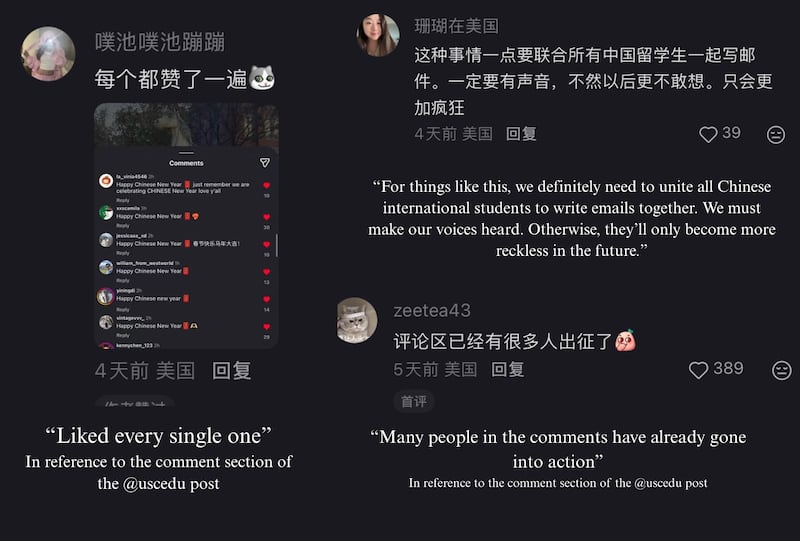
In the Instagram comment section on USC’s page, several users described the post as diminishing the role of Chinese culture. One commenter wrote, “It’s impressive how the word ‘Chinese’ disappears so easily when Chinese students are the largest group of international students at USC.”Another said, “This is not inclusion, it is cultural erasure.”
The response reflects frustration among some Chinese students who said they did not feel represented in the post.
Lin Wu, an international student from China and a junior majoring in communications, said the university should have made a stronger effort to showcase a broader range of cultures in the post given the specific phrasing used in the caption.
“If USC chooses to use the term ‘Lunar New Year’ to include various Asian countries, then the representation should reflect that broader cultural scope,” Wu said.
USC declined to comment on the feedback received on the post, noting that “Lunar New Year” is an inclusive term widely used by businesses, corporations and sports teams.
For Doris Li, a sophomore physics major, the issue was also what she viewed as a lack of recognition.
“I wanted my voice to be heard when people opened the comments,” said Li. “You can call it Lunar New Year, but for us it will always be Chinese New Year.”
Li added that there was no mention of China in the post, even though many students most closely associate the holiday with Chinese traditions. She added that Chinese New Year is one of the most important times of the year for many Chinese students, and seeing it described without mentioning China made her feel overlooked.
“I felt like it was stripping away our culture,” Li said.
Li said she believes the university should have anticipated the negative reaction.
“It’s a controversial topic,” she said, “they should have known that. Posting it this way felt disrespectful.”