
Following a rainy Tuesday, Feb. 24 screening of “Sinners” hosted by San Francisco Film at Oakland’s Grand Lake Theatre, actor Delroy Lindo reminded the audience of the significance of where they were.
“We are here in Oakland, and this is a native son right here,” he said, placing a hand on writer-director Ryan Coogler’s shoulder. “Zinzi [Coogler], Raphael [Saadiq],” he continued, emphasizing the Oakland-born collaborators. “And it’s my adopted home.”
The panel included Lindo, Coogler, original song co-writer/producer Saadiq, supervising sound editor Benny Burtt and sound designer Steve Boeddeker. Producer Zinzi Coogler sat in the crowd.
What Lindo, who plays Delta Slim, was recognizing was more than geography. The historic theater, which celebrates its 100-year anniversary on March 4, was filled for a hometown screening of what many are already calling the year’s most significant film — a project born from the memory of Black Oakland’s Southern roots, built by collaborators with deep ties to the city and now circulating globally with critical acclaim.

Earlier that afternoon, Tajianna Okechukwu, a participant in SFFILM’s yearlong FilmHouse Residency program, packed up her classroom at Westlake Middle School, where she teaches digital media to middle schoolers just blocks from Grand Lake Theatre. By early evening, she was across the Bay at SFFILM’s office in San Francisco, seated around a table with her residency cohort for a production meeting. SFFILM’s Executive Director and USC alumna Anne Lai later stopped in to speak with the group.
Hours later, Okechukwu retraced her steps back to the East Bay for a quick babysitting shift and then made her way toward the glowing marquee of the Grand Lake Theatre, just two minutes from her day job. An hour before showtime, people were already lining up to secure their seats for the rare 70mm presentation organized by SFFILM.
The evening underscored a larger truth about artistic ecosystems. Global cinema does not emerge from nowhere, and regional institutions are integral to the infrastructure that makes it possible.
In 2012, the organization helped fund Coogler’s first feature, “Fruitvale Station,” before Hollywood had taken notice. As “Sinners” played in front of a hometown crowd, Coogler’s global success stands as proof of concept, evidence of what can grow when institutions invest early and locally.
Okechukwu represents the next generation of homegrown talent. A native of San Leandro, she earned a double degree in acting and film & TV studies from Azusa Pacific University before returning to the East Bay to continue developing her practice as both an actor and filmmaker. She has worked with companies including PBS, Google, A24 and Marvel Studios, while building a body of work that often moves through Afro-surrealist and speculative terrain. An excerpt of her pilot script “HERITAGE” was featured in Betti Ono’s The Next 15 Minutes: Full Spectrum Futures showcase, a live staged reading spotlighting Bay Area sci-fi writer-directors. The project emerged from her selection as a writing fellow in the Justice For My Sister BIPOC Screenwriting Lab, an incubator supporting visionary writers of color crafting futuristic narratives.
Still, she sometimes questions her progress.
“As an artist, we’re freelancing, working these odd jobs and trying to figure out, is this doing anything for my career?” she said.
Programs like SFFILM’s artist development initiative are especially affirming, given the organization’s history of supporting filmmakers like Coogler.
“When SFFILM first met Coogler, he was developing what would become ‘Fruitvale Station,’” Lai said. “We had the Rainin Grant that, at the time, was still in its fairly early days,” she continued.
The aforementioned grant provides unrestricted funding and is the largest granting body for independent narrative feature films in the U.S. and “entrusts the artist, producer, writer or director to deploy that fund in a way that’s going to be useful for them,” she explained.
In practical terms, that could mean rent, casting space or production costs — the kinds of resources that allow a first-time filmmaker to move from idea to execution.
In an industry where, as Lai describes it, independent voices often face a “chicken and egg” dilemma, unable to be recognized without first making something, organizations like SFFILM attempt to interrupt that cycle. The goal is not simply to support a single film, but to recognize promise before market validation arrives.
“I always think about what can happen through our organization and others like it,” Lai said, “which is to try to find and recognize and support someone before anyone else is interested in doing it.”
Investing in emerging artists and first-time filmmakers is often framed as risky. Lai reframes that thinking.
“It’s a risk, but it’s not as risky as what the artist is doing,” she said. “The risk that an organization takes is so small compared to an individual who maybe doesn’t have a network, maybe doesn’t have all the resources, and most likely doesn’t have any of those things.”
For Lai, the calculus is less about commercial success and more about creative urgency.
“Do they have something urgent that’s driving them to say it? Is this the right moment that might actually impact them the most?” Lai said. “It’s not about, is it going to be popular? Is someone going to buy it? It’s really, can this help them get off the ground? The risk is that it might not. But you never regret the ability to help someone invest in themselves.”
Coogler exemplified that early promise.
“He had something really specific to say,” Lai said. “It happened to be rooted in his perspective, in his personal influences and the audience that he wanted to talk about, and the people he wanted to put on screen.”
More than a decade later, that specificity has translated into one of the most closely watched careers in contemporary filmmaking. Coogler has garnered dozens of award nominations over the course of his career, and “Sinners” has received a record-breaking total of 16 Oscar nominations, more than any other film in Academy Awards history.
If “Fruitvale Station” revealed the urgency SFFILM recognized over a decade ago, “Sinners” is a continuation of that same excavation of his first feature film. During the panel, Coogler recalled growing up in the 1980s watching elders riveted by black-and-white war documentaries, only to find himself, decades later, similarly drawn to interrogating history.
“One of the coolest parts about getting older for me is having a chance to gain more context on who you are and how you got here,” Coogler said during the panel. The film was inspired by his Mississippi-born uncle James, who first introduced him to the blues.
“The more I looked at it, I could kind of excavate my own cultural history, this very unique American art form that I think is the most important one our country has produced,” Coogler said. “And then throwing in my love for cinematic storytelling, I just kind of cooked them all up like gumbo.”
That excavation — personal, regional and historical — mirrors the kind of work SFFILM’s residency now supports in filmmakers like Okechukwu. The throughline is not just talent, but infrastructure and systems that allow artists to explore memory, risk and identity long enough for something fully formed to emerge.
For Okechukwu, sitting just feet away from the stage, “Sinners” was an affirmation, proof that stories rooted in specific cultural histories can resonate far beyond their point of origin.
Her working script, “Nights in Fillmore,” is a social thriller set in 1950s San Francisco. It follows a Black couple confronting racism and the supernatural in the Fillmore District, once known as Harlem of the West.
“It’s helping me tap into my San Francisco lineage,” she said, explaining that her mother is from San Francisco by way of her great-grandparents migrating from Texas to the city in the 1940s.
Like Coogler’s excavation of blues and memory, Okechukwu’s screenplay turns to place and migration as a narrative spine. That kind of historical interrogation is exactly what SFFILM’s residency was designed to nurture.
“The residency was born out of this idea of, what does it look like to provide an environment that is supportive not only of a project, but of an individual?” Lai said.
Unlike a one-time grant tied to a single deliverable, the yearlong program offers structure, including monthly production meetings, creative advisors, a cohort model that counters the isolation of independent filmmaking and perhaps most importantly, accountability.
“Sometimes the best free gift you can give someone,” Lai said, “is a deadline for the next draft, a structure that helps them keep making the work.”
Since 1957, SFFILM has presented the longest-running film festival in the Americas, serving as a cornerstone of Bay Area film culture. But while the region has long been rich in creative talent, its narrative film ecosystem has historically operated in the shadow of Los Angeles and New York, cities where industry infrastructure is concentrated and career pathways more clearly defined.
However, Lai sees that imbalance as an opportunity.
“We’re not L.A., and we’re not New York,” she said. “And I think that’s a good thing.”
The Bay Area has been a part of cinema since its earliest days, from the silent film era to experimental and documentary traditions that flourished outside the studio system. But with Hollywood just a few hundred miles south, the region has long represented only a small fraction of the industry’s economic footprint.
That dynamic may be shifting. In the past two years, both San Francisco and Oakland have passed expanded financial incentive programs aimed at attracting film and television production back to the region, tax rebates designed to compete with states like Louisiana and Georgia. San Francisco Mayor Daniel Lurie recently announced that the majority of the third season of Netflix’s “A Man on the Inside,” starring Ted Danson, will shoot in the city, crediting the new film incentive program for securing the production.
Policy, in other words, is beginning to catch up to creative ambition.
For local filmmakers, those policy shifts signal possibility.
“I’m a part of so many beautiful budding Bay Area film organizations and initiatives like Make It Bay and Cinemama,” Okechukwu said. “There’s so many beautiful things that are happening. I think that we, as artists who are from the Bay, don’t want to feel like we have to move in order to make it.”
She added that a stronger local production economy could mean more than pride. It could mean jobs.
“We’re so hungry,” she said of Bay Area narrative filmmakers. “A lot of what we’re working on now is how do we bring more productions to film here so that people can get hired to work on movies. We are not without talent, as we can see.”
Following the screening, Lindo reflected on collaboration and the trust built over years of working with the same creative partners, relationships often formed in film schools like USC’s School of Cinematic Arts — where Coogler met many of his collaborators — on early sets and in residency programs like SFFILM’s.
Working with longtime collaborators, he explained, creates a kind of security and trust.
“That gave a certain kind of confidence,” Lindo said, “that no matter what the challenges were, they were surmountable.”
“Sinners” continues a pattern that has defined much of Coogler’s career. The film marks his fifth collaboration with actor Michael B. Jordan. Behind the camera, he has also worked repeatedly with Bay Area native and legendary sound designer Ben Burtt, as well as San Francisco-based sound designer Steve Boeddeker on “Creed” and “Black Panther.” These sustained partnerships reflect more than loyalty; they signal the long-term creative relationships that often underpin filmmaking.
“You find collaborators that you grow and evolve parallel to each other,” Lai said, noting Coogler’s longtime partnerships with composer Ludwig Göransson and producer Sev Ohanian.
That continuity, collaborators growing together, project by project, is something Lai also sees as part of the independent ecosystem. Infrastructure, in this sense, is not only financial. It is relational, the accumulation of trust and shared language that allows filmmakers to take bigger risks over time.
“Not everyone has the benefit of film school or a more structured environment,” she added. “So sometimes a residency can help provide that.”
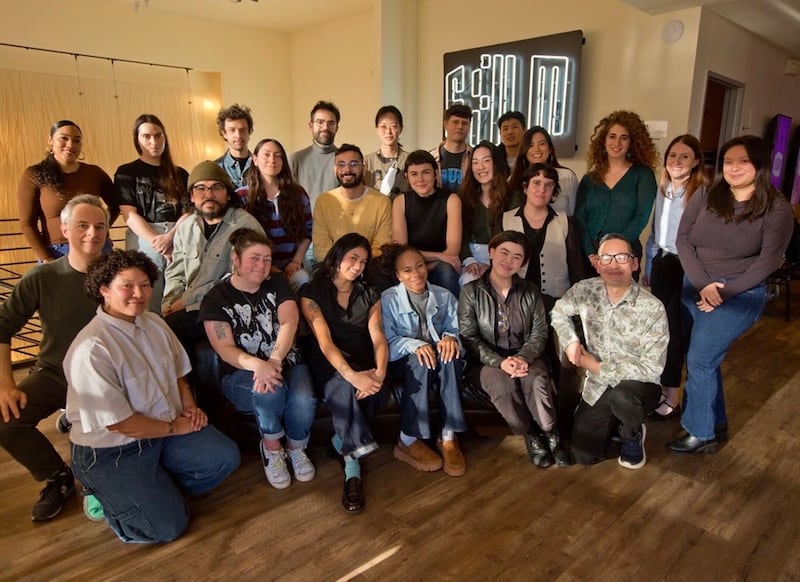
For Okechukwu and her cohort, that process is just beginning.
“We’re going to be hiring each other and working together and coming up together,” she said. “I always say that filmmaking is the best team sport…You’re in the trenches together. That’s what it feels like, a family, because you’re going through some ups and downs, and it’s all worth it in the end.”
As the crowd spilled out of the Grand Lake Theatre, just steps from her classroom, Okechukwu reflected on a film made by a writer-director who was once in her position, local, emerging and entrusted with early belief. In an industry where access often determines opportunity, SFFILM has operated as critical infrastructure for local and emerging filmmakers.
“If it didn’t exist,” she said of SFFILM’s support system, “oh my God, what would we do?”