
A hush fell over the crowd as the lights dimmed inside the Albert R. and Dana Broccoli Theatre at the USC School of Cinematic Arts on Saturday afternoon.
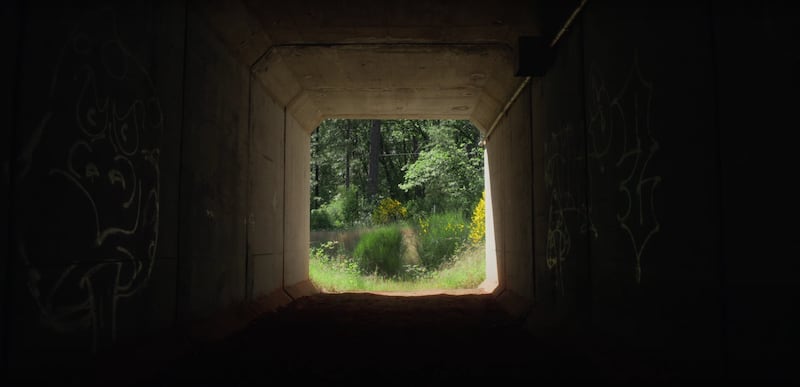
On screen, deer wandered near a highway at night until one was struck by a car — the screen went black, prompting audible gasps from the audience.
The scene became one of the festival’s most jarring moments, underscoring the fourth annual Eco Media Fest’s focus on student films and media art that confront environmental realities.
Presented by the Arts & Climate Collective and SCA’s Division of Media Arts + Practice, the festival serves as a gateway for emerging filmmakers seeking to tell environmental stories in an industry that rarely prioritizes ecological urgency.
A 2025 study from Rice University revealed that just under 13% of the 250 most popular films released between 2013 and 2022 depicted climate change, while 19% of the films addressed other environmental issues, such as air pollution, erosion and species extinction.
Industry leaders, including Grammy-nominated filmmaker and USC alum Danny O’Malley, were present to weigh in on how these young voices could shape Hollywood’s future.
“Hollywood doesn’t always acknowledge these stories, and I think there’s a lot more room in that space than people think,” O’Malley said.

O’Malley cited his work on “Chef’s Table,” the Emmy-nominated Netflix documentary series that elevated food television while subtly prompting audiences to consider sustainability, sourcing and humanity’s relationship with the natural world.
By weaving environmental consciousness into a mainstream series, he helped introduce audiences to ecological storytelling that is usually pushed to the industry’s margins.
“In my experience working on ‘Chef’s Table,‘ we’ve had everything from chefs who focus on ocean sustainability to chefs trying to connect people in their communities after generational trauma and genocide,” he said. “People tune in to watch a food show and then they experience these things about deeper values.”
The Eco Media Fest was founded in 2023 by USC alum and Argentinian actress Natasha Nua with the help of a grant from the Arts and Climate Collective. Her passion for climate storytelling began while growing up in Miami, where she dealt with the region’s hurricanes and floods.
“With the grant, I did a short film called ‘Our Garden,’ and it explored themes of climate anxiety, climate grief, and how as young people we’re falling in love in this crisis,” Nua said. “How do we have a hope and future for romance in our future, while we feel like the world is ending?”
She added that while she was proud of her work on the film, she found there was nowhere to show it, leading to her development of the event — originally called the Eco Film Festival — to fill the space.
“I was super proud of this film, but there’s nowhere to show it,” she added. “So, why don’t we organize an Eco Film Festival?”
This year, the festival was rebranded as Eco Media Fest to reflect its expansion beyond film, incorporating art installations and music. The event also drew submissions from around the world, with projects arriving from India and the Netherlands.
Outside of the black-box setting of the Broccoli Theatre, a gallery-style hall showcased environmental student art installations. After a two-hour screening featuring 16 films, the space buzzed as students connected with industry professionals.

Among them were the directors, Ryan Grant and Karli Korszeniewski, of “Crossing the Divide,” the event’s opening film depicting deer struck on a darkened highway, a topic they felt was often ignored.
“We kind of look over roadkill every time we go onto the highway,” Grant said.
The 10-minute documentary examines how road fragmentation disrupts wildlife habitats and highlights wildlife crossings as a solution.
“I think being more conscious about your carbon footprint, like getting into a car and using the freeways — I mean, we can’t really get around that because that’s our transportation — but wildlife was here first. Our environment comes first,” Korszeniewski added.

Other students translated similar concerns into immersive art installations.
Graduate student Avidha Raha stood beside her photo project, “Rising Above the Melt,” which captures life in a village in the Indian Himalayas. The project features nuns of various ages facing and adapting to water scarcity, where access to the natural resource is limited to school hours.
She captured the photos over the course of three years, during a prolonged stay in the region.
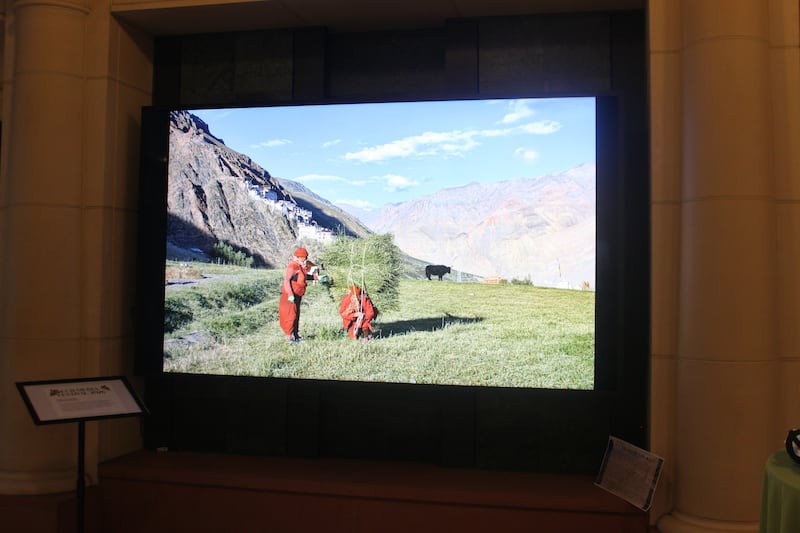
Raha said she hopes audiences will better understand climate impacts beyond urban centers.
“People in urban regions talk a lot about climate change,” she said. “But if people get to know what’s happening in the remotest corners of the world — ecologically sensitive regions like the Himalayas — there will be more empathy amongst people.”
Festival director Arian Tomar, a senior studying film production at USC, said the growth is less about scale and more about impact.
“I think the real value of Eco Media Fest is showing students that there are places where their voices are valued,” Tomar said. “We hope the festival is a beacon for creatives looking for an outlet to express their anxiety and despair and to build community around it.”
O’ Malley cautioned that environmental films sometimes struggle in mainstream spaces when messaging overshadows storytelling.
“Sometimes the characters take a backseat, and it becomes more of an ‘An Inconvenient Truth‘ approach or just getting the facts out,” he said. “You lose the ability to cut through in Hollywood or to an audience because a film is supposed to entertain. It’s supposed to get to the heart before it gets to the head.”
O’Malley added that the future of environmental storytelling in Hollywood may depend less on genre and more on values.
“Ultimately, films are about values, and if you’re telling a story, chances are it can have values that are relevant to the environment,” he said.