
Tucked away in the Don Cota cul-de-sac, dozens of Baldwin Hills residents gathered early in the morning for the third annual “Walk in the Dons,” a community health and wellness event.
Some residents stretched their legs, warming up before the walking tour of the neighborhood. Tables and tents lined the dead-end street, hosting local businesses and organizations and encouraging neighbors to learn more about the community. A mother pushed her baby in a stroller while browsing a table of fruit, granola and fruit snacks. Others signed up for a free Pilates class.
For longtime residents like 18-year homeowner Sherri Taylor, the Walk in the Dons event is necessary for the historic Black neighborhood of Baldwin Hills, as gentrification poses a threat to the community.
Gentrification is often described as a process in which a historically disinvested neighborhood sees rapid economic and real estate growth. But an often overlooked aspect is the racial makeup of residents and its impact on a community’s cultural identity.
Though Baldwin Hills is not a disadvantaged neighborhood, it is not immune to the effects of gentrification. As the nation battles the housing crisis, Los Angeles has seen its Black population steadily decline since 2010, according to the U.S. Census Bureau.
While property values rise in Baldwin Hills, giving homeowners the incentive to sell, many of the new homeowners do not reflect the neighborhood’s 65% Black population, according to the Los Angeles Almanac.

Resident Sherri Taylor takes pride in the Baldwin Hills community. Her home sits on Hillcrest Drive overlooking the Jungles, the Los Angeles cityscape and mountains dusted with snow after rain. Taylor’s hillside backyard, secluded by lush bushes, flowers and fruit trees, creates a jungle-like haven she feels is rare to find in Los Angeles. The New Orleans native and longtime L.A. resident has found her home and community in Baldwin Hills.
When Taylor bought her home, she recalled being the youngest among her all-Black neighbors. But in just a few short years, that changed. “Now we have four white couples on my street, and my street’s not that long,” Taylor said.
Taylor purchased her home in 2007, before the U.S. housing market crash. USC professor Gabriel Kahn and founder of Crosstown, a nonprofit data driven newsroom, compared the housing crisis to riding a roller coaster.
“Everybody thought, ‘I better get on this train now,’” Kahn said, but then the crash happened.
In 2007, as people became homeowners, property values dropped significantly. Foreclosures increased, creating a greater supply of homes than demand and pushing values down further.
Historically, Black people have been able to accumulate wealth through real estate, something Kahn noted white people have been able to do for much longer. Through institutional practices like redlining, Black communities were disproportionately excluded from homeownership.
“Here we have a success story in Baldwin Hills, but is it a victim of its own success?” Kahn questioned.
In Los Angeles, white households are more likely to be homeowners (68%) in contrast to approximately 40% of U.S. Black descendant homeowners. Of those Black homeowners, 78.4% are more likely to have high debt-to-equity ratios on their homes, according to a 2016 Color of Wealth Report.
Joyce Johnson, a 25-year homeowner, shares the same question raised by Kahn. She is concerned for future generations, like her younger brother, who she fears may never get the chance to purchase a home in Baldwin Hills as she did. Johnson remembers growing up in the area and the prominence of the community, inspired by many celebrities, professionals and entrepreneurs who were her neighbors.
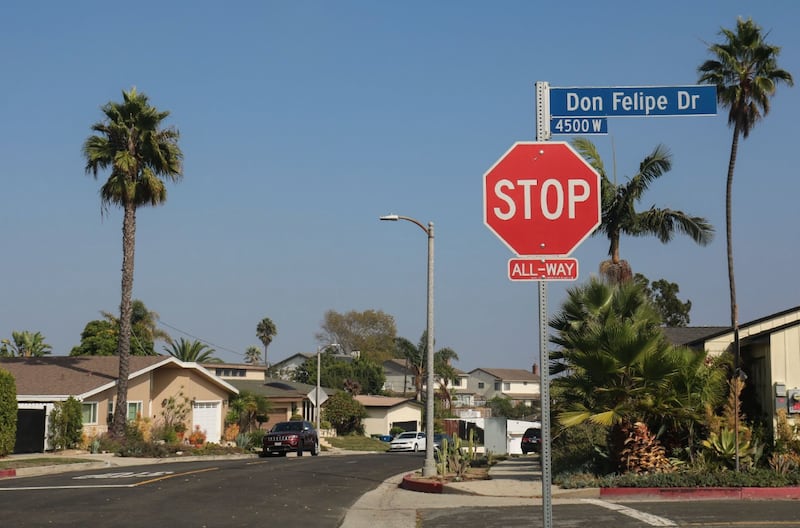
Every Saturday morning, Johnson goes to the corner of Don Luis Dr. and Don Felipe Dr. to meet her friend, another decades-long homeowner, Adrienne Smith, to walk around their neighborhood. Smith talked about the neighborhood’s history, from its first construction project to house Olympians in 1924 to the first home built in Baldwin Hills on Don Mariano Street.
As Johnson waves at passing cars that honk in response and stops to talk to neighbors outside, she cannot help but notice the “for sale” signs in some yards and think about the neighbors who once lived there.
Johnson believes a new form of racism is emerging in real estate in the form of pricing out interested buyers. “When you come in and you’re willing to pay $50,000 and $60,000 over asking, that’s a form of racism because you price somebody out of their neighborhood,” Johnson said.
Some neighbors, like five-year residents Jon and Eve, who asked that their last name not be used for personal reasons, recognize they pose a risk to the Black identity of Baldwin Hills as Jon identifies as white and Eve of Asian descent. Eve described themselves as “gentrifiers,” though her husband Jon does not fully agree with that label.
“I would say we’re half gentrifiers,” Jon said. “There’s an acknowledgeable cultural background difference, but financially, career-wise it doesn’t seem that different.”
Jon said that in low-income areas compared to Baldwin Hills like its next door neighborhood Leimert Park, he and his wife would be considered gentrifiers because their dual income, lack of children and different ethnic backgrounds could significantly impact the financial and cultural identity of the area.
However, because many Baldwin Hills residents are of high career and economic status, Jon said he and his wife mostly affect the cultural identity and population makeup of the area — hence his label of “half-gentrifiers.”
But for Jon and Eve, protecting the cultural and racial identity of Baldwin Hills is important.
“I came here to be a part of this neighborhood. I don’t want to have a domineering personality in this place,” Jon said. “My fear is that this kind of trajectory will continue and it just won’t be a Black neighborhood anymore.”
While some are fearful, others, like 22-year real estate agent Heather Presha, are frustrated with what they see as a lack of education around homeownership. Presha believes this lack of knowledge is why more homes in Baldwin Hills are being sold rather than passed down.
She said that in her experience, most people do not fully understand basic real estate concepts like interest rates, appreciation, equity, tax deductions or simply the long-term value of owning. “If you teach the youth and the heirs what equity really is, they’re probably not going to want to sell the property,” Presha said.
Yet some Baldwin Hills homes remain in families for generations.
Johnson recalls one friend whose family bought a home in Baldwin Hills in the 1960s after being denied housing elsewhere and lived on the same street she did. “They wouldn’t rent to him in the Jungles,” Johnson said. The Jungles or Baldwin Village is a section of Baldwin Hills comprising town homes and apartment complexes built in the early 1940s and where Jon and Eve reside.
Still, property values are on the rise.
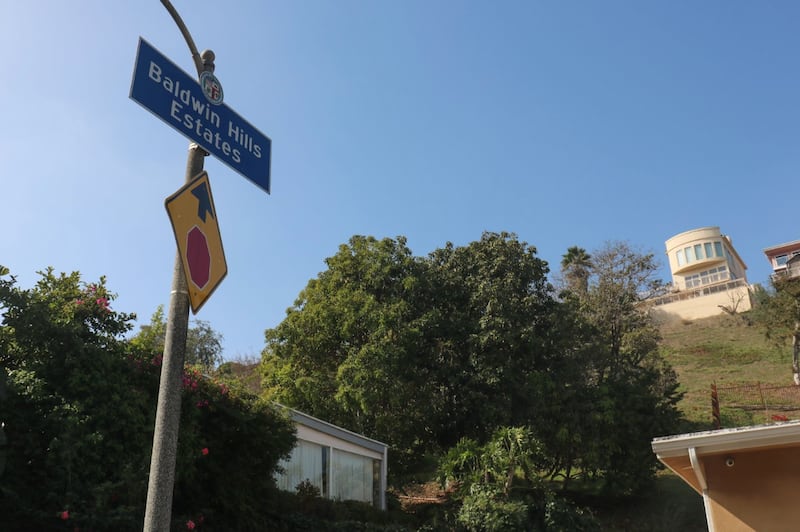
The Baldwin Hills-Crenshaw area, including Baldwin Hills Estates, saw an 81% property value increase between 2016 and 2024, according to Crosstown LA’s By the Numbers database. For residents like Taylor, her 1.6-acre property nearly doubled in value since her 2007 purchase.
Johnson also raised the issue of property taxes. “We had property taxes that, if a home was inherited, used to pass from parent to child, they called it an inheritance tax. [Voters in LA County] voted it away,” Johnson said.
In 1978, California voters passed Proposition 13, which caps property tax rates at 1% and restricts annual increases to no more than 2% until the property is sold. More than 40 years later, most California homeowners still support the measure, except Black Americans, according to the Public Policy Institute of California. The PPIC found that 39% of Black homeowners oppose Proposition 13.
Some critics, including organizations such as the Opportunity Institute and Pivotal Learning, argue that Proposition 13 allows longtime homeowners to benefit from tax breaks at the expense of vulnerable communities. The Opportunity Institute is a nonprofit advocating for equitable outcomes for Californians, and Pivotal Learning is a consulting agency that partners with schools to improve academic achievement.
The groups co-authored a 2022 report, “Unjust Legacy,” which connects the history of redlining and discriminatory housing practices to the lack of access Black Californians have had to homeownership. The report argues that because white homeowners on average have owned their homes longer, they benefit more from Proposition 13’s tax protections, while minority homeowners face higher tax burdens.
“Most of the reason people move is because the property taxes may increase and they can’t keep up with that,” Johnson said. At one point, she considered selling her home but decided against it, hoping her decision would inspire the next generation of Black homeowners to move into the neighborhood. She wants young people to desire the community and protect it.
“I don’t want it to turn so white that we don’t desire it. This is where the love is. This is our community. It’s our community,” Johnson said.
Hope for preservation also lingers in new residents like Jordan Tazewell and Dr. Shenise Gilyard, who purchased their home in 2024 with the specific goal of helping preserve Baldwin Hills’ Black community. Tazewell said events like Walk in the Dons are essential to the neighborhood, allowing residents to meet, connect and learn about its history.
Tazewell said what makes Baldwin Hills special is the people. He knows he can go to any neighbor on his block for help, perspective or simply a good time, and he worries he will not find anything like it if he were to leave.
“I didn’t have to try hard to find community; it sought me out,” Tazewell said. “Baldwin Hills is just like a little oasis; it’s heaven on earth.”
Residents like Taylor and Johnson see themselves as passing the torch of protecting Baldwin Hills to younger generations like Tazewell with hopes of preservation on the horizon.