
Despite having been blind since his early 40s, Roy Payan has advocated for those with disabilities all his life.
“I’m fighting for the rights of people to have the proper accommodation in school, not only for those who are blind, people who are in wheelchairs, people who use walkers, people who have neurodivergence; we all deserve accommodations,” said Payan.
After losing his sight serving overseas, he struggled to live with his newfound reality, and dealing with it made him go through “seven stages of grief.” But with each passing day, he found more confidence in himself.
“I’ve learned to stand up for myself, and to begin to fight back and say, No, this is my life now. If I’ve got to live this life, then let me live it to its fullest,” said Payan.
With each tap of his walking stick, his confidence transformed into advocacy for others in his position.
“I do everything I can to teach other disabled people. [Hey] Look, we’re not dead, we’re still alive. Let’s start living,” said Payan.
He decided to go back to school in 2016, but quickly learned that it did not have the necessary learning equipment to accommodate his needs.
“I realized that none of the digital technologies that were being employed at school at the time worked for somebody like me. began to challenge them on why things didn’t work for me, then the school just kept rejecting my recommendations to remedy these issues,” said Payan.
In 2021, he filed a lawsuit against the Los Angeles Community College District, accusing it of denying blind students equal access to learning programs. He was awarded a financial settlement, but no changes took place in the schools. Two years later, he enrolled at USC to earn his Master’s degree. That’s when he met fellow USC students, Henry Fox and Henry Warren, who introduced him to their AI clip-on assistant, Sidekick.
“People like Roy don’t just need more devices that describe the world. They need technology that helps them move through it, said Fox the CEO of SEIR technology.
The device clips onto a user’s glasses and processes information from a front-facing camera, built-in speakers and a microphone. Using AI, the device guides users through complex tasks, including reading directions out loud, real-time scene descriptions and describing what a user is currently looking at.
The Henries and Payan joined forces to improve the Sidekicks’ capabilities in the hopes of helping the seven million people in the United States who have vision impairment, one million of whom are legally blind, according to the CDC. Payan, who is among those statistics, tested Sidekick for a year and helped advise the Henrys on how to make their product more accessible.
“In disabilities, we have a saying, don’t do nothing for us without us. If you want to do something for us, include us,” said Payan.
That collaboration helped the Heneries better understand the needs of blind people and tailor Sidekick to their needs.
“Roy helped us make sure that everything we were doing was user-informed, so really rooting it and data,” said Fox.
Using that data, they made different versions of Sidekick over the last four years and eventually built a product that has uses beyond what they intended.
“It really feels amazing. You can sleep at night knowing that you’re working on something that people have expressed a want for,” said Warren, the CTO of SEIR Technology.
The Heneries met on the first day of school at USC Iovine and Young in 2021. Henry Warren, now a USC alum, told a friend about his app called Iris, which looked to help the low-vision community. The friend stopped him, saying, “I swear I just heard this pitch.”
The friend guided Warren across the room to Henry Fox, a fellow student who had a similar idea. They joined forces to launch their startup, Seeing is Everyone’s Right, SEIR Technology, and its flagship product Sidekick.
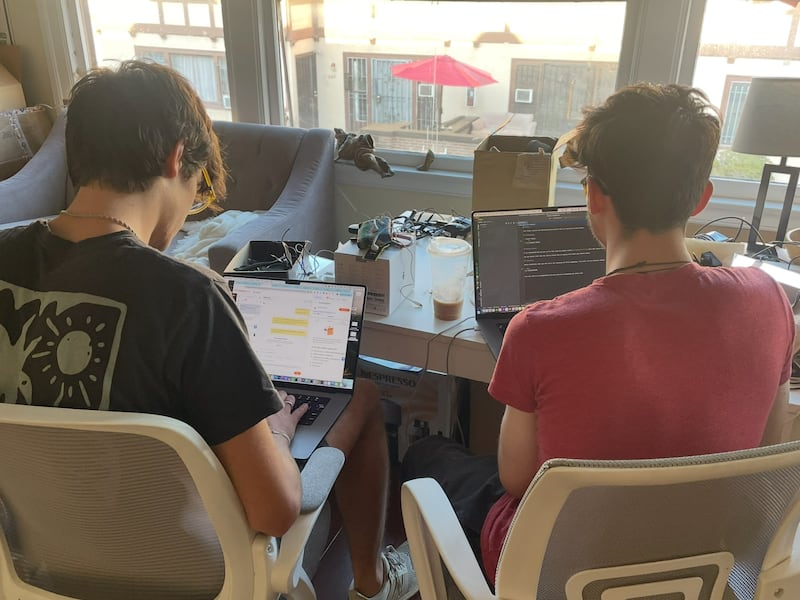
What started as a passion project built and perfected in a USC dorm room has turned into a company with funding from investors. In 2023, they won the Min Family Challenge grand prize of $50,000 at an engineering startup competition. They funneled all of that money into research and development for new versions of Sidekick.
For Fox and Warre, both of whom are founders with disabilities, involving Roy in their production process was crucial to their goal of building inclusive technology. They also heavily considered fit and style, and made sure their designs would be enjoyable for users without being too noticeable.
“I grew up using Accessibility Tech, and remember how hard it is to use something that makes you stick out,” said Fox. “We both understand what it’s like, and we’re really motivated to build something that was different, that anyone would want to wear,” said Fox.
With the fears surrounding the negative uses of AI, the Henries say this device is meant to assist people without risking their privacy. They ensure the device works on any eyewear and “doesn’t have to share any user data,” because “it’s not recording all the time,” according to Fox.
Their goal of inclusion remains at the forefront of their innovations as they start making the product more accessible to the general public.
“Part of Henry and I’s mission is to show that we can make better things if they are built with accessibility in mind.” said Fox.