
Numerous, vividly realistic oil paintings hung on the walls of the Helen Lindhurst Fine Arts Gallery inside Watt Hall, from Jan. 15 to Feb. 4, 2026.
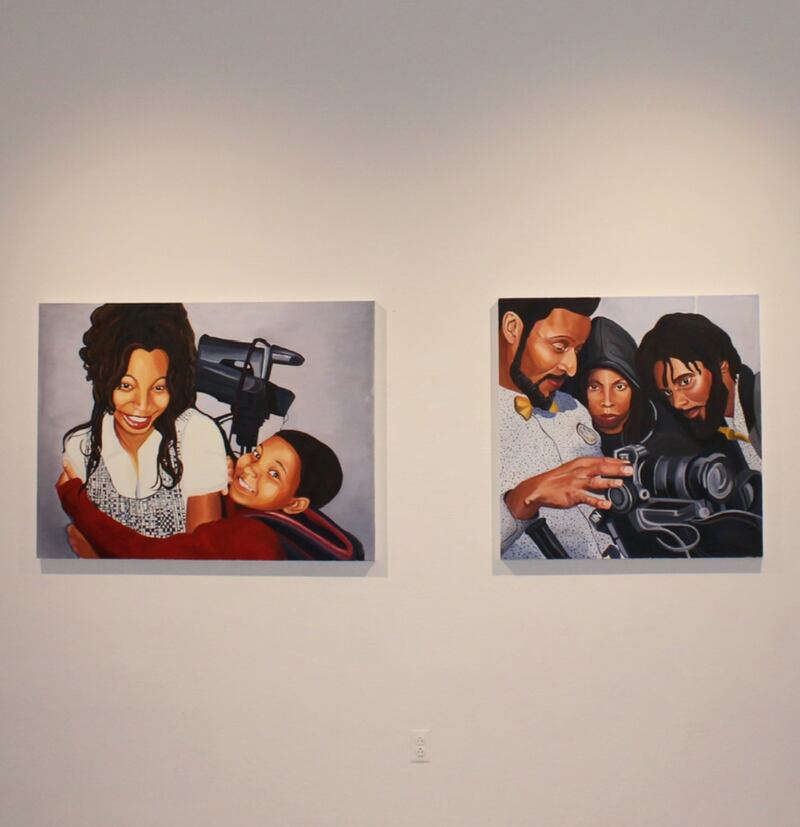
Presenting her exhibit “Unfinished Sentences,” Zoe James MacDonald, a third-year student studying fine arts at USC, paints core memories from the childhoods of formerly incarcerated individuals and their current endeavors, emphasizing that their lives extend beyond prison walls.
MacDonald explained that her role is not to speak for her subjects but to amplify their stories in an effort to dismantle the stereotypes and stigma surrounding incarceration.
“It doesn’t matter really what anyone did or how long they were incarcerated for. It just matters that they’re sitting across from me and we’re making work and telling stories,” said MacDonald.
With USC Roski’s Rebekah and Howard Farber Fund Grant, MacDonald chose to portray the stories of people who are also creatives and artists.
“I was actually really excited to be the subject of portraiture,” said Aimee Wissman, a visual artist from Ohio who served five years in the carceral system.
She said she felt butterflies in her stomach at the thought of someone else spending their own time with her images.
Coming from a time when physical photographs were the norm, Wissman and her mother sifted through shoeboxes to find childhood photos. She sent MacDonald a picture of her younger self in a Mickey Mouse sweatshirt, along with a photograph from her adulthood that paid homage to an elderly artist with whom she once shared a studio space.

“It’s nice to have someone take an interest in telling a part of your story that’s not specifically picturing you as a person inside the system,” Wissman said.
Alongside Kamisha Thomas, another portrait subject from Ohio who served seven years in the carceral system, Wissman co-founded the Returning Artists Guild (RAG) in 2018. This nonprofit organization supports the journeys of currently and formerly incarcerated individuals with art.
Wissman and Thomas were drawn to MacDonald’s approach to the topic of being portrayed outside of the carceral system.
“I just thought she had a very sincere interest in it,” said Wissman. “It didn’t feel exploitative or anything like that.”
Thomas is primarily a filmmaker, and sent MacDonald a photograph of her receiving her first video camera from her father
“I was overwhelmed with nostalgia,” said Thomas. “To see where it started, to where it kind of ended up. That was an awesome feeling. And to have someone else put their artistic creativity spin on it. I was honored.”
A 2026 study from Springer Nature, including 20 in-depth interviews with formerly incarcerated men, found that the removal from daily decision-making and creative autonomy often leads to experiencing incarceration as a period of stagnation. Scholars from this study describe the carceral system as a space of limbo, where time stretches, and life feels paused. MacDonald aims to disrupt these narratives and invite viewers to see these individuals as whole people rather than products of the carceral system.
“We were incarcerated together. We did art sh** in there. There was no way we weren’t going to keep doing art sh** out here,” said Wissman.
In many facilities, art or creative programs offer rare opportunities for expression within an otherwise rigid and controlled environment, according to a 2025 study published in the National Library of Medicine. Through drawing, music, or film, incarcerated individuals can hold onto memory while giving shape to emotions that the system rarely makes space for, the study found.
Since its founding, the RAG has hosted numerous workshops, exhibitions and community events to support artists impacted by incarceration.
“Finding opportunities for other artists and making sure that we are in community with each other is important for our healing and our growth,” Thomas said.
Another story featured in MacDonald’s exhibition is that of Jeremy Lee MacKenzie, who goes by JLee, a filmmaker from Vermont who was incarcerated as a teenager.
MacKenzie had the opportunity to visit the exhibition during its opening reception on Jan. 14. Upon entering the gallery, his portraits appeared tucked along a side wall and invited viewers to quietly peer into his childhood memories. There were four lifelike paintings of digital photos, including a scene of MacKenzie and his cousins playing with a bow and arrow.

“When I walked into Zoe’s show,” MacKenzie said, “I saw a picture of my sister painted on a wall on the other side of the room. It was just such a surprise.”
MacDonald depicts moments from her subjects’ lives before and after incarceration, and one of the childhood photographs MacKenzie shared included his sister, Julie Isabel Jenkins.
Jenkins passed away when she was just a few months old, and the portrait holds deep significance for both MacKenzie and his mother. He said it meant a great deal to finally have something tangible to remember her by.
“Oh my God, my sister has a painting now. Oh, and it’s on a wall at a gallery,” he said. MacKenzie and MacDonald have discussed the possibility of his eventually keeping the painting as a personal keepsake.

MacKenzie earned his master’s degree at the USC School of Cinematic Arts after discovering his passion for film and screenwriting, and developed his own arts practice while in the carceral system.
“I worked as a movie projectionist in there, and that was how I fell in love with film,” he said.
For many, the word “incarceration” might evoke images of mugshots and criminal records. But behind people with sentences, there is a person with a history before prison and a future that continues long after release.
“I think people forget that everyone has had a life before and will have a life after,” said MacDonald. Ultimately, she believes “Unfinished Sentences” asks viewers to look beyond criminal records and toward the ongoing lives of those who survived the system.
“That’s why I called this exhibition ‘Unfinished Sentences,” she said. “Because these aren’t sentences that are finished.”