
South Korean indie artist Kim Jimin, better known by her stage name Meaningful Stone, describes her journey to becoming a musician as one of self-discovery and evolution that has rooted in a desire to heal and connect with others. Much like a boat in a river, her path has followed the flow of her intuition and her ambition — not unaware of the societal nudges that shape the conventional, ‘safe’ path, but determined to stay true in spite of them.
Hailing from South Korea, Meaningful Stone is known for her indie rock music. She made her debut in 2017 with “꿈속의 카메라” and has since garnered millions of plays on Spotify with some of her most popular songs, such as “Beep-Boop, Beep-Boop” and “A Call From My Dream.”
Meaningful Stone described her music as “meditation, or diviner self” with a sound akin to “shoegaze.” Through her music, she attempts “to touch the human unconsciousness.”
Meaningful Stone had been involved in music from a young age. In middle school, her cohort of 8-11 students formed a band. She said the experience was formative.
“Since I was in a band, I had dreamed to be a musician,” she said, “But I kept thinking, can I be the one, like, the super cool one?”
Majoring in cello in school at age 17, she realized that classical music didn’t suit her, subsequently dropping it before studying social sciences in college. Yet, her dreams to be a musician still persisted.
“When I went to university, I realized I wanted to be a musician. [...] I tried to make demos, I don’t know, I was preparing to be a musician,” Meaningful Stone said.
At the age of 20, Meaningful Stone picked up the guitar and began making demos in her small room in Seoul. After initially uploading her music on SoundCloud and YouTube, Meaningful Stone started to amass a small following, prompting her to launch a crowdfunding campaign. This served as the initial jumping point for her journey to becoming a musician.
“[I received] almost $2 million. I had no money by the time I was like, 23, 24,” said Meaningful Stone. “I didn’t expect that [I] would be so hot because I didn’t think I could be a musician at that time.”
The crowdfunding campaign allowed her to debut her first studio album in 2020, “A Call from My Dream‚” and attend the Korean Music Awards, where she won the Rookie of the Year Award.“So after I released my album, and then I got the Rookie of the Year in [the] Korean Music Awards. And that was the beginning of my music career, because it felt [to] me, ‘Hey, you’re like a real musician,’” Meaningful Stone said.
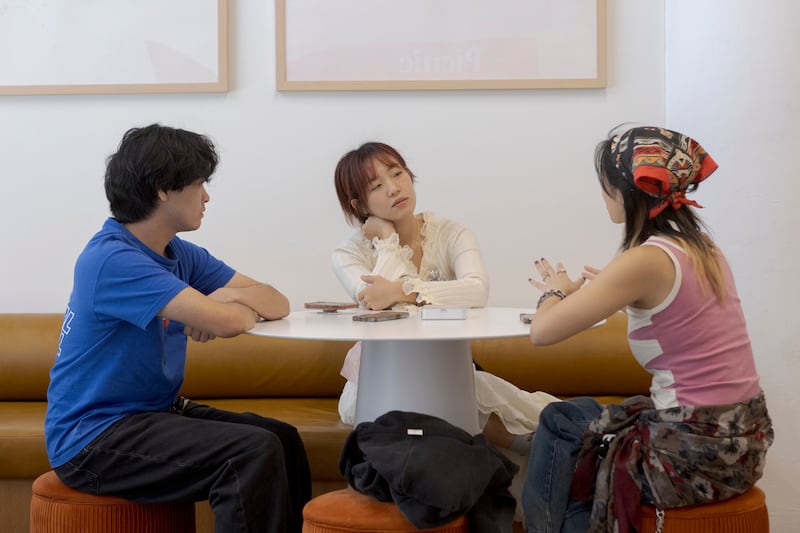
When asked about the origins behind her stage name, she explained that “Meaningful Stone” was her name.
“It’s my real Korean name, Jimin,” she said. “It means ‘meaningful stone.’ That’s why I like the meaning of my name, ‘Meaningful Stone.’ I thought it was weird because nobody uses the meaning of ji, the old Chinese character.”
“Nobody puts the meaning in their name. They always like [...] something pretty,” the artist said, “but I thought it was pretty fun and weird, so I wanted to bring my own name to my art career.”
Much like her music, Meaningful Stone was eclectic, unabashedly honest; the line between Kim Jimin and Meaningful Stone was a blurry one. “Also, I really like stones,” she added.

Having just performed for one night in Mexico City in November last year, Meaningful Stone made a stop in Los Angeles for a week before flying back to South Korea.
“I felt the fans — I was backstage — it was like they were on a rollercoaster. They were screaming and shouting, it was fun stuff. I didn’t feel like I made the concert; it felt like the fans made the experience,” Meaningful Stone said. In comparison to Korean fans, she noted that “Korean [fans] have to learn from them how to make the artist happy.”
While Meaningful Stone’s music is primarily in Korean, a few tracks from her most recent album, “Angel Interview,” featured songs sung in English, such as “Red Car.” Seoul and Mexico City are quite literally an ocean apart; with her music, she said she wanted her music to “be more connected with the people all around the world.”
“It’s like the effect from K-Pop scenes,” Meaningful Stone said. ”People try to translate Korean to their own language. I want to be more open to another language, like to make songs more in English and more, like Spanish, or Japanese, Chinese. I want to be more open with a different way. I wanted to tour and heal people when I was a kid, so I can bring all the messages through the music, and I believe that it’s all Korean, but I believe that people can feel what I say, like what I want to express through music.”

She also noted differences in fans and fan culture between the different places she had performed — the unspoken “rules” of the Korean music industry, the expectations of fans.
“I would say I’m trying not to follow the rules, of course, right? And I have to be very aware to not follow the rules, because once you get known by Korean fans, especially Korean fans, I think there’s [a] specific way that fans consume the artist,” the artist said. “You’d think, ‘Oh, I’m independent, I can do what I want.’ But then you kind of forget that you’re still influenced by what’s around.”
Meaningful Stone also mentioned the plastic surgery scene and strict beauty standards for idols and women that’s especially prevalent in South Korea. She elaborated on the struggle and effort to stay true to her own craft and music, amidst the pressure from Korean fans to keep to the same genre or “style” of music that she had previously released.
“I feel we have to be very ‘awake’ as an artist to not be a K-Pop idol, or to be more into the art, not the industry.”
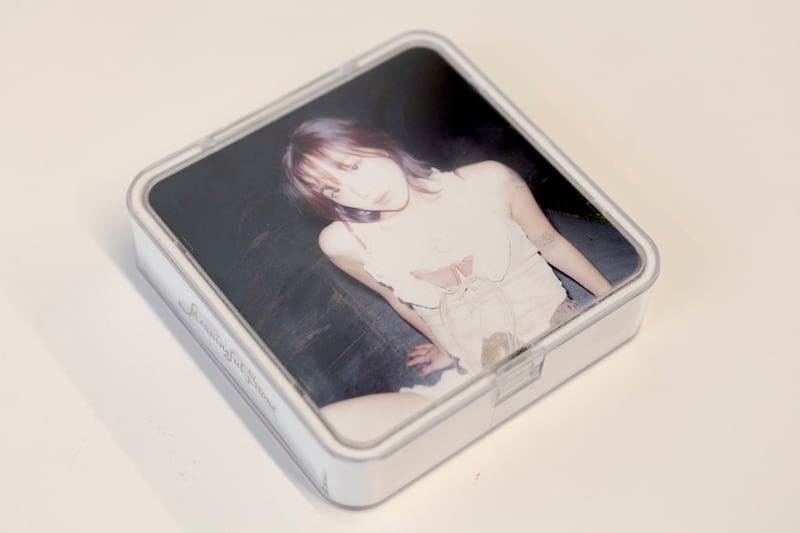
As an independent artist, particularly one who started off her career by making demos by herself, Meaningful Stone recalled not being open to collaboration as much in her early days. Being entirely self-recorded and produced, and writing her own songs, she prefers having full control over her music.
“But nowadays I keep changing,” she said, noting that she was excited to collaborate with more artists, both Korean and internationally.
“One of my biggest idols is Bjork, she’s [been] number one since I was a kid.” Meaningful Stone said. She also said she wants to collaborate with Seo Taiji and my bloody valentine, citing her love for shoegaze, which heavily influenced the sound of ‘Angel Interview.’
While Meaningful Stone currently has no shows planned for North America, she will be performing on May 30 in the second lineup for Asian Pop Festival 2026 in South Korea.
“I think it’s the best job to be a musician and play all over the world and meet fans that we could never meet [otherwise],” she said.