
A dozen “sundown towns” across Los Angeles County used to ban Black Americans from being outside after dark in the mid 1900s.
In the second half of the century, the “white flight” phenomenon led to hundreds of thousands of white residents in those former sundown towns to far-flung suburbs in L.A. County and nearby counties.
Now, decades later, some of those sundown towns that are now home to mostly Black and Latino residents are experiencing a wave of gentrification that is forcing many of them to leave as the cost of living skyrockets.
Several of those places – including Hawthorne, Inglewood and Compton – are seeing pockets of advanced gentrification and “ongoing displacement.”
An Annenberg Media analysis found that in these areas, there is a significant overlap between former sundown towns and current minority neighborhoods that are now facing gentrification and ongoing displacement.
Gentrification is the process of changing a neighborhood that includes the historic conditions and disinvestment of a neighborhood. Ongoing displacement refers to the practice of pushing long-term residents out of these communities making it difficult for them to benefit from new investments in housing, healthy food access, or transit infrastructure.
According to the Urban Displacement Project, Los Angeles County had the highest rates of gentrification, with 10% of its tracts classified as at risk of gentrification, in early or ongoing stages of gentrification, or already advanced. Another 5% of tracts were not gentrifying but experienced ongoing displacement of low-income households.
Using a neighborhood change database, Urban Displacement Project found that the number of gentrified census tracts in Los Angeles County rose by 16% between 1990 and 2015. During this time the populations of white, Hispanic and Asian communities grew as the Black population began a slight but steady decrease.
In California there are 112 possible sundown towns, according to the Sundown Town database from the History and Social Justice Program hosted by Tougaloo College. The areas are categorized as either possible, probable or confirmed. Places that are marked as “surely” sundown towns include locations such as Inglewood, Glendale, Hawthorne, Palmdale, Culver City and Compton.
The history of “sundown towns” is typically associated with the Midwest and the South; however, many also thrived in California, including Los Angeles. A “sundown town” refers to the mid-20th century practice, that either legally or unofficially, banned Black Americans from being outside after dark. The history of sundown towns expands across Los Angeles County and lies within current minority communities.
67-year old Sherman McGowan remembers the stories his family would tell of sundown towns in Los Angeles.
“The intellectual understanding of a sundown town was probably in my late teens, but the emotional awareness is before that,” McGowan said. The self-proclaimed L.A. historian grew up in the Crenshaw District Area but credits his knowledge to personal research and living in metro areas of the county, particularly Culver City.
“In the 40s and 50s Black people if they were in a sundown town after six o’clock literally had to have permission from their employer. If they did have permission to be in town at night then they’d be arrested, you know, or worse.”
Stephen A. Berrey is an adjunct professor and historian that oversees the Sundown Town database and worked closely with its creator sociologist James W. Lowen. Compiled from historical documents, census information and personal accounts, Lowen crafted the only national database of sundown towns across the country.
“James Lowen started this work and one of his goals was for people to reach out when they had questions and he wanted people to know more about this history,” Berrey said. “It’s not only about African Americans, although that is a big part of the history. It’s not a coincidence that a lot of these areas were emerging when Jim Crow segregation practices were emerging, especially in the South, but also with Chinese exclusion and attempts to drive out Chinese populations throughout the West.”
While most times the racism and discrimination was targeted at Black people, other minority groups were often targeted as the Los Angeles population began to grow and racial demographics changed from the 1930s to 1970s according to the U.S. Census Bureau.
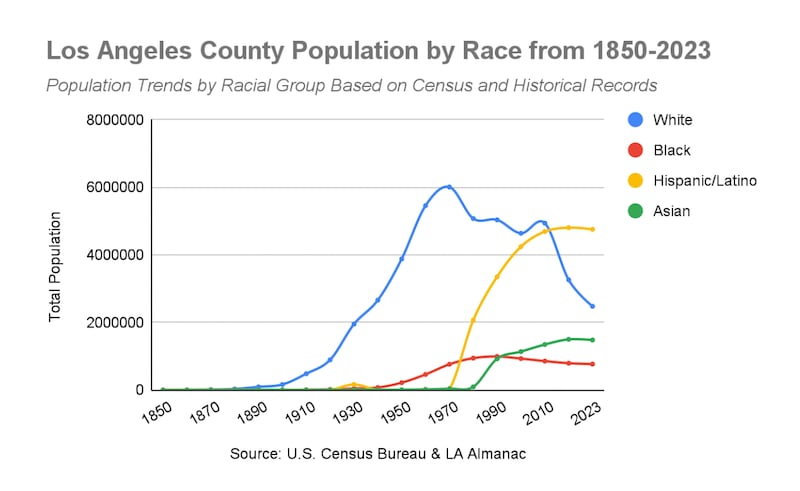
In the 1970s, Los Angeles’ white population began to decline, also what is known as “white flight” as a result, many of these areas began to be populated by minority communities.
As the population shifted, so did the socioeconomic standing of these communities and now they face a new problem; gentrification and displacement.
“I think in the late 90s and the 2000s, I think they had a revelation. The revelation was especially for new homeowners, particularly white ones,” said McGowen who made a career as a mortgage lender and owner of a luxury transport service.
These areas used to be Sundown towns, and its effects may linger in these areas as discrimination and police brutality McGowen says.
“I think that Sunday sundown towns have, especially in the 60s,70s and 80s, really left an emotional impact on black people, especially youngsters, ‘cause we really felt restricted about where we could go. We really was not comfortable leaving beyond our immediate residential area and that’s a little bit limiting,” McGowen said.
Berrey also shares this viewpoint, highlighting that there is research that shows the long term effects of these events. “I know there are people doing studies of impacts on public health, on policing, on racial attitudes, even things like life expectancy and sort of measuring by focusing on places that we know were sundown towns, that even if they’re no longer a sundown town,” Berrey said. “It still has an impact on the present.”
Yet things rarely stay the same, and as demographics, populations and cultures change so does history as the City of Glendale passed a sundown town resolution in 2020, becoming the first metropolitan area in Los Angeles County to do so.
Methodology
The general methodology includes sourcing information from the Sundown Town Map, which lists all confirmed, possible and probable sundown towns across America, compiled by sociologist James W. Loewen. Loewen is also the author of the book Sundown Towns: A Hidden Dimension of American Racism.
Data was sourced from the U.S. Census Bureau from 1850-2023 to create a timeline of population change by ethnicity. Data was also sourced from The Urban Displacement Project head researcher, Julia Greenberg, information was gathered by assessing different factors like income, ethnicity and homeownership to determine the stages of gentrification and displacement in Los Angeles County.
Using the Sundown Town Map, and Urban Displacement Project GEOID information, I created a google map to recreate the areas of former sundown towns and added the layer of current gentrification and displacement to determine overlap between the two.