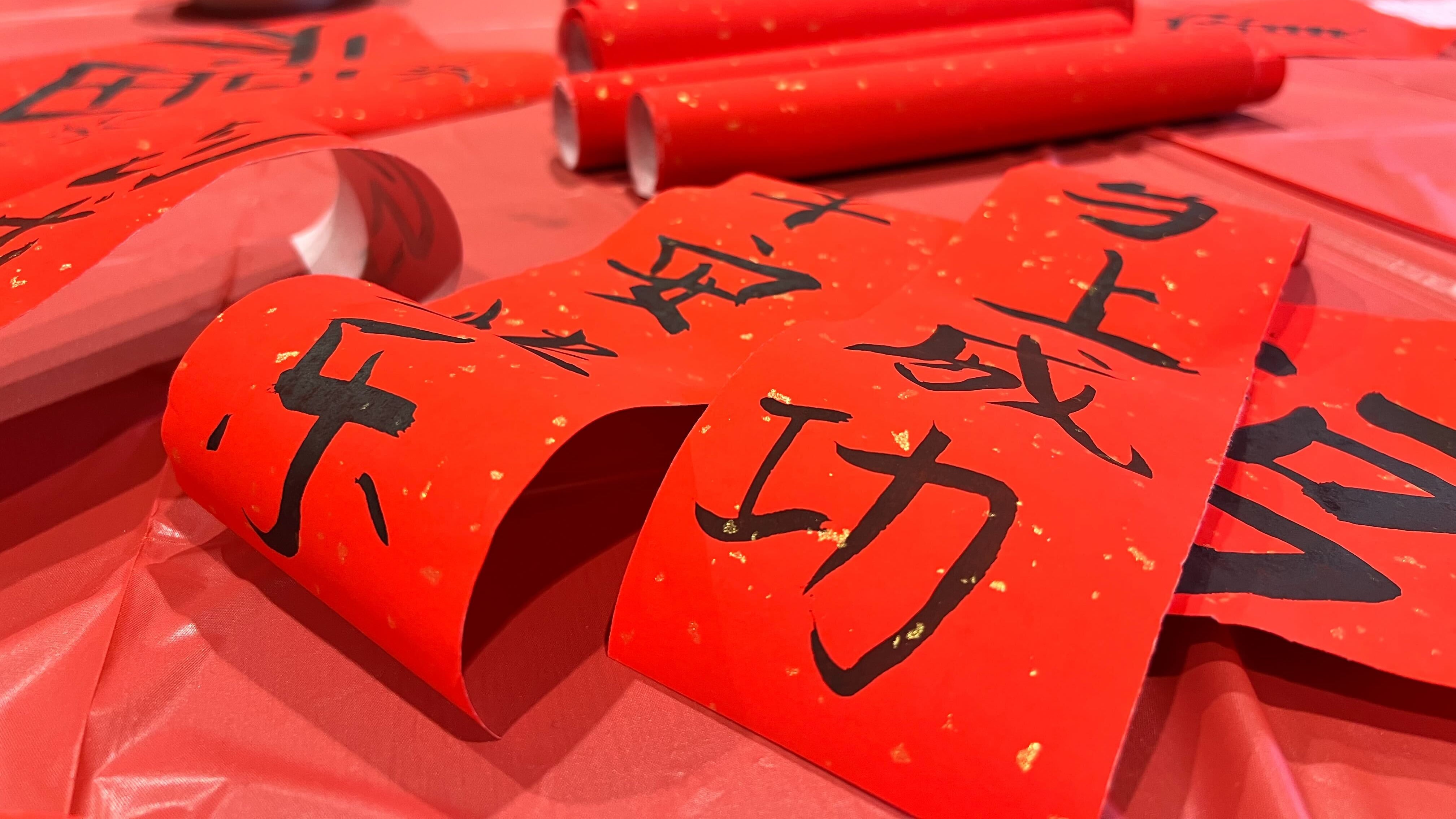
Trojans had a lot to celebrate on Tuesday. Students gathered for Mardi Gras, the Lunar New Year and Ramadan, sharing a renewed sense of community.
Mardi Gras festivities kicked off this Tuesday, Feb. 17 in New Orleans. Riley Gilbert, a Business of Cinematic Arts major, visited her friend at Tulane University to join in on the celebrations.
“I’d say the parades are super fun,” Gilbert said. “Everyone’s throwing beads, and you’re trying to catch them, and everyone’s so lively and in fun outfits and in the best mood possible.”
Mardi Gras, which is French for “Fat Tuesday,” is a Catholic holiday celebrated before Ash Wednesday. It’s a final burst of partying, indulging in rich foods and pleasures, before the start of lent, a time for penance and reflection. Each year, hundreds of thousands of people flood the streets of New Orleans dressed up in masks, feasting and parading.
USC Annenberg Career Development and the U.S. China Institute hosted a Lunar New Year celebration on Tuesday afternoon. Faculty, students and staff gathered to celebrate the new year together with activities like a Lunar New Year bingo and food.
”It’s a super awesome event, because I’m from China, so celebrating this new year is our cultural tradition,” said Katherine Shi, an Annenberg alumni and program specialist at the U.S. China Institute.
The Lunar New Year is determined by the Lunisolar calendar, which tracks both the phases of the moon and position of the sun. The new year begins on the new moon closest to the midpoint between the winter solstice and spring equinox.
For Shi, the celebration represents more than a festivity, it’s about belonging. ”That’s always the best part…a lot of international students feel at home during this time,” Shi said.
Vicki Higgins, a program manager at the U.S.-China Institute, said that Lunar New Year is meant to be about community.
”It’s just really important for us, for people to get together,” Higgins said. “This is a family holiday, so a lot of people, a lot of students, are away from their families right now, and we wanted a place so you can hang out, so you can do activities.”
Higgins added that the event isn’t exclusive and is open to anyone curious about the holiday.
“An important part to me, for the celebration, is to have that opportunity to come and be curious and say, ‘What is it,’” she said.
That same curiosity also resonated with Isabelle Wright, an Annenberg career coach and strategist.
“I think it’s important for people who don’t even necessarily celebrate this to have that sense of exposure,” Wright said. “I’m really happy that Annenberg has put a focus on [it].”
Wright saw the confluence of holidays as a great opportunity to recognize unity amongst communities.
“Purely coincidental…but I think it’s just another way to celebrate, to bring everybody together and just build that community we’re so fond of,” Wright said.
As the sun went down on Tuesday, the first night of Ramadan began. Students gathered at the University Religious Center (URC) to commemorate the start of a period of fasting, prayer, charity and reflection.
For Arsalan Saeed, a senior and strategic engagement and initiatives director at the Muslim Student Union (MSU), having a space at the URC to gather during Ramadan builds a strong sense of community throughout the fast.
“The way the URC supports Muslim students is that we have a prayer space and a lounge space,” Saeed said. “Students can come pray together, break their fast together and, most importantly, build community together.”
That sense of community is especially important for college students who are often away from their families during the holy month.
“We’re all college students. We’re away from our families most of the time,” Saeed said. “It’s amazing to have such a tight-knit community in one particular location.”
“You have a group here that can say, ‘We’re all fasting, but we’re all in this together,’ it makes a big difference,” he said.
Saeed says Ramadan frequently overlaps with other holidays. In a couple of years, Christmas and Ramadan will be on the same day.
Ramadan begins 10 to 12 days earlier each year. This is due to it following the Islamic calendar, based on the lunar Hjari calendar. The ninth month on the calendar is observed by Muslims worldwide as a period of fasting, communal prayer, reflecting and finding community through the shared experience.
The holiday overlap was a reminder of how interconnected campus communities can be.
“It’s incredible to be able to celebrate events like Lunar New Year, Mardi Gras and Ramadan all at the same time,” Saeed said. “It’s a great way to have multiple communities celebrate their individual traditions, but also come together to appreciate how nice it is to have community.”
Saeed reflected on his time with MSU and encourages students, regardless of faith, to find community on campus.
“While MSU is something for Muslims, it’s not just for Muslims,” he said. “Anyone is invited. I encourage everyone to join a community that aligns with who they want to be.”