
Classical pianist Yuja Wang returned to perform with the Los Angeles Philharmonic on Feb. 7 at Walt Disney Concert Hall as part of a three-performance run in Los Angeles, presenting a program that moved between contemporary and classical works.
Born in Beijing in 1987, Wang has built an international career that places her among today’s leading pianists. Recognized for her bold interpretive style and technical command, she won a Grammy Award in 2024 and received another nomination in 2025, affirming her standing on the global classical stage.
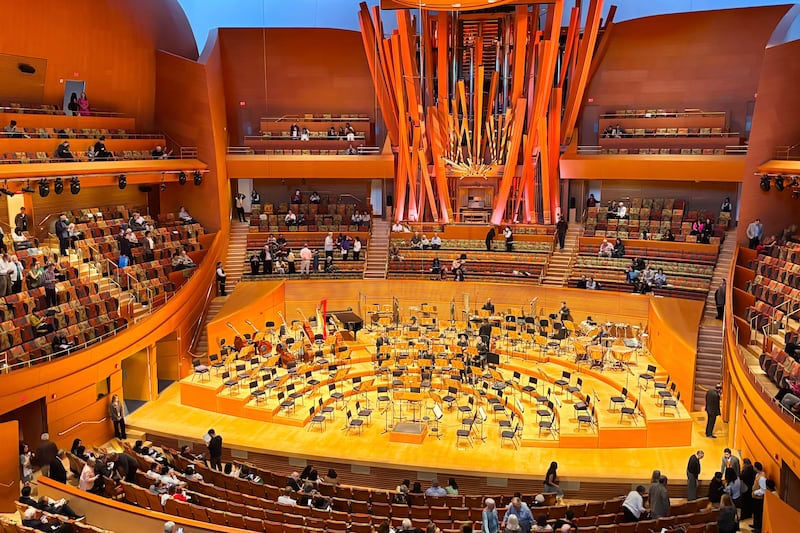
The Los Angeles engagement underscored not only Wang’s musicianship but also the self-defined stage presence that has shaped her international career. Over the years, her stylistic choices and performance persona have drawn attention beyond the score, positioning her as one of today’s most distinctive classical pianists. That presence announced itself before the first notes were heard.
When Wang walked onto the stage in a teal sequined dress and high heels, the hall buzzed with anticipation. Her short hair caught the stage lights as she took her seat at the piano and began.
Some critics have questioned her choice of attire, suggesting it departs from classical norms. In a 2017 interview with The Guardian, Wang addressed those critiques directly, saying, “If the music is beautiful and sensual, why not dress to fit?” She added that for her, it is “about power and persuasion.”
The program, conducted by Thomas Adès, opened with William Marsey’s “Man with Limp Wrist,” followed by Prokofiev’s “Piano Concerto No. 2,” Tchaikovsky’s “Francesca da Rimini” and concluded with Adès’ “Aquifer.” The repertoire shifted between tension and sweeping drama, maintaining a heightened sense of energy throughout the afternoon.
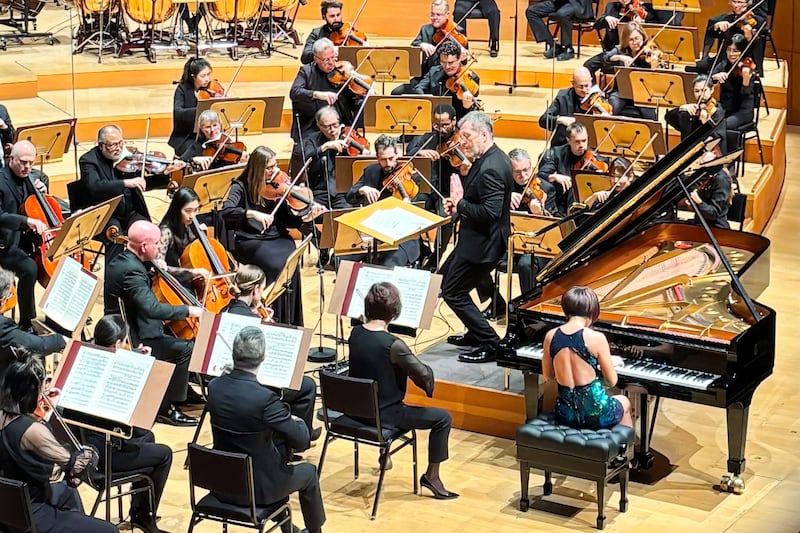
In Prokofiev’s concerto, Wang played with visible intensity and control. Rapid passages unfolded with clarity, her hands moving swiftly across the keyboard. At several moments, her energy appeared to propel the orchestra forward, reinforcing the dramatic force of the piece.
Under the stage lights, the vivid teal of her dress became part of that momentum, echoing the force and precision of her playing. Questions about her attire felt secondary to the authority she commanded from the keyboard.
Audience members responded to that presence. Audience member Elizabeth Blilie said the concert was “more intense than meditative,” calling the piano playing “very technical and very talented.” While noting that it differed from the more lyrical repertoire she typically prefers, she described the performance as “extremely powerful and impressive.”
Another audience member, Mason Huebler, summarized it in one word: “firing.” Cheers of “Bravo” echoed from the balconies as the applause stretched on.

For one of the encores, Wang returned to the piano with Adès to perform Eric Satie’s playful “Trois morceaux en forme de poire” with four hands. The piece offered a lighter contrast to the earlier intensity. Seated side by side, the two moved in quiet coordination, their phrasing fluid and relaxed, briefly shifting the mood from forceful to playful.
As the hall rose once more to its feet, Wang gave her signature forward-leaning bow before leaving the stage. Following her Los Angeles appearances, her 2026 season will continue with performances across the United States and Europe.