
Ben Wolf, 45, of Los Angeles, spends his nights shuttling USC students around campus in the free Lyft zone.
At each red light, he opens the PrizePicks app on his phone to track the progress of his latest multi-leg NBA player prop parlay. That’s betting talk.
“Goddamn it,” he said, staring at a 5-leg parlay that had just fallen apart.
Since a landmark 2018 Supreme Court decision, the sports gambling industry has exploded across the United States.
The Court’s ruling in Murphy v. NCAA gave states the power to legalize sports betting. At least 40 states, plus the District of Columbia and Puerto Rico, now allow some form of commercial sports betting. California and Texas still do not.

But the legalization of sports betting in certain states also opened the door for online platforms like DraftKings and FanDuel.
In October 2025, the Pew Research Center reported that 1 in 10 U.S. adults has placed an online sports bet in the past year – a 6% increase since 2022.
“The friction has been reduced,” said Wayne Taylor, a professor of marketing at Southern Methodist University. “You can just pull out your phone and start betting, whereas in the past you had to drive to a casino or a sports book.”
Taylor, along with Daniel McCarthy of the University of Maryland and Kenneth C. Wilbur of UC San Diego, found that average online gambling spending has risen 369% since legalization.
Taylor said one reason for the surge is constant advertising by major sportsbooks.

Another driver is the rise of micro-bets, particularly player prop bets.
Player props are often wagers on an individual athlete’s performance, such as how many points, yards or hits they will have in a game. A prop bet, however, can be on anything: for instance, whether the second half kickoff goes into the end zone.
A parlay combines two or more bets – called ‘legs’ – into one. Each leg must hit for the bet to
win. Under a parlay, a small stake could pay out big.
“It’s a way for people to stay entertained,” Taylor said. “Rather than one big dopamine hit at the end of the game, you’re getting these hits throughout the whole game. That’s a recipe for addictive behavior.”
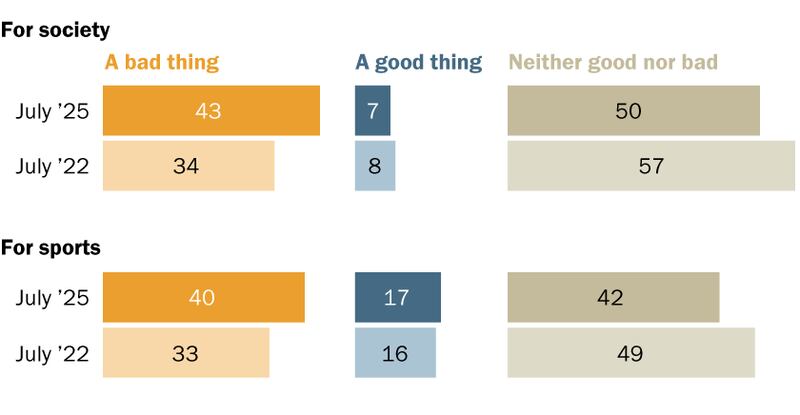
While legal sports betting continues to expand, public concern is growing. According to the same Pew study, 43% of U.S. adults say legal sports betting is bad for society, up 34% from 2022.
Asked if it is bad for sports, 40% of adults say yes, up from 33%.
Mark Nichols, a professor of economics at the University of Nevada, Reno, called the current state of U.S. sports betting “rushed.” In the same vein, McCarthy called it the “wild, wild West.”
The key concerns surrounding online sports gambling include behavioral and financial consequences for bettors and the growing threat to the integrity of the game amid recent scandals.
“Online sports betting is resulting in people decreasing their savings and investment opportunities and also increasing their credit card debt,” Nichols said.
In October, Miami Heat guard Terry Rozier, Portland Trail Blazers coach Chauncey Billups and former NBA player Damon Jones were indicted in a federal gambling case. Prosecutors allege a group of insiders, bookies and mafia affiliates used private player data to wager on prop bets.
In November, Cleveland Guardians pitchers Emmanuel Clase and Luis Ortiz were indicted on charges of taking bribes to rig specific pitches to exploit prop bets. Following the scandal, MLB and major sportsbooks announced a $200 cap on pitch-level micro-bets and banned them from parlays.
Although sports betting is not legal in California, many residents still place bets through rebranded daily fantasy sports (DFS) apps like PrizePicks or Underdog, or utilize offshore betting sites.

Paul Choi, 57, of Santa Clara, California, said his friends introduced him to BetAnything, an offshore sportsbook in the United Kingdom. Since opening an account several years ago, Choi said he has bet almost every week, mostly on NFL games.
“It makes the games more exciting when you’ve got money on the line,” Choi said.
Jason Yang, 43, of nearby San Jose, California, placed his first sports bet on a trip to Las Vegas after turning 21.
“It’s exciting,” he said. “It makes watching the games more exciting, and you get an adrenaline rush.”
After Vegas, Yang continued betting through a friend who ran an illegal bookmaking operation.
“One of the best feelings was elation, like when you win on a slot machine,” he said. “The tough beats were gut-wrenching, frustrating, depressing, all those things.”
Hughie Choe, 45, of Mountain View, California, regularly places bets ranging from $100 to $1000. He believes California should legalize sports betting.
“I don’t think it’s fair for certain states to have it and other states not to,” he said. “It’s clearly more political than anything else, which is really not fair.”
Zackary Homrich, 20, of San Jose, California, a sophomore computer engineering student at Purdue University, made his first bets in high school on an app called Fliff that offers free daily credits so users can play without putting ‘skin in the game.’
“I could spend 20 bucks to go bowling with my buddies on a Friday night, or I could put 10 bucks on the game and make it interesting,” he said. “It makes it more fun when you have something specific to root for.”
As for Wolf, the 45-year-old Lyft driver, he knows he’s unlikely to “hit it big,” but still places a few parlays each day. Even during his current losing streak, he fires off betting slips hoping the next one pays off.
“I know I’m donating at this point,” he said. “One day it will hit.”