
From immigration raids to Bad Bunny, headlines continue to surface about large and diverse Latine communities. Yet, Latine reporters and Latine-focused coverage are underrepresented across news outlets, according to the National Association of Hispanic Journalists.
Many existing publications, such as De Los of the Los Angeles Times, L.A. Taco, and Boyle Heights Beat, have set the standard for strong, ethical reporting on the Latine community and have already drawn in large audiences.
However, there remains a need for increased coverage of Latines in journalism and more leadership positions in newsrooms held by Latines to ensure that coverage of Latine communities is as authentic as possible.
“Because of a lack of diversity, equity, and inclusion, and a lack of representation of Hispanic Latinos in newsrooms, especially in leadership roles, there’s often a one-dimensional narrative of the Hispanic Latino community,” Hugo Balta said, publisher of the Latino News Network.
The recent anti-diversity and DEI campaigns leveraged by President Trump have also impacted how media and storytelling companies have recently approached DEI programs and initiatives.
Amazon Studios and Disney are a few major media companies that have reversed division-wide policies aimed at promoting diversity among employees, according to The Hollywood Reporter.
There has to be a shift in how Latinos are included in newsrooms and media outlets so that the stories about Latinos are a reflection of the diversity of the communities within the Latine demographic.
Limited newsroom representation
A major reason for the growing need for coverage of the Latine community is the low number of Latines working in newsrooms and producing journalism. According to a June 2025 report by the UCLA Latino Policy & Politics Institute, only 2% of daily newspaper articles mentioned Latines, despite Latines comprising 19% of the population across the United States.
“It’s really important for news outlets to have Latinos on staff,” Martina Ibańez-Baldor said, design director of De Los. “You can’t tell Latino stories without Latinos telling those stories.”

Newsrooms should also allocate more resources to Latine journalism and work to involve the community in reshaping the scope of coverage catered to Latine communities.
“If the Los Angeles Timeswants to do something with the community, they need to provide resources, provide training to community members on how to report...that is how we get our stories told,” Crystal Villareal said, a freelance journalist and former assistant editor at De Los.
Rising demand for bilingual journalism
The need for more coverage of Latine communities has also risen due to the demand for bilingual news among younger and older generations. A 2025 study by the Pew Research Center examined how Latines receive their news and found that U.S.-born Latines prefer English-language news while immigrant Latines prefer Spanish-language news.
Along with ongoing stories about the Latine community, there is also a growing need for bilingual journalism that caters to both Latine audiences who prefer English and those who choose Spanish.
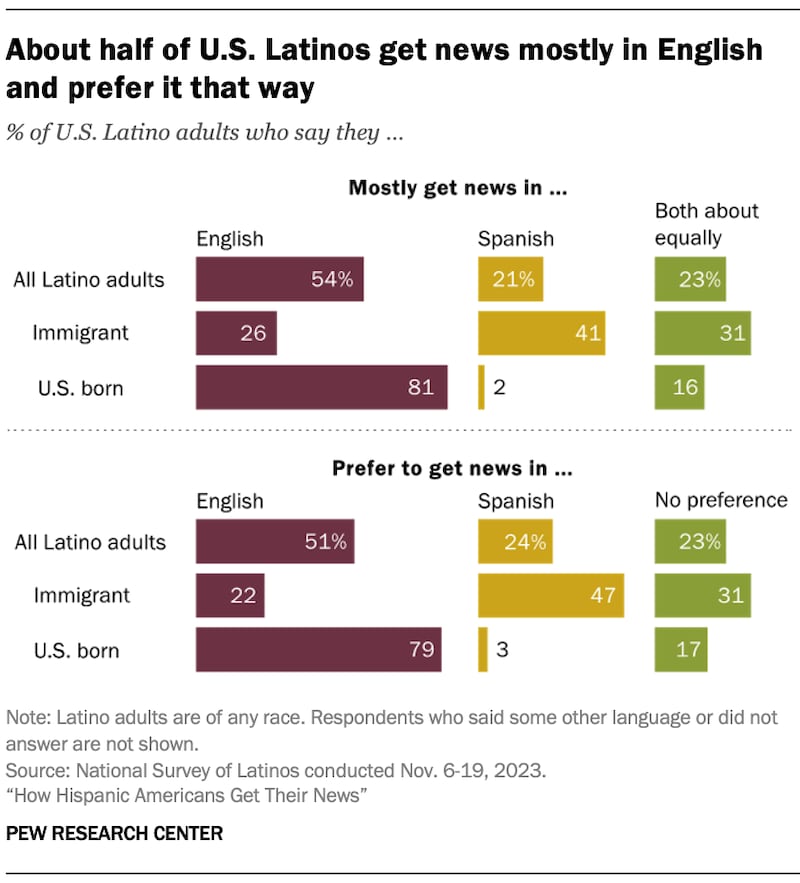
With younger, U.S.-born Latines seeking out English-language reporting, news outlets need to have coverage representative of Latine communities in both languages to cater to the younger and older demographics.
“The importance of news outlets focusing on Hispanic Latinos is multi-pronged. It starts with representation in newsrooms and how that has an effect on representation in coverage for it to be as dynamic as that community,” Balta said. “There’s also a language need with an emphasis in English because there is a nuance in how you engage with those communities in telling their stories.”
A new era for digital age journalism
Social media has played a significant role in the demand for more journalists and news outlets to cover the Latine community. With more youth seeking their news online and on social media, news outlets have to prioritize utilizing social platforms to further the reach of their reporting.
“Visuals are sometimes overlooked in journalism, but they’re really important, especially in a day where the younger generations are very visual, and aesthetics are really important to get people’s attention into reading our stories,” Ibańez-Baldor said.
Data from the Pew Research Center connects to how publications like De Los are working to reach their audiences.
Latines prefer to use digital devices over other platforms, with 87% saying they receive their news through online devices, the study reported.
“Instagram is probably the biggest way that we get our stories out there, and we try to be really engaging on the platform,” Ibáñez-Baldor said. “Instagram is a really good way of making the relationship with the reader a two-way street. We want to be talking with them and engaging in the conversation.”
Similar to having more Latine journalists in leadership roles, having Latine creators on social media teams will also improve the authenticity of their coverage.
“It’s important that all of our designs are designed by Latinos; we’ve done a lot of research to make sure it’s not stereotypical, cheesy Latino designs that corporations might traditionally lean into,” Ibáñez-Baldor said.
How to cover our communities
Beyond bringing more Latines into newsrooms, news outlets can continue working to accurately and authentically cover Latine communities.
“We need to listen to these communities and reach out and go to the places where they are. We can’t expect that everyone is online or on social media or will come to us with stories and concerns. We have to go to them,” Jessica Perez said, the senior editor of Boyle Heights Beat.
Perez also emphasized the importance of building trust among the Latine communities that outlets aim to cover. For outlets that have weak pasts of trust with certain communities, Ibañez-Baldor suggests making an intentional effort to rebuild those relationships.
“It’s especially important, like at the LA Times, which has a history of vilifying Latino communities, to try and rebuild that trust. De Los has been a really big part of that effort,” Ibañez-Baldor said. “That’s also a reason why De Los is in front of the paywall. We don’t ask people to pay for our content because how can we ask people to pay for our content when we’re trying to rebuild that trust?”
What’s next?
The demand for coverage and ways to receive news is more of an opportunity than a problem. Print, television, and digital media companies have the audience to produce content for, but the main issue is having a few journalists and reporters who are Latine.
To address this, news outlets should prioritize bringing more Latines into the newsroom and engaging directly with the Latine communities they cover through social media, bilingual journalism, and in-person engagement to establish trust among their audience.
