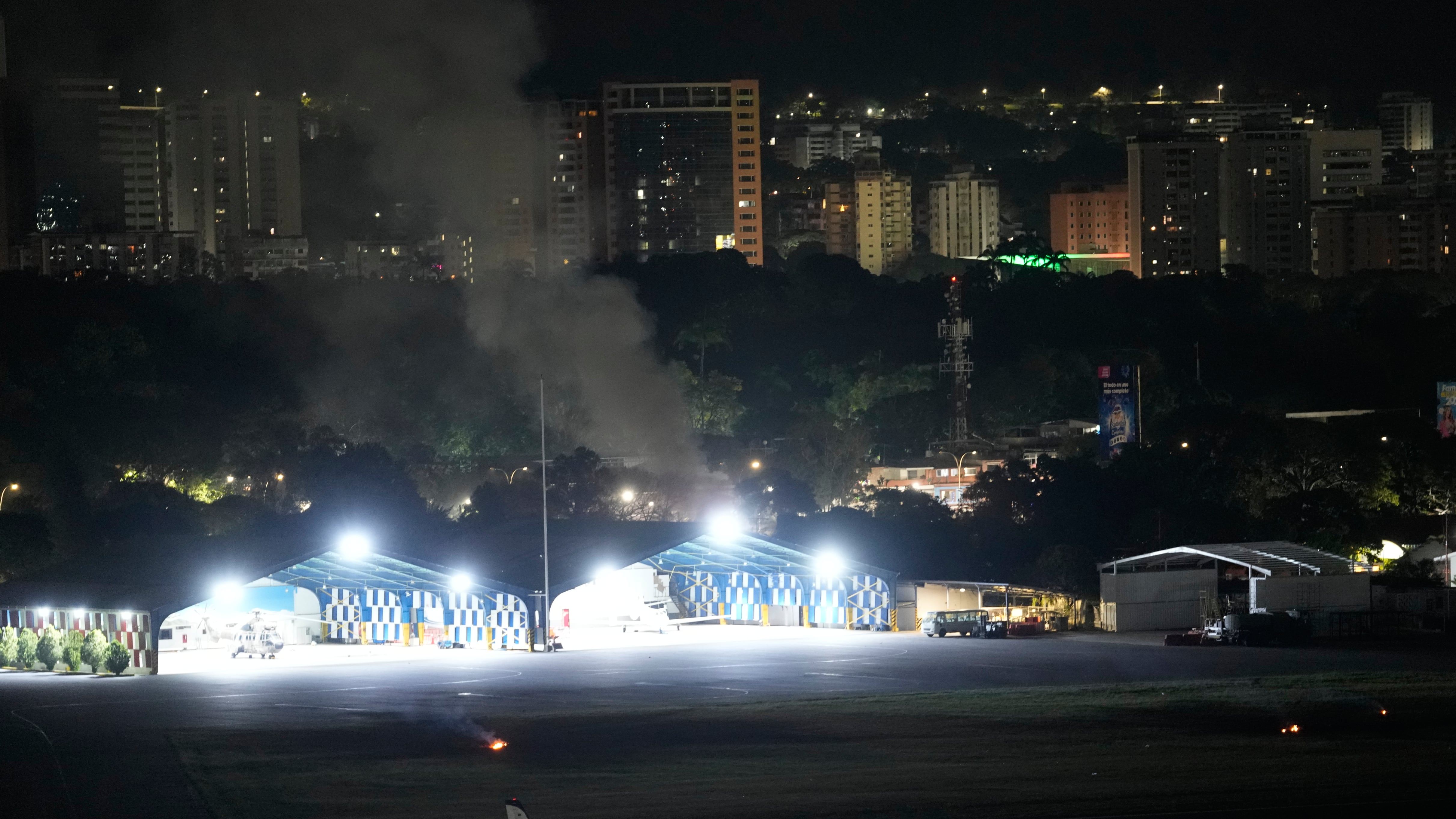
The United States launched a series of strikes in Venezuela’s capital and seized Venezuelan President Nicolás Maduro in what President Trump called a “spectacular assault” early Saturday morning.
Explosions and low-flying aircraft were reported over Caracas beginning around 2:00 a.m. local time. The assault involved at least seven blasts and lasted less than 30 minutes, according to the Associated Press. The strikes left civilians and Venezuelan military personnel dead, said Venezuelan Vice President Delcy Rodríguez, who did not specify how many were killed.
Trump announced on Truth Social shortly after 4:30 a.m. ET that Maduro and his wife were taken into custody at their residence in an operation conducted alongside U.S. law enforcement. Maduro was then flown by helicopter to a U.S. warship and is expected to be transported to New York, where both he and his wife were indicted on narco-terrorism charges.
Speaking at a news conference Saturday morning from his Mar-a-Lago resort in Palm Beach, Florida, Trump described the action as “an assault like people have not seen since World War II.”
“It was dark. It was deadly,” he said, adding that Venezuelan forces were “completely overwhelmed and very quickly incapacitated.” Trump said no American service members were killed in the operation.
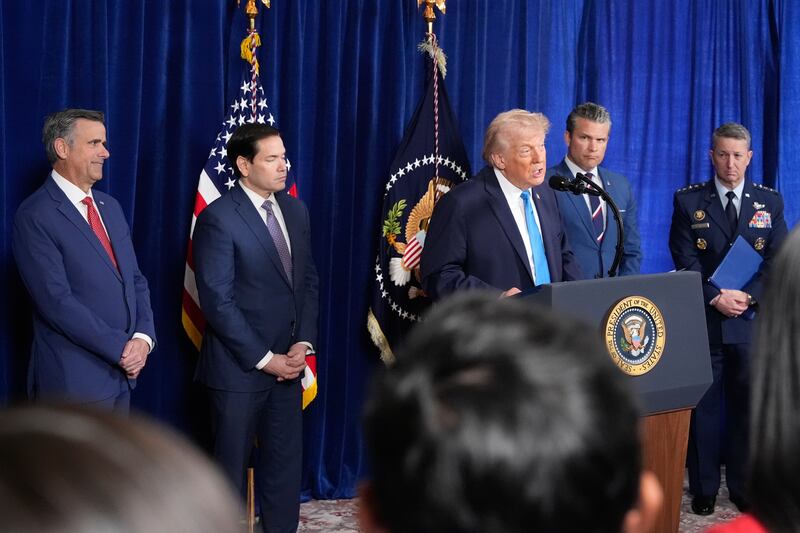
Chairman of the Joint Chiefs of Staff Gen. Dan Caine said the U.S. military spent months studying Maduro’s movements and routines, including where he lived, traveled and how he operated day to day. Late Friday, helicopters carrying an extraction force crossed into Venezuela. The force reached Maduro’s residence within the Fort Tiuna military compound around 1:00 a.m., where Maduro and his wife surrendered and were taken into custody by U.S. authorities, Caine said.
Trump later posted a photo on Truth Social that he said showed Maduro in U.S. custody aboard the USS Iwo Jima. Maduro is expected to be arraigned in federal court in New York’s Southern District next week.
The military operation follows months of efforts to disrupt alleged drug smuggling on Venezuelan vessels bound for the United States, which Trump has repeatedly linked to the Maduro government. Since early September, the strikes have killed at least 107 people across over 30 attacks, according to figures shared by the Trump administration.
At the Mar-a-Lago briefing following the operation, Defense Secretary Pete Hegseth reiterated that Trump is “deadly serious” about ending gang activity and stopping drug trafficking.
“Nicolás Maduro had his chance, just like Iran had their chance until they didn’t, and until he didn’t,” Hegseth said. “He effed around and he found out.”

Earlier this week, Trump told reporters that the U.S. carried out a “major explosion” at a docking area allegedly used to “load up” drugs, marking the first direct action on Venezuelan soil. The U.S. military also struck a vessel in the eastern Pacific on Monday, killing two people. The next day, three more boats accused of drug smuggling were targeted, killing at least three. On Wednesday, two additional vessels were attacked, leaving five more dead.
In an interview with state media aired on New Year’s Day, Maduro claimed that Venezuela was open to negotiating with the U.S. on ways to curb drug trafficking but declined to comment on the dock strike earlier in the week. The president maintained that the U.S. is attempting to force a regime change in Venezuela and secure access to the country’s rich oil reserves, citing the pressure campaign that began with a major military buildup in the Caribbean in late August.
Following the early-morning operation, Trump told reporters at Mar-a-Lago that the U.S. is “going to run the country” until “a safe, proper and judicious transition” can occur, noting that Vice President Delcy Rodríguez has been sworn in as president.
Trump also announced plans for U.S. oil companies to invest billions in Venezuela, creating a new “partnership” that will “start making money for the country,” revive the nation’s oil industry and make the people “rich, independent and safe.”
However, Maduro’s backers quickly voiced their opposition to the U.S.’ actions. The Venezuelan government condemned the operation as an “imperialist attack.” In Caracas, supporters of Maduro staged protests, including a march led by Mayor Carmen Meléndez, who referred to the raid as Maduro’s “kidnapping.” Demonstrators chanted slogans such as “We want Maduro!” and “Maduro, hold on, the people are rising up!”
At the same time, some Maduro critics welcomed the operation. Venezuelan opposition leader and 2025 Nobel Peace Prize winner María Corina Machado praised the U.S. strikes and Maduro’s capture, posting on X Saturday morning, “The time for freedom has come!” Venezuelans living abroad in countries including Peru and Chile also celebrated in the streets, waving national flags and carrying signs that read “Free Venezuela.”

Meanwhile, many across the international community have raised concerns over the legality of the U.S.’ actions, noting that international law — including the U.N. Charter — bars states from using force against another country without provocation.
“All Members shall refrain in their international relations from the threat or use of force against the territorial integrity or political independence of any state, or in any other manner inconsistent with the Purposes of the United Nations,” the U.N. Charter reads.
Ben Saul, the U.N.’s special rapporteur on human rights and counterterrorism, criticized what he described as the administration’s “illegal aggression against Venezuela” and the “illegal abduction” of Maduro.
“Every Venezuelan life lost is a violation of the right to life. President Trump should be impeached & investigated for the alleged killings,” Saul wrote on X.
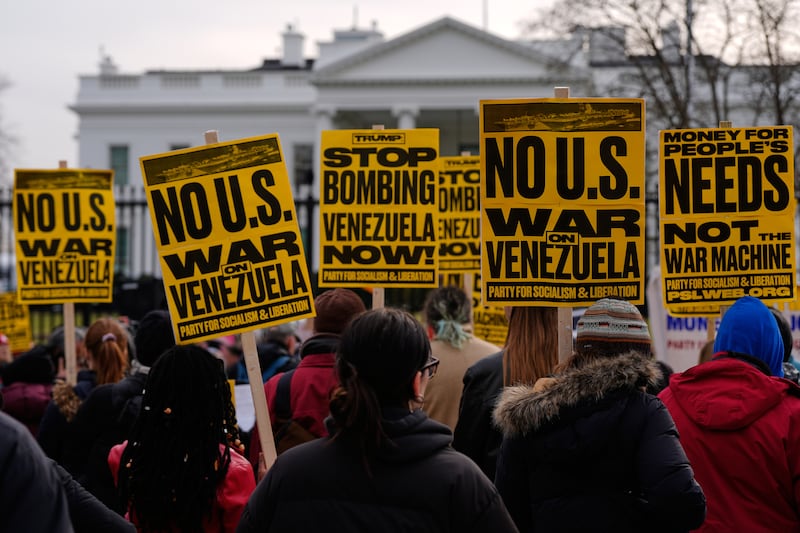
Protests against U.S. intervention have erupted across the country and around the world. Outside the White House, demonstrators carried signs reading “No U.S. War on Venezuela” and “U.S. Out of the Caribbean,” while additional anti-war rallies were planned in cities nationwide throughout the weekend.
Despite the backlash, Trump said the U.S. is prepared to carry out a second and “much larger” attack if necessary.
“The first attack was so successful we probably don’t have to do a second, but we’re prepared to do a second wave,” the president said.
Standing alongside the president, Secretary of State Marco Rubio described Trump as a “president of action,” warning world leaders not to “play games with this president’s office.”
“It’s not going to turn out well,” Rubio said. “I hope that lesson was learned last night, and we hope it will be instructive moving forward.”
This is a developing story.