
Pakistani singer Atif Aslam performed at Hollywood’s Dolby Theatre on September 28, as a part of his Borderless Tour. The organizers announced that it was the first time that a South Asian artist had sold out the highly sought-after venue. The theatre is in demand due to its location on Hollywood Boulevard and its iconic status as the permanent home of the Oscars. The theatre was indeed packed and everyone kept screaming, “Atif, Atif!” in unison throughout various phases of the concert. People even gathered in front of the stage and tried to talk to him during the performance.
Aslam initially began his career with the pop-rock band Jal in the early 2000s, before going solo and finding commercial success. His voice obviously made a mark in his native country Pakistan, as well as in the Indian Bollywood industry and all over South Asia, mostly where Urdu, Hindi and Punjabi languages are spoken. The Bollywood industry is a gigantic business even globally, hence making a mark there ensured his fame across the whole subcontinent.
The audience at the Dolby theatre that night included people with roots from Pakistan, India, Bangladesh, Nepal, Afghanistan and Sri Lanka. Each of them had come to see the vocalist, whose emotive singing style and genre-defining ballads found resonance with audiences across national, religious and linguistic divides.
Fauzia Shami, a fan originally from Lahore (where Aslam also hails from), who has been living in Los Angeles for thirty-five years, said, “I have heard these songs for ages so it was wonderful to see him live.” Shami adds, “I do feel a connection and remember a lot of things.”
Mandeep Walia, who was born and raised in India and has been living in the US for nine years, said:, “I have been connected to his music in different levels of my life and music is beyond color, religion and borders – like this is what his tour is, beyond borders.”
The history as well as the current situation of the Indo-Pak relations need to be taken into account to understand why it is a big deal to watch Aslam’s diverse fans under the same roof, even in 2025. In a piece for Congress.gov, South Asian Affairs Specialist Dr. K Alan Kronstadt describes the current relations as such: “India and Pakistan in early May 2025, engaged in the worst fighting between the two nuclear powers in decades.”
Despite the current rising geopolitical tensions within the South Asian subcontinent, a digital cultural unity can be seen frequently on the Youtube comment sections of the region’s early 2000s music videos, including the videos featuring Atif Aslam. These are mostly civilian people who take to social media to express themselves during times of political tension. With Y2K nostalgia trending nowadays, music lovers are drawn back to the simple yet boldly experimental character of that era – which saw unbelievable fusions and collaborations. Back in the early 2000s, Aslam became a huge star with the band Jal and then solo. Now, in his sold-out live shows, he is acting as an anchor to remind people of that particular time.
Mahfujur Rahman, a fan from Bangladesh who was also in the audience that night, grew up listening to Aslam’s music. He got hooked to the music because of the inclusion of rock elements with narrative Urdu lyrics.
Speaking to Rahman also reminded me of a time when Aslam’s songs would play on the radio of our school bus and we would all headbang and mimic playing guitar or drums, while returning home from school – quite a cherished memory.
While many Pakistani bands exploring rock and metal during the early 2000s became popular across the subcontinent (such as Junoon, Noori, Strings, Call, Fuzon, Entity Paradigm, etc), Aslam’s individual popularity – and his connection to Y2K nostalgia – is something that needs to be studied.
The early 2000s marked a unique cultural moment in South Asia, as it was a transient period of cultural diplomacy and engagement, particularly through the arts and entertainment. The music industry left a permanent mark as it flourished across borders, becoming an informal yet powerful medium of regional connectivity. The popular music transcended national borders and fostered a sense of unity amid a relative pause in the perpetual political turmoil. It was a time that witnessed the convergence of traditional music practices with global pop/rock aesthetics, and fusion music like Urdu rock became quite popular among the youth. This period saw the expansion of private music television networks (such as MTV India, Channel V, ARY Musik) paving the way for a rise in cross-border music collaborations.
More importantly, India and Pakistan were engaged in diplomatic peace talks following the 1999 Kargil War, culminating in people-to-people exchange programs that allowed Pakistani artists to perform and work in India. The music industry benefitted from this climate of relative détente.
Bollywood films and even independent albums increasingly featured Pakistani musicians during that era. These cultural flows marked a shift in regional identity – it was no longer strictly national, but also emotionally and aesthetically transnational. This was also a time without any mobile phones, autotune, artificial intelligence, or easily accessible internet. People would buy cassettes to play in tape recorders or outsource pirated CDs of their favorite musicians, putting in time, energy and effort to enjoy music.
Atif Aslam’s breakout song “Aadat” (2003), was originally released in Pakistan with his band Jal. It became a superhit across South Asia before being officially featured in the Bollywood film Kalyug (2005). When he started singing it at Dolby Theatre, within the first three seconds, everyone started howling in joy. The audience sang most of the song; he just had to lead us on.
This is one song which everyone knows him by – his hypnotic voice impacted the youth and it soon became an anthem signifying heartbreak and pain.
The song’s original unplugged version, which has the biggest fan following and over 38 million views, is still not available on Spotify or other streaming platforms; only Youtube has it.
His crossover success in India’s Bollywood was further solidified with chart-topping movie songs such as “Woh Lamhe”, “Tera Hone Laga Hoon”, and “Pehli Nazar Mein”, making him one of the most recognizable voices of the 2000s.
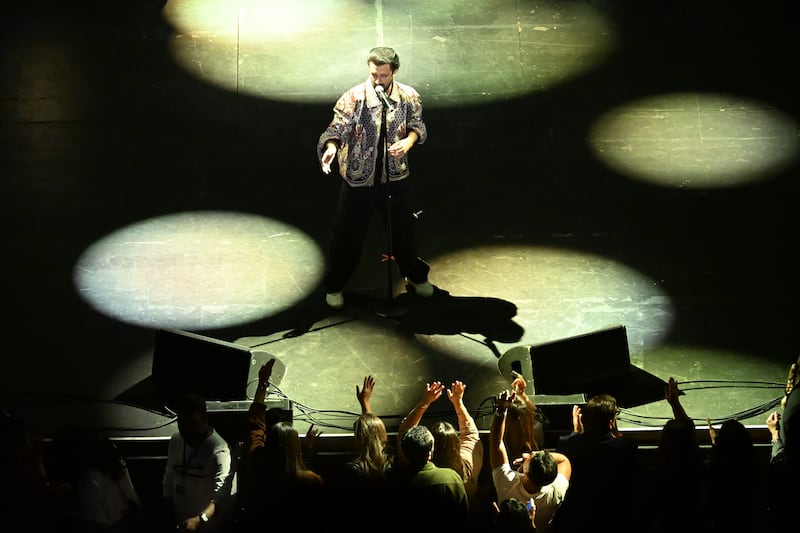
For the South Asians living abroad, Atif Aslam’s music often generates the emotions related to home, first love or heartache. His concerts in the US, UK, UAE, and Canada regularly draw large crowds of multi-generational fans, proving how nostalgia becomes a tool for cultural cohesion.
Los Angeles resident Purvi Patel said, “There are some artists that are generational. I think he is going to go beyond generations if he keeps up with the organic music that he creates.” She added that her kids also listen to Aslam’s music.
Aslam’s appeal had multiple layers: his raw, textured voice, his melancholia, the romanticism, and his alignment with the emotional tenor of South Asian youth culture at the time. His music reflected a sense of longing, idealism, and emotional vulnerability that mirrored the socio-cultural anxieties of a generation navigating globalization, digitalization, becoming independent countries free from colonization and the post-Partition memory.
Topics related to Indo-Pak relations can emotionally trigger a huge population whose ancestors have been Partition refugees and survivors, who grew up listening to stories of a forced migration and a sense of belongingness to an inaccessible land. I have witnessed this feeling when my late grandfather narrated his childhood survival stories from the partition and how he grew up in a refugee camp in Calcutta.
As the border was officiated overnight across the subcontinent, his family had to leave their native land and migrate to Calcutta in 1947, never being able to visit their childhood homes again.
There are millions of stories like this, passed down through generations.
The dynamic amongst the countries of the subcontinent have mostly been rocky, but the decade of 2000s served as an example of a time when regional identities appeared pleasantly fluid and interconnected.
Nostalgia operates not only as a personal sentiment but as a socio-cultural phenomenon. The early 2000s are now remembered by many South Asians as a golden era of music, where cross-border collaborations were not only possible but widely celebrated. By situating Atif Aslam within the sociopolitical and cultural landscape of the early 2000s, it can be observed that his continued relevance lies in his ability to evoke a collective memory that recalls South Asia’s complex relationship with unity, memory, and cultural longing.
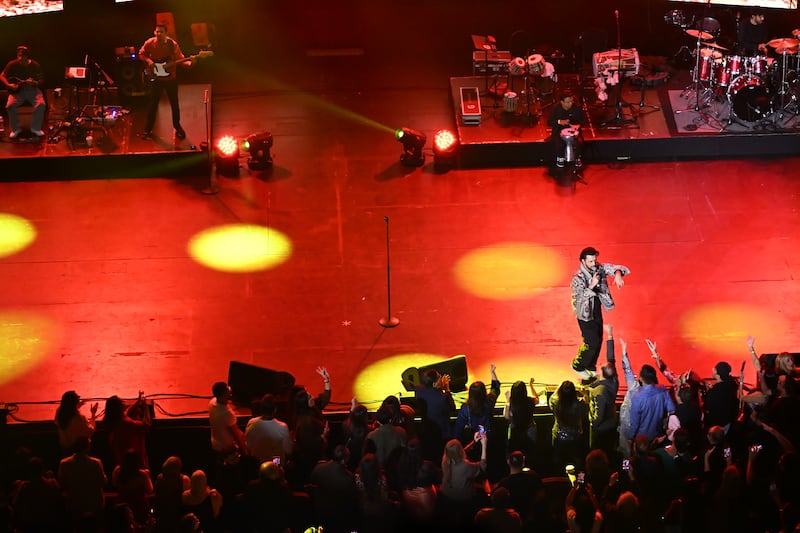
As a child growing up in the 2000s India, I always wanted to see Atif Aslam’s concert at least once in my lifetime. That dream almost faded with time, but getting to experience his voice live in a different country, even if it’s just for once, felt surreal. I had tears in my eyes when lights fell on the stage and he began with singing a rock version of “Rabba Sacheya” followed by his other hit songs like Hona Tha Pyar, Tajdar-e-Haram, Jal Pari, Hum Kis Gali Jaa Rahe Hai, Woh Lamhe, and of course Aadat.
I saw so many other people like me – living one of their dreams, almost in tears and disbelief – grieving collectively for an era long gone in the past. While I personally believe that there are other bands and artists who can evoke such a similar strong sense of nostalgia, I am not sure if they can sell out all tickets at a prime location in the heart of Hollywood.