
In an era where pop sounds dominate global playlists, very few artists have managed to reconnect younger audiences with centuries-old musical traditions quite like Ali Sethi. The Pakistani-American musician, known internationally for hits like “Pasoori”, has popularized Sufi devotional music such as qawwali and ghazal into contemporary cultural consciousness.
On a chilly evening in October, Sethi performed at The Ford in Los Angeles, hosted by the LA Philharmonic. Located at Hollywood Hills, the amphitheatre saw a South Asian majority crowd, from countries like India, Pakistan, Bangladesh and Nepal. Most of them were glittering in designer, embroidered clothing and thoughtful minimal jewellery.
Sethi’s social media account has been banned in India, along with multiple other Pakistani artists. This happened after the April 2025 terror attack in Kashmir’s Pahalgam, creating further tensions between India and Pakistan.
The San Francisco-based band Mehfil opened the show, playing some of their original songs such as “Jalsa” and other Punjabi covers.

The lights dimmed as Sethi’s band came onstage and started playing the cello, guitar, and drums. After setting the ambiance, Sethi appeared onstage in a shiny silver salwar-kameez – a traditional South Asian garment consisting of baggy pants (salwar) and a tunic-like top (kameez). It was paired with a green “jangly scarf” on his shoulders which he received at a wedding and decided to include with his outfit.
Someone from the audience screamed, “I love your costume!” making Sethi blush and do a little dance in acknowledgement.
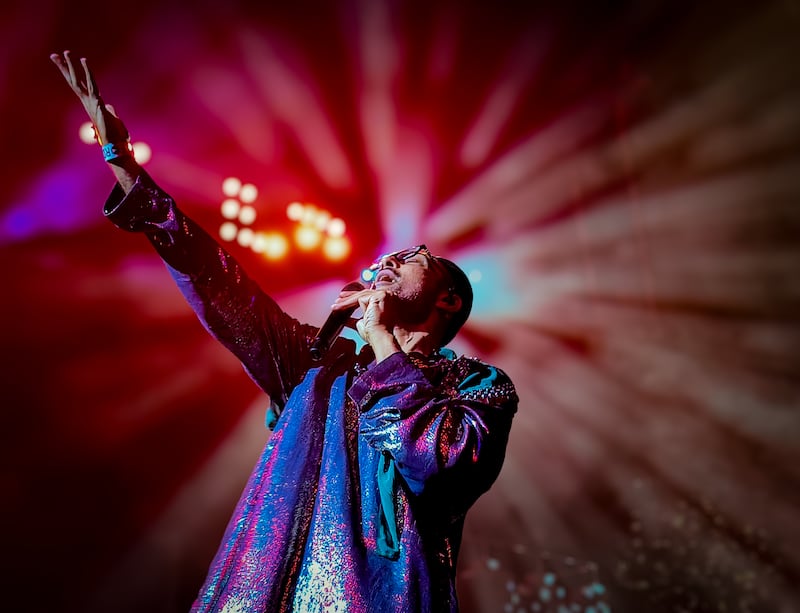
Sethi is trained under ghazal singer Farida Khanum and Ustad Naseeruddin Saami, the latter a master of classical music specializing in qawwali and khyal. Sethi has also been vocal about legendary qawwali singer Nusrat Fateh Ali Khan’s influence on his musical sensibility.
Sethi’s expertise in classical music showed, as he started his set singing “Gulon ke Rang” – which, as he described, is a song about flowers written in Pakistan during a time of dictatorship, that has the underlying tone of democracy. He then added that perhaps we all should write about flowers.
In between songs, the concert had moments of stand-up comedy as he played with certain stereotypes only South Asians could relate to. For instance, Sethi joked about South Asians being overachievers as he pointed towards his guitarist Ria Modak, who is pursuing her PhD along with playing guitar professionally. He shared that he usually has two microphones – one for singing, another for comedy.
Apart from being a musician, Sethi is also an author and has a degree in South Asian Studies from Harvard University.
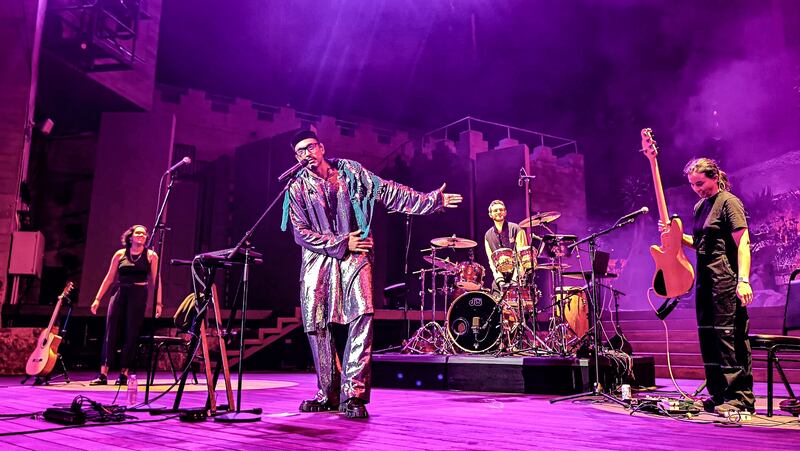
One unique thing about Sethi’s concerts is that he always incorporates educational elements into his live shows through storytelling. He sang popular songs like “Chandni Raat,” “Yeh Sama,”“Chura Lia,” and so on. Then gradually he shed light on “ghazals” and how it originally travelled from the Arab region, connecting the history to his version of the famous Urdu ghazal “Ranjish Hi Sahi” that he sang for Coke Studio in 2017.
Sethi also delved into his recent debut album Love Language, which sees him translating the 16th century language Braj Bhasha, which has its roots in India. The album includes a multitude of influences ranging from Indian classical ragas to flamenco and even gypsy music. Rather than diluting tradition, Sethi feels, such fusion reflects the multifaceted identities of many young listeners today.
His ability to switch amongst various genres is something that has sustained his fans. When he sang Sam Smith’s “Unholy” in the middle of Indian classical tunes, the crowd could not stop screaming. Knowingly or unknowingly, he upholds the ‘desi’ queer image at a global platform.
In a conversation with Sethi, he traced back to his childhood growing up in Lahore. He saw the time when people got introduced to the audio cassettes and mixtapes that would arrive at stores in the city, when people got to know about English-speaking artists like Led Zeppelin, The Eagles, Pink Floyd, Madonna, Michael Jackson, Spice Girls and so on.
He said, “it was the wild wild west in the sense that it was a completely unmediated music world, and that was kind of wonderful – because there were no rules, no hierarchies, no one told you what to listen to. You could listen to whatever you wanted to, without having to announce your personality or your identity to your peers.”
Doing fusion music was not something he deliberately pursued, but what came naturally. He grew up listening to qawwalis, ghazals, Bollywood movie soundtracks, and western music. He opined that ultimately it is about the “aesthetics” that connects with people. “I was just doing what felt most natural to me as a cosmopolitan person growing up in a globalized world”, he said.
Even though Sethi’s music inspires young listeners, he shared that his inspiration while growing up, came mostly from the older generation. His mother would ask him to go play cricket with other boys, but he would go and find their grandparents who indulged in his ghazal singing for hours. “I would be like, ‘take me to the hard of hearing and preferably immobile’,” Sethi giggled.
Sethi remembered how every Wednesday, his grandmother would send her cook upstairs to “fiddle with her antenna” so that they could watch the Indian TV show Chitrahaar, a long-running popular music program on Doordarshan that showcased clips of Hindi film songs during the 80s and 90s. He shared that his grandmother was born before the partition of the subcontinent and enjoyed all kinds of music.

Sethi has been influenced by several layers of experiences and that manifests in his music. His music resists being pinned to a single era, genre, or audience because it resonates powerfully with the complex identities of contemporary listeners. Such identities include being diasporic, queer, postcolonial, or multilingual. This ability to hold multiple truths at once is what makes music timeless.
Raj Dhillon, 81, a Punjabi woman who has been living in LA for over forty years, was seen grooving to “Pasoori” with her sister Tej Bains at Sethi’s concert in The Ford. “I have been following him for ten years. The best part is that he brings back classical music to those who cannot go back in time, and connects it with the people now,” Dhillon said.