
During the wave of protests over heightened immigration enforcement activity that swept across the country this past spring and summer, Patrick Martinez was not only in his studio — he was in the streets of Downtown Los Angeles. So was his art.
As demonstrators marched throughout the city, the crowd was dotted with placards printed with the artist’s signature neon sign art, bearing messages like “THEN THEY CAME FOR ME” and “DEPORT ICE.”
Speaking out when he sees injustice has always been instinctive for Martinez — and art, he says, has long been his most natural language.
“If we’re paying attention to the landscape, we have to pay attention to things that are happening in it,” Martinez told Annenberg Media at the Hammer Museum, where his work is displayed as part of the biennial Made in L.A. showcase. “And if I think that something is brutal and deplorable, then I’m going to say something about it and try to push back in the way that I know how.”
As immigration crackdowns continue to intensify nationwide under the Trump administration, Martinez continues to translate the urgency of the moment into work that elevates often silenced or overlooked communities. It’s art that refuses to retreat — pieces that confront viewers head-on, slow them down and leave little room for looking away, whether through a glowing neon message in bold lettering or a reimagined school folder evoking the threats confronting immigrant Angelenos today.
Martinez seeks to capture the “collective conscience” of Los Angeles during periods of significant unrest, reflecting the shared emotions felt by many across the city that words alone cannot fully convey.
The artist pulls imagery and language from the streets of Los Angeles, reshaping it into pieces that return to the landscape as deliberate disruptions. In doing so, his art becomes both a living record of the times and a pointed critique of the inequities that define them — “work that pushes back,” as he describes it.
Seeing his art in the street during recent protests, circulating through the communities that shaped it and in the hands of people speaking out, feels not only natural but necessary, Martinez said.
“It really activates when a person has it out on the street,” Martinez said. “I’m really into taking things from the landscape, and sampling them, and then placing them back into the contexts that they were inspired by.”
Early influences
Martinez came of age in Pasadena during the 1990s, a decade shaped by events that would have a lasting influence on his artistic outlook. The 1991 beating of Rodney King by Los Angeles police officers and the subsequent 1992 L.A. uprising formed the backdrop of his adolescence, which unfolded alongside the rise of rap music and his brother’s early experiments with graffiti art.
Influenced by everything from cartoon characters to New York City subway art, Martinez had been drawing for as long as he could remember. By the time he entered middle school, he picked up a spray paint can himself — an act that, he said, allowed him to channel those early impressions into a visual language of his own.
“I was hooked,” Martinez said. “And parallel to my brother, I understood the culture through the art of graffiti.”
Martinez continued to experiment with graffiti during his time at Pasadena High School. He went on to study at ArtCenter College of Design, where he learned traditional techniques like landscape and figure painting.
His art style tackled themes like identity, police misconduct and racial justice. Martinez said he struggled to find a market for his work, as he often felt that the people around him didn’t understand his vision.
“The professors at the school didn’t even know how to critique it,” Martinez said. “I thought art was supposed to be dangerous, and should be something that’s not polite.”
Martinez soon lost interest in conventional art techniques and typical surfaces like canvas, feeling they constrained his ability to create work with deeper significance and “say something that hasn’t already been said.”
“I had to get my hands dirty,” Martinez said, “and get involved with, ‘well, what am I interested in? What is already existing that feels like it’s connected to our history?’”
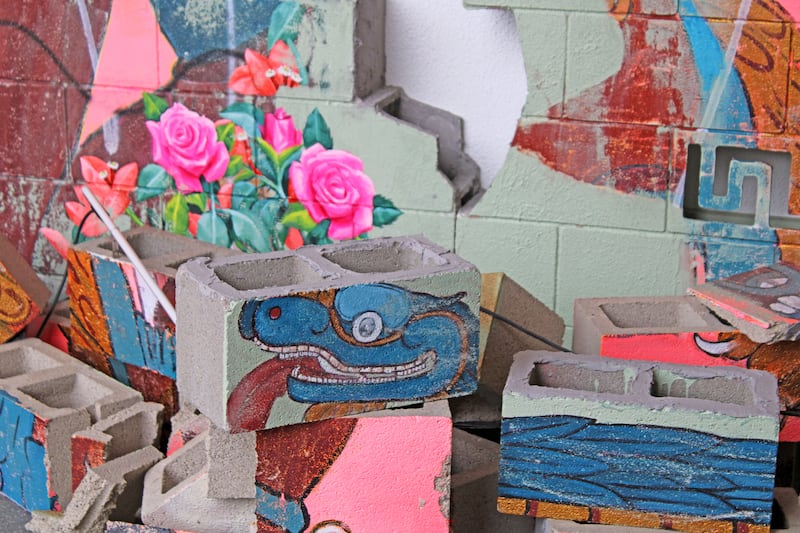
He began to draw on materials from the landscape around him, like the stucco on storefronts and markets and the cinder blocks of local mom-and-pop shops and liquor stores. All of these elements came together into what he calls a “woven tapestry of the surroundings” — particularly the parts of Los Angeles often overlooked in traditional art and media.
“I’m going to be the artist that really shows you areas of Los Angeles, the pockets of L.A., the bridges of L.A. that really, in my opinion, make L.A.,” Martinez said.
Neon as a medium
Drawing inspiration from the commercial signage that caught his eye while driving through the city, Martinez started using neon as a primary material for his work. Just as neon signs advertise local services, he co-opted the medium to convey his messages in a way that was immediately visible and familiar.
Martinez began experimenting with neon in the late 2000s, creating signs with all-caps neon messages including “LA MIGRACION ES NATURAL (Migration Is Natural),” “AMERICA ES PARA LOS DREAMERS (America Is For Dreamers),” “NO BODY IS ILLEGAL” and “WE MAY HAVE ALL COME ON DIFFERENT SHIPS, BUT WE’RE IN THE SAME BOAT NOW.”
These are now displayed across the country in museums including the The Broad in Downtown Los Angeles, the Whitney Museum of American Art in New York and the Rubell Museum in Miami.
The artist describes himself as instinctively drawn to honoring the “discounted and discarded,” with his work reflecting both his lived experiences and the communities he grew up in and alongside. Martinez is of Filipino, Native American and Mexican descent and was raised in an immigrant family. He says the themes woven throughout his work reflect the challenges and realities affecting his community — dynamics he described as impossible to ignore.
“It’s not something I can just not speak about,” Martinez added.
One of Martinez’s early neon works, “Hold the Ice,” is currently on view at the Hammer Museum. Martinez describes the piece as a fusion of two protest signs: one part an homage to the 2016 Dakota Access Pipeline protests, where Native American residents in North Dakota carried placards with slogans like “Water Is Life” to oppose a pipeline that threatened their water supply, and the other a call to remove immigration agents from local communities today.

Martinez said that this approach of combining messages is a deliberate way of pointing out the interconnectedness of these issues, with the artist seeking to present an ongoing conversation about injustice that “continues to evolve, change and happen,” he said.
“I try to find those connections and try to expose them in a real way,” he explained.
While his “Hold the Ice” sign was created over five years ago, many viewers assume it was made recently, Martinez said, as his earlier neon works have resurfaced and circulated widely amid the recent surge in immigration enforcement under the Trump administration.
Since creating his first neon sign in 2008, he has produced over 200 additional pieces. In 2020, he began participating in what he refers to as “mutual aid,” selling merchandise such as prints, t-shirts, hats, yard signs and skateboards featuring these designs, with proceeds donated to local organizations that assist immigrants.
“Hopefully that will continue to be a tool to show solidarity throughout, and understand that we’re not isolated,” Martinez said. “We’re more of a unit, and we’re going to continue to come closer together and kind of form a strong bond, all through this trauma and this brutality.”
Pee Chees in protest
Martinez believes the increasingly aggressive tactics used by federal law enforcement, driven by the administration’s push to detain and deport immigrants, have reached a level of brutality he hasn’t seen in his lifetime.
“They’re trying to make a point. They’re trying to break people right now. And that’s the difference. It’s overt,” Martinez said. “They’re trying to brutalize people to break them so that they can continue to do more damage in other ways.”
One of Martinez’s signature series involves Pee Chee folders, a school supply widely used in classrooms from the 1970s through the 1990s, which he says portray “idealized versions” of American youth participating in sports like football, track and tennis. In the series, he transforms these folders into social commentary on police brutality against Black and brown youth, and more recently, immigration raids.
Like many kids of his generation, Martinez was first introduced to PeeChee folders in middle and high school, and once used them to doodle his own observations.
“I’m just imagining if I was in school, what I would be thinking about?” Martinez said. “Or what I’m seeing on the TV and the news, how would that live on these folders? What would I say?”
The Pee Chee series initially documented individual acts of violence, such as Eric Garner’s death after being placed in a chokehold by New York police in 2014, and Philando Castile’s fatal shooting by a Minnesota officer during a traffic stop in 2016.
More recent pieces in the series have focused on communities being terrorized by immigration enforcement: kids on a track team being seized by plainclothes masked agents, a football player being stopped mid-sprint by an officer in military gear, a young protester holding a sign reading “ICE out of schools” being beaten by an agent.
Scribbled messages around the images, suggesting notes written by students, mix incident reports like “Black ICE SUV behind El Sereno Middle School – 8:46 a.m.” and “1,200 detainees missing from Alligator Alcatraz” with reminders like “test next Monday!”
As Martinez describes it, he intentionally transforms this familiar and nostalgic object into a tool for social critique. The artist said he not only seeks to raise awareness of these incidents unfolding across communities but also to preserve them in the historical record, and demand accountability at a time when he says many in power are “trying to literally erase history.”
“If we let that happen, and we don’t say anything visually, or with our voice, or push back, then they’ll continue to do more,” Martinez said.

Connecting the present with the past
Martinez’s work goes beyond current events, reaching into the past to explore how today’s violence is shaped by generations of complex historical forces.
In “Battle of the City on Fire,” a stucco and cinder block piece created this year, Martinez turns to the ancient Cacaxtla murals of central Mexico to explore themes of lineage and indigeneity. He blends Native American, Mayan and Aztec-inspired imagery with visual elements rooted in modern Los Angeles: graffiti text found on signage across the city, bold block-letter advertisements for “ICE” and “AGUA” commonly seen outside gas stations and painted beverages often seen on liquor store walls. A painted bottle of water is depicted pouring into the eyes of a figure beneath, referencing protesters who have been tear-gassed and pepper-sprayed during recent demonstrations.
Layered in are other images, including a warrior in feathered armor pierced by an arrow, taken directly from the Cacaxtla murals, and vibrant patterns and designs inspired by the work of the East Los Streetscapers. This composition rests on a scorched base, referencing the Southern California wildfires last January and the broader unrest the city has faced under the strain of recent immigration raids.
By placing these depictions on a tattered wall, Martinez said he seeks to convey two things: attempts to sideline, separate or silence Angelenos, and the enduring presence of local communities, whose art and culture continue to peek out through the rubble.
“That’s essentially what L.A. is sometimes,” Martinez said. “Things are sanctioned in the neighborhoods, but the city kind of erases or covers it up … the city painted them out, but they’re resilient and trying to break through.”
As Martinez sees it, Angelenos of color are being “disappeared” not only through the physical removal of people by immigration enforcement, but through gentrification that erases the cultural identity of neighborhoods, leaving little trace of the communities that once defined them.
Martinez hopes that immigrant Angelenos and other locals who feel stifled at this moment can see his work and feel represented.
“They’ll tell me, ‘seeing it makes me feel warm, it makes me feel better,’” he said.
The artist noted that it’s not only vulnerable community members who hesitate to speak out against immigration raids, but also museums, which often remain silent out of fear of backlash during this politically polarized moment. In these times, he emphasizes that it is crucial for artists themselves to take ownership of their messages and amplify them within their communities.
“I’m set up to speak and push back, because I’ve been doing that type of work for a long time,” said Martinez, who insists he’s not an activist, but simply “an artist paying attention.”
“I think at a certain point, artists need to come together, and push back together,” he said, “and this is the way we can do it.”