
Almost 15 years after he was honored as one of the top point guards in the country, D.J. Gay is still seeing the play before it develops.
Sitting at his desk in the Trilling Family Athletics Office on the campus of Windward School, Gay is working on a presentation for a potential recruit. To his left, he has a small legal pad; to his right, he has a notebook. Off to the side, there’s a basketball and a pile of blue, white and black jerseys.
Gay’s focus is interrupted by a question from his daughter.
“Are you the coach? Or are you the boss of the coach?” she asks.
The answer is both.
Gay was hired by Windward in the summer of 2022 to be its Boys Basketball Program Lead. His original role seemed big enough, given Gay was brought in to replace Colin Pfaff, who led the Wildcats to a CIF sectional title in 2020.
But Gay’s job has become about so much more than the play on the court.
As the Associate Director of Athletics, Gay is Windward’s sherpa in navigating the swirling winds of the name, image and likeness era.
“D.J.’s been an incredible strategic partner for me,” says Tyrone Powell, Windward’s long-time Director of Athletics.
Powell is my former colleague. I taught middle and high school history at Windward in 2020 to 2022, leaving just before Gay was hired. But when I reached out to Powell to learn more about how high schools are navigating the new world of NIL, he emphasized that I needed to get to know Gay.
Every coach leading an elite program in the fiercely competitive Southern Section must navigate the overt and covert promises that schools and their representatives make in recruiting players. It’s not atypical for a player to transfer in the middle of their high school careers; USC junior guard JuJu Watkins attended Windward for ninth and tenth grade before moving north to Sierra Canyon. But what has changed is the pace and volume of that roster churn, with student-athletes trying everything from signing agents before starting ninth grade to reclassifying to enter college early in the quest to maximize their present and future earnings.
Which is why Gay, at 3:45 p.m. on a Monday afternoon, is palming his laptop instead of a basketball.
He turns to his fellow athletics administrator, Ben Thomas, to chat about the presentation for the visiting recruit and their current players’ needs. They discuss how much time Gay has already been spending with his team despite the fact that the regular season is officially starting that day, October 13.
“You’ve got enough on your plate,” Thomas says.
Gay is not loquacious. In practices, he often lets his cadre of assistant coaches share their insights before speaking up himself.
But just because Gay is quiet doesn’t mean that he doesn’t have a plan.
“The thing that I appreciate about D.J. is that he is direct,” Powell says. “He will speak his mind. But he also does a lot more listening than he does speaking.”
This approach dates back to Gay’s time in college, when he helped lead San Diego State to its first ever NCAA Tournament victory in 2011. Gay’s college coach was Steve Fisher, the architect of the Aztecs and the man who assembled Michigan’s “Fab Five” in the 1990s. Fisher recruited Gay from Poly High in Sun Valley, Calif., despite some early reservations.
“Initially, we asked, ‘Is he quite skilled enough, and is he quite good enough?’” Fisher recalls. “And then, when we got to know him, we said, ‘We have to have him.’ He has all the intangibles that you build an amazing, successful program with.”
Fisher asserts that while it was his decision to appoint Gay captain during his senior year, if the players had voted, Gay’s selection “would have been unanimous.”
“So often, players are obsessed with minutes, shots, points,” Fisher explains. “That’s not who D.J. Gay was, and that rubbed off on the team. He just wanted to be successful.”
Gay went from being a volume scorer at Poly to more of a facilitator at San Diego State. This later included assists to Kawhi Leonard, who joined the Aztecs in Gay’s junior year. Leonard and Gay were the top two scorers on SDSU’s team in 2010-11 — a season in which Gay was a finalist for the Bob Cousy Award, an honor recognizing the top point guard in the nation.
When assessing what has made him successful as a coach, Gay points back at his own trajectory as a player.
“I’ve had to play all different types of roles: scorer, coming off the bench, starter, sacrificing my own offense,” Gay says. “I’ve been part of teams that won a lot, but I’ve been part of teams that didn’t win, too. So it’s just knowing what works in every situation.”
Having this knowledge is crucial at Windward, which features top athletic prospects like junior Davey Harris but also players for whom basketball is a path to admission at a college that prioritizes academics. Navigating a roster and a school that prioritizes both ends of the basketball spectrum has been part of the learning curve for Gay.
“D.J. has become a Windwardian in the sense that we believe in responsive teaching,” Powell says. “Sometimes that means that a student who may not be at the level of NIL deals or [Division I] offers still needs to be supported to get to where they aspire to be.”
A maxim that Gay frequently repeats in practices is “be a basketball player.” Sometimes, the phrase stands on its own — an exhortation offered in explaining a strategy. However, occasionally Gay points out in exasperation that his athletes are “missing opportunities to be a basketball player.”
As someone who Fisher describes as doing “all the little things that you need to be successful,” Gay wants his own players to make the most of what’s in front of them.
“I always tell them basketball is not a thinking game, it’s a reaction game,” Gay says. “So, the defense will tell you exactly who’s open, tell you where to go, where not to go. So all you have to do is go out there and just react to what you have.”
Reacting will have to be part of Gay’s repertoire this season as well. Harris is returning to competitive basketball after two seasons off for injury, and much of the rest of the roster lacks experience at the varsity level — a now-typical reality in the NIL era.
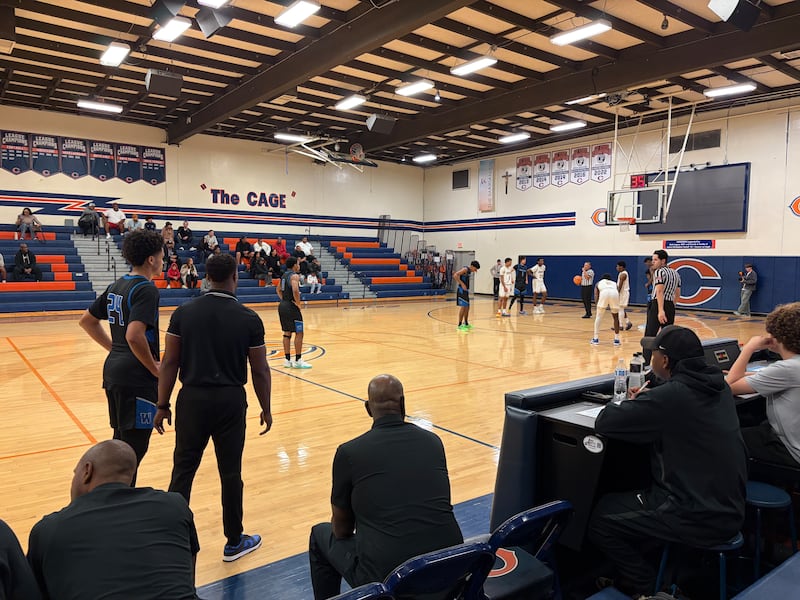
In Windward’s opening game of the season against Knight High on November 24, Gay leaned on his starters in the first half. But as the Wildcats stretched the lead to double digits, he distributed playing time to everyone who dressed for the game.
In the third quarter, Gay called a timeout because one of his athletes seemed flummoxed by a play call. Windward was up by 20 points, and the lead did not seem to be at risk.
But the former point guard knows that the key to succeeding is seeing the play before it develops.