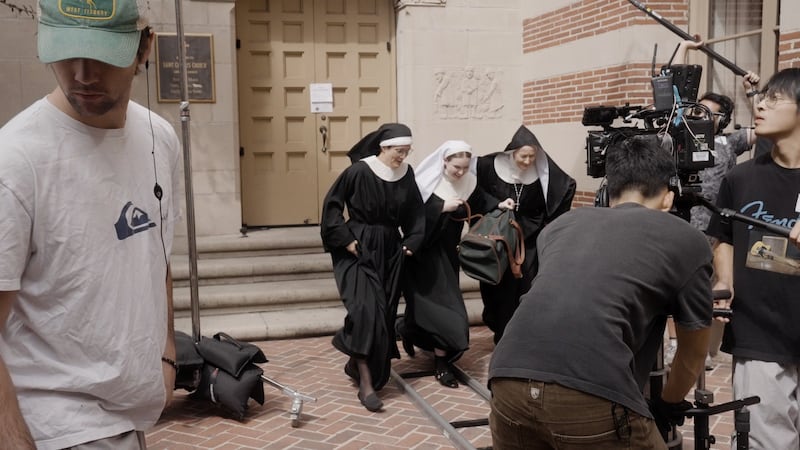
Students with cameras, nuns with guns: this USC School of Cinematic Arts (SCA) Senior thesis project takes absurdist comedy to the next level with “Nuns with Guns.” The short film is a defining example of what USC’s young filmmakers can accomplish with talent, trust and a $12,000 budget.
Every year, only four short films earn the green light in the SCA’s competitive senior thesis program. This year, one title in particular — a 12-minute action-comedy by director and senior cinematic arts, film and television production major Rhys Zemeckis — has captured the campus’s attention.
Senior writing for screen and television major Charlie Korman remembers the moment the idea for the script was born. He and Zemeckis were in a car tossing around funny movie titles that rhymed, when they realized they “actually thought of something good.”
“One, because it rhymes, and two, because you never think of those two things together,” Korman said. “Nuns with guns popped up, and immediately I was thinking, ‘Okay… but why would nuns have guns?’”
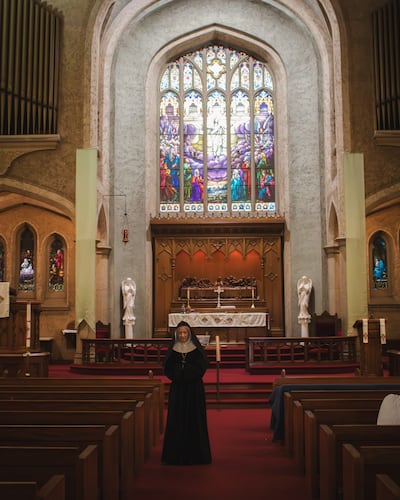
From that single question came the film’s premise: a group of nuns, facing the foreclosure of their church, choose to rob a fictional bank that has been exploiting them to preserve their community.
“At the end of the day, the story becomes about friendship and sisterhood more than saving the church,” senior cinematic arts, film and television production major and “Nuns with Guns” producer Daniella Raphaël said. “It could just as easily be three women working at a coffee shop that’s about to close. The nuns make it funny, but the emotional journey is universal.”
When USC releases its shortlist of potential directors, writers and producers, students typically scramble to form teams. But this group was different.
Zemeckis, Korman and Raphaël had already formed a creative bond through USC’s junior thesis program, where students rotate roles in small trios.
“We’d already made three films together,” Raphaël recalled. “[Zemeckis] produced for me once; I was his cinematographer another time. But I had never produced a film he directed, and we always wanted to make that happen.”
So when both Zemeckis and Korman were shortlisted, and Korman brought in a finished script based on the joke they had riffed on months earlier, building the team was effortless.
“It’s frantic when the shortlists come out,” Zemeckis, the son of Robert Zemeckis, a film student at USC’s SCA in 1973 and Hollywood-renowned filmmaker, said. “But we were lucky we already knew we wanted to work together and were aligned on the film we wanted to make.”
Producer and senior cinematic arts, film and television production major eMJay Al Barr rounded out the group and the four entered the formal pitch process: 10 minutes of presentation followed by 10 minutes of faculty questions.
They got the green light that same night.
“Comedy works best when the characters treat the situation with absolute seriousness,” Zemeckis said. “To the nuns, this heist is life-or-death. That’s what makes it funny.”
“Comedy works best when the characters treat the situation with absolute seriousness...To the nuns, this heist is life-or-death. That’s what makes it funny.”
— Rhys Zemeckis
Zemeckis has a clear comedic philosophy that the funniest moments come when characters treat the absurd with complete seriousness. His taste leans toward drama-infused humor, not slapstick or cheap gags. According to Zemeckis, his favorite films aren’t comedies; they’re dramas with elements of comedy baked in.
“Rhys’s junior thesis was intense but still a little funny without being a straight comedy,” Raphaël said. “So an absurdist heist about nuns robbing a bank felt like the perfect evolution of that.”
Because the team was selected in the spring, they spent the summer reshaping the script and preparing for production, even while scattered across different parts of the world.
“For us, summer wasn’t really a break,” Zemeckis said. “But doing the groundwork early made everything possible once the school year started.”
When the fall semester began, the team launched into three weeks of official pre-production, one test weekend, three consecutive weekends of shooting, a full month of editing, and now post-production in sound, color, score and graphics.
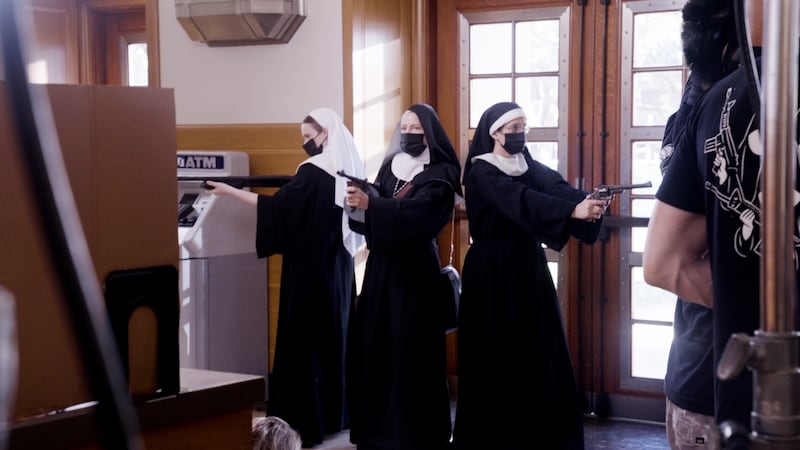
One of their biggest creative achievements was transforming USC’s Allan Hancock Building into a fully realized bank.
“The production design team completely transformed the rotunda,” Zemeckis said. “Seeing the nuns, the extras, the prop weapons, it felt like the movie was suddenly real.”
One of Korman’s favorite moments of the process was seeing that robbery scene come to life. “Seeing what the actors did with it, and how Rhys staged it visually…I was in awe,” he said.
USC provides support equipment, funding, and institutional backing, but also imposes rules that shape what students can and cannot do. A major responsibility fell on the producers to ensure the project followed every guideline.
“USC has a lot of red tape, especially around safety,” Korman said. “A huge part of the producers’ job was reeling in mine and Rhys’ craziest ideas.”
The most intense challenge, according to the team, was bringing prop guns onto USC’s campus.
“If someone saw them out of context, the campus could’ve been shut down,” Korman said. “The producers made sure every single rule and regulation was followed so we could focus on story and character.”
The producer acts as the mediator between the ‘studio’ — in this case USC — and the creative team, Raphaël explained.
Although the crew was almost entirely USC students, the cast featured a mix of SAG-AFTRA actors and one USC drama student. USC provides access to a casting breakdown platform where student teams can post roles and receive submissions. The cast was selected from 200–300 submissions through USC’s casting breakdown platform, with rounds of self-tapes, in-person auditions, and chemistry reads.
A crucial creative choice was making the nuns different ages: a mother superior in her 60s, a second nun in her early 30s, and the youngest nun in her late teens. Extras were sourced through casting sites, older community volunteers, parents, and family friends to create an age spread that grounded the film’s emotional throughline while elevating its comedic absurdity.
“We loved that generational spread because women of any age can relate to at least one nun…And to make a bank look real, you need older people in the background,” Raphaël said. “Not just a room full of 20-year-olds pretending to be retirees.”
Aside from actors, every major creative and technical role, from producers, editors, sound designers, production designers, cinematographers, colorists, composers, to graphic designers, was filled by USC students.
“Everyone doing sound, production design, the camera team, they were all SCA students,” Korman said. “It proved we never had to look outside the school for crew because we have highly skilled people all around us.”
“It proved we never had to look outside the school for crew because we have highly skilled people all around us.”
— Charlie Korman
Raphaël added, “So many classmates in SCA are full of talent and looking to sharpen their craft and build their reels.”
USC supplies each senior thesis with $12,000 in funding, access to high-end cameras and equipment, and a department dedicated to festival submissions after the project is done. However, there are specific limitations like no paying actors, no paying crew, strict safety rules and precise role boundaries.
“As a director, I can shape the film, sit with the editors, and give notes,” Zemeckis said. “But I’m not allowed to edit or write it myself.”
This structure is intentional, and according to Zemeckis teaches you how collaboration works in the industry.
The film premieres December 16 at USC’s Norris Cinema Theatre, where all four senior theses will screen in a celebratory showcase.
After that, Raphaël leads the festival submission strategy with SCA’s support. For all three, “Nuns With Guns” is more than a class project; it’s a taste of what their careers as filmmakers will look like. Student films can gain wider recognition by applying to both small and large national festivals designed for this purpose.
“You aim for a few dream festivals, a few strong mid-tier ones, and some smaller niche festivals, especially comedy-friendly ones,” Raphaël said. “It’s like applying to college.”
Korman also explained how the project serves as a portfolio piece. “This film is a pitching tool. I can send it to people and say, ‘This is what I can do as a screenwriter.’”
Zemeckis discussed how he is excited about collaborating independently, maybe developing something new after USC, but for now, “we’re pouring everything into finishing ‘Nuns With Guns’ the right way.”
According to Korman, film school is great for technical skills, but the most important thing is the network you build — especially in Los Angeles, where the SCA-to-industry pipeline is strong.
Raphaël shared a similar sentiment that the most rewarding part is seeing an idea turn into a real film, with dozens of people bringing their talents to it.
“When you trust your team, you can make something bigger than any one of you could have done alone,” Zemeckis said.