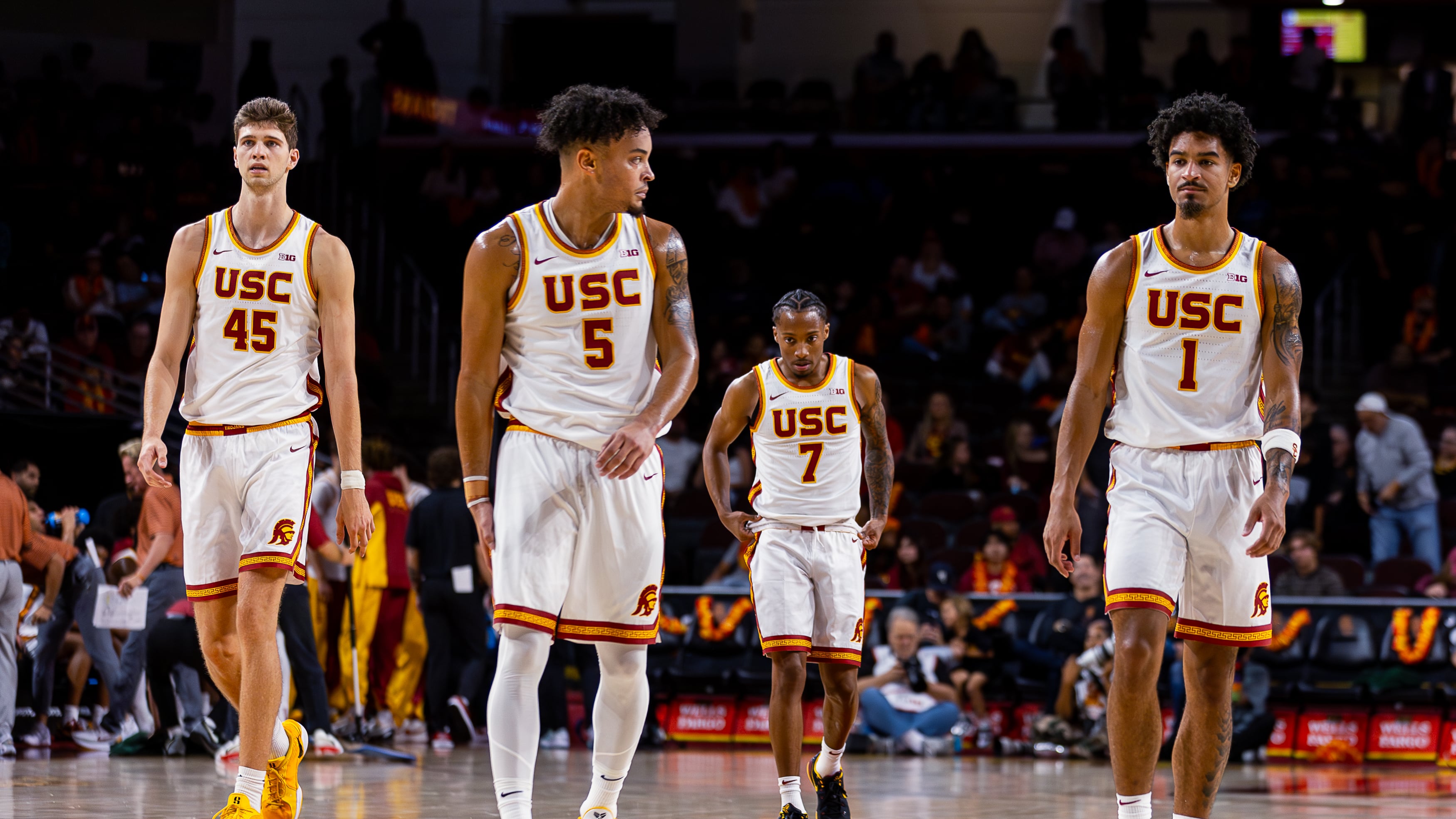
Heading into Friday’s nonconference matchup, the Trojans look to keep their offensive rhythm and defensive focus. In their win over Manhattan last weekend, USC put up 114 points, its highest single-game total since 1998. That performance showed the team’s depth and new offensive identity.
Head coach Eric Musselman’s squad looked confident, pushing the pace and playing with an energy that was absent last season. The challenge now is to replicate that same effort tomorrow against Illinois State.
USC’s roster looks completely different from the one that finished the regular season 17–18 (7-13) in its first year in the Big Ten. Through strong recruiting, Musselman has rebuilt the program, adding newcomers to the roster including veteran transfer forwards Chad Baker-Mazara and Ezra Ausar, two players that have quickly made an impact.
Sophomore forwardJacob Cofie has been a bright spot in the lineup, averaging a double-double through two games. The Trojans’ ball movement and shot making have taken a noticeable leap within the first two games, with junior guard Rodney Rice and graduate forward Jaden Brownell capable of scoring in double figures.
Defensively, however, consistency remains the next step. The Trojans have slowed down at times in transition and rebounding, which are issues that can become costly against disciplined opponents.
“In the two exhibition games, there were times where we were playing pretty fast, but turning it over unnecessarily,” Musselman said.
Illinois State, though not a powerhouse team, can still play a clean brand of basketball typical of other Missouri Valley Conference programs. Head coach Ryan Pedon’s team thrives on rebounding battles and forcing opponents into mistakes.
For the Redbirds, this game is a measuring stick. The team is coming off a solid start in MVC play with a 1-1 record, and will likely see the matchup as an opportunity to make some noise.
Guards like freshman Ty’reek Coleman (13.5 points per game) and junior Johnny Kinziger (13 points ppg) are capable of heating up offensively, and could test USC’s defensive rotations.
“It’s a team that can space you out and will walk the ball up the floor after making baskets and make you guard for an entire shot clock,” Musselman said.
The key for Illinois State will be to control the tempo — slowing down the Trojans’ transition attack and try to make the game more physical down low in the paint.
For USC, the key is more simple: start fast and move the ball. If the Trojans control the pace and dominate the glass, the game could mirror their performance against Manhattan. Musselman reflected on what USC is doing well so far.
“We’re doing a really good job of playing with pace and not playing reckless,” he said.
Musselman will also look to refine his rotations and continue to build chemistry among his new pieces before the schedule ramps up into conference play. Expect the Trojans to come out with focus and aggression, while hopefully feeding off the energy of the home crowd in Inglewood. With the approach Big Ten play forcing urgency, every game matters for building rhythm and identity. Illinois State may hang around early, but USC’s depth and firepower should prove sufficient enough against the Redbirds.
It’s an early season nonconference matchup, but it’s one that holds significance as the Trojans look to keep building momentum and consistency under their second year with Coach Musselman at the helm.