
MAKING THE MAGIC
“Sinners” is the R-rated, vampire horror drama film we never knew we needed on Easter Sunday weekend. Horror films typically drop off in sales after opening weekend, but “Sinners” stacked on an additional $45.7 million this past weekend in sales following a $48 million box office debut. Written and directed by Ryan Coogler, “Sinners” has received widespread acclaim and seems to be the movie everybody has seen, with frenzied fans taking to social media threads in droves to dissect the movie’s intricate plot and seemingly endless layers. The film earned a nearly perfect score on Rotten Tomatoes and features a star-studded cast of beloved newcomers and veterans, alike, such as Michael B. Jordan, Miles Caton, Wunmi Mosaku, Delroy Lindo and more. To celebrate these achievements, Proximity Media, Coogler’s media company, released a heartfelt letter from the director last week, sharing his thanks to moviegoers for their support.
Beyond impressive box office sales, Black cinema takes a powerful step forward with “Sinners.” Coogler, a 38-year-old African American man, requested and secured an extraordinarily rare deal with Warner Bros., and will receive full ownership rights to the film in 25 years time. In an industry where white appropriation has profited from Black art and stories, Coogler’s negotiation shows us that there is power in cultural ownership staying in the hands of the creatives who make it — although some portrayals in the media beg to differ, arguing that the director is getting away with turning a profit on a movie he didn’t pay full price for.
“Sinners” was produced under a $90 million project deal with Warner Bros, so comparisons between Coogler’s film and director Quentin Tarantino’s “Once Upon A Time… In Hollywood,” are being made, considering that the two films have identical production budgets and almost identical opening weekends. Despite this, the portrayals of success for these films in the media are drastically different — and a strong case can be made that the differentiation is racially motivated. Last week, Variety published a misleading comment on X (formerly Twitter), stating that despite wide claim success, “Sinners” fell short of the profit necessary to break even with its production budget. Social media users (including a fired-up Ben Stiller) instantly came to Coogler’s defense, criticizing the media outlet for an unfair portrayal of Coogler’s quickly-grossing film.
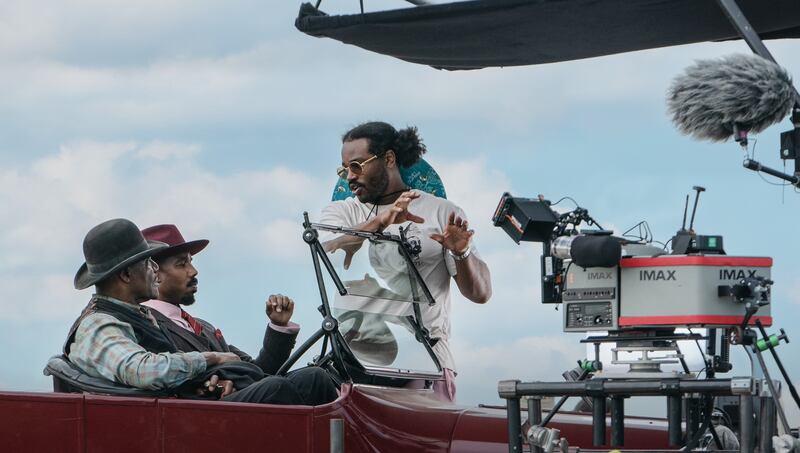
Prior to the film’s release, Coogler has actively voiced his commitment to revamping movie theater culture post-COVID. He chose to shoot “Sinners” on large format IMAX and Panavision film cameras for a larger-than-life, immersive movie theater feel — one that would pale in comparison if watched on a home television set or cell phone. Leaving digital film behind for richer detail and sharper clarity is not only a pivotal cinematic stride, it also establishes the director as the first Black filmmaker to project a movie on IMAX motion picture film, according to Coogler.
However, serving viewers this much of an over-the-top experience comes at a price that’s not only monetary: it presents an uphill battle for even Hollywood’s more renowned actors, tasked with delivering lines before the roll of film runs out. Actors Hailee Steinfeld and Michael B. Jordan weighed in on their challenges shooting on large format film in a recent interview with IMAX. “[With] cards you shoot as long as you want, now [we are] going back to the intentionality and the focus you gotta have when you’re shooting film…when you’re locked in you’re locked in,” said Jordan, who plays identical twins “Smoke” and “Stack” in the film. “It made everybody be on their A game even more.” Steinfeld, who plays Mary in the film, added that “It’s also a crazy thing when you’re in the middle of a scene that has a lot of dialogue, and you can hear [the film] rolling out.”
BACKGROUND
“Sinners” was born out of Coogler’s long-standing love for the horror genre, but a case can be made that this movie is more of a thriller, drama or suspense…maybe even a genre Coogler invented on his own, should you ask heralded American filmmaker Spike Lee. The movie takes place in the 1930s, during the sharecropping era in the American South. African Americans were “free” under the Jim Crow law, but still had to endure the day-to-day terrors (“horrors,” even) of segregated living and a lurking Ku Klux Klan. Blacks flocked to juke joints (gathering spaces held in abandoned shacks, open fields or houses in the middle of the woods) for solace, safety and a sense of humanity. In the juke joints, musicians transcribed the sorrowful sounds of the Black experience through bluesy chords, as patrons drank and dirty danced their hardships away under the nighttime sky. The words “juke” and “jook,” derive from the African word “juga,” meaning “wicked,” and refer to the promiscuous behavior that would take place at the juke joints.
Coogler channeled his experiences growing up in Northern California to write “Sinners,” most notably the time he spent under the wing of his uncle, James, a Richmond, California transplant who fled from Mississippi in the middle of the night after an encounter gone wrong with a white boss. In a recent podcast interview, Coogler recalled sitting with his uncle as a child, observing the World War II veteran pour out his pain into glasses of Old Taylor whiskey and bob his head to vinyls of the Delta blues. Coogler’s uncle James worked long shifts at the steel mill, and leaned on alcohol and music for a mental escape from the day-to-day traumas of being a Black man in America — topics Coogler would later explore further in “Sinners.” The film also delves into the spiritual, mystical activity of the Delta blues, a genre rumored to have the ability to transcend time. Coogler now credits the Delta blues as one of the greatest contributions Blacks artists have made to the art scene, stating that its influence still heard in music we devour today, such as R&B, Rock n’ Roll and Hip Hop.
“[The Delta blues] is a massive concept, I gotta shoot this on the big cameras,” Coogler explained in the same interview. “I gotta bring all my homies that are really good at this filmmaking thing. I gotta bring them to the South so we can spend six months making this.”
And he certainly did just that. Coogler assembled a band of esteemed old colleagues to make the magic of “Sinners” come to life, such as Swedish composer Ludwig Gӧransson. Gӧransson is a college friend of Coogler’s and co-founder of Proximity Media; he is known for working in other major films such as Christopher Nolan’s “Tenet” and “Oppenheimer.” He has scored all of Coogler’s prior films, and brings a remarkably disturbing, suspense-packed element to “Sinners,” that gives the movie somewhat of a gospel-infused, country Western type of feel. To capture his vision for lighting, exposure and more on camera, Coogler teamed up with director of photography Autumn Durald Arkapaw on “Sinners” (note: the duo also collaborated on Wakanda Forever), marking her as the first female DP to shoot a feature movie on IMAX film. Acclaimed costume designer Ruth E. Carter also joined Coogler’s team to create “Sinners.” The duo’s third time working together, Carter and Coogler have also collaborated on the “Black Panther” movie franchise. Carter, a two-time Oscar-winner, delivers big in “Sinners,” flexing her reputation of cultural accuracy and authenticity to fashion a wardrobe so tangible and believable you’ll want to feel it through the IMAX screen.
Last but not least, Coogler cast his faithful friend, actor Michael B. Jordan, to play the lead role(s) of twin brothers at the center of the film. Coogler’s personal connection to twins runs deep: he is Gemini with a knack for telling twins apart and has several sets of identical twins in his own family. Coogler drew inspiration from his fascination with the Ibeji twin deities of the African Yoruba religion, as well, to breathe life and believability into the twins depicted on screen. Together, Coogler and Jordan nail down twins so realistic that viewers can tell the two apart by the midpoint of the movie, but that is no accident: Jordan worked with both a dialect and “twin” coach to prepare for the roles, and Carter uses color-coded costuming to make the differentiation process easier, dressing one twin in red and the other in blue. “Sinners” marks Coogler’s fifth time directing Jordan, and comparisons of the pair being the next iconic filmmaker/actor duo since Denzel Washington and Spike Lee are ravaging through the Internet.
THE PLOT (warning, there are spoilers!)
After leaving in the Great Migration and striking luck in Chicago, a free state up north, twins Elijah “Smoke” and Elias “Stack” Moore are on the run. Returning back to their Mississippi hometown, the brothers look to rebuild their lives and call upon their old community to help in doing so. As they run into old acquaintances on screen, it’s as if the townspeople have seen a ghost; but, the twins assure them that “[We] came back home to deal with the devil we know.” Smoke and Stack decide to open up a juke joint to make some money, and extend a grand, opening night invitation to the town’s sharecropping residents. For entertainment, the brothers recruit the best Delta blues players they can find, including their little cousin, Sammie (Miles Caton).
The SmokeStack twins are soldiers turned money-hungry and power-driven hustlers, although Smoke and Stack are governed by two starkly different moral compasses. Stack is a slick-talking, hot-headed diehard willing to cross any and everyone who gets in the way of his money; Smoke, the older brother, is a chain-smoking burdened man who asserts his dominance in gentler, more reserved ways despite having killed their father to protect his younger sibling. Perhaps even more surprisingly, Stack is the twin with a heart for the town’s people — so much so that he comps charges at the juke joint for sharecropping patrons despite possible pushback from his miserly elder brother.
Regardless of their separate natures and personalities, the Mississippi Delta community sees both of the twins as outlaws. This presents a fascinating juxtaposition when viewers are introduced to their love interests and watch how women motivate and influence the brothers’ actions. Smoke and Stack fell deeply for women in their hometown before leaving for Chicago, and moviegoers learn that reuniting with their love interests is a prize deeper than just a single night of backroom hookups, provocative dancing and excessive drinking — that the bonds these men have with their women are deeply rooted. In fact, the hard-nosed twins are often seen letting their guard down and showing vulnerability (even submissiveness) toward the women they love. And that love is reciprocated…or so it seems.
Even the loyalty between Smoke and Stack, themselves, goes deeper than life or death. This reverence overflows into their mutual protection of their younger cousin, Sammie, who they often refer to as “Slim” and “Preacher Boy” (the latter due to Sammie’s father being a pastor). A tantalizing contrast from his youthful face, Sammie possesses a head-turning, rich bass voice, making him a perfect vessel for bringing forth the sorrowful sounds of the Delta blues. Ultimately, Sammie’s spiritual gift and calling to play the blues is what annexes the young man out of his father’s church, and we feel the residual effects of that tension simmer beneath the surface throughout the entire movie. Oftentimes in the film, viewers can hear the voice of Sammie’s father ringing out in a stark warning: “You keep dancing with the devil…one day he’s gonna follow you home.” And it turns out, he is right.
In “Sinners,” Coogler delivers a master class in slow-burning tension, with the juke joint’s opening night climax proving well worth the wait. As the party gets underway and musicians strum the Delta blues, Sammie is invited to sing for the crowd. The boy begins to perform a toe-tapping, somewhat forlorn folk song written to his father, reflecting on how he is selling out to a love playing of the Delta blues. As he belts the blues, Gӧransson’s score swells behind him and sounds of a gospel chorus erupt, creating a song so powerful it can raise the dead. Soon, Sammie’s performance opens up a sci-fi-esque portal, unleashing dimensions, cultures and ancestral lineages in the juke joint from a spectrum of time periods. (A nod to the blues’ speculated supernatural power to bridge eras.) Amidst the hair-raising chaos, Sammie’s veil-piercing voice interweaves with a sinister, funk-inspired electric guitar lick. Coogler’s brilliant images swirl and dance across the IMAX screen, evoking an eye-opening, deep euphoria through the cinematic surrealism. In this multidimensional, trippy sequence, the costumes, body paint, traditional masks and more tell the stories of heritage behind the African and Asian descendants partying at the juke.
But not all of the spirits Sammie conjures are good ones. It isn’t long before three white strangers show up at the doors of the juke joint. String instruments in hand and singing an eerie folk song, the three ask for permission to enter the party and play along with the infectious music rumbling from the inside. If you know anything about vampire movies, you know this is an absolute no-go. According to traditional vampire tropes, a vampire cannot simply walk into someone’s home, instead they must be invited inside. The partiers deny the strangers access into the juke joint, so the trio wanders to a nearby sitting area. With Stack’s permission, Mary (Stack’s lover, played by Hailee Steinfeld) leaves the juke joint to find out the real reason why the musicians have come to the party.
Mary returns to the joint, seemingly unfazed, but by this time moviegoers are yelling at the screen full throttle for Stack to get far away from her — something about Mary is clearly different, possessed even. But, at that point it’s too late; Stack gets bitten by his lover, the now blood-thirsty Mary. Once the other partiers in the juke joint realize what is happening (spearheaded by the Hoodoo priestess, Annie — played by Wunmi Mosaku) the group makes a pact to stick together and not let the vampires in. Playing into those classic vampire rules, Annie collects some silver and makes each of the (suspected) living humans left standing eat a clove of garlic (a repellent for vampires, and a reaction to the food being a direct indicator of an immortal spirit). She then prepares wooden stakes to shove through the hearts of the immortal attackers, and after a heartbreaking exchange of words, Annie forces her lover, Smoke, to promise to kill her if she gets bitten. He obliges.
As the threats from the now-immortal former partiers of the juke joint persist, tension inside the house reaches a boiling point. While everyone in the juke joint gets threatened, it’s the local grocery owner Grace Chow (played by Li Jun Li) who ultimately succumbs to the pressure. The vampires, including her husband Bo, threaten to attack Grace’s daughter while she hides inside the house, and in a shocking, head-turning act that still has social media up in arms, Grace screams out the vampires, giving them verbal consent to enter the juke joint. As if mirroring the audience’s now bulged eyeballs, Coogler expands the film’s aspect ratio from standard super-wide screen to IMAX dimensions, intensifying viewers’ immersion in the terrifying sequence. From then, it’s on: The thrill of the action commences in an Avengers-style face off. As the blood flies everywhere, this is the point of the movie where you (or the person next to you…or both) are most likely to gasp, cry out and shed a few tears for the film’s fallen soldiers.
At the height of the heart-pounding action, Sammie is seen fighting for his life, wrestling back and forth with the master vampire, Remmick (played by Jack O’Connell) in waist-deep bayou water. In a final effort to defeat the demon, the church boy reverts to his Christian foundation, reciting the Lord’s prayer in Remmick’s face. But then, something surreal happens: The vampire joins in on Sammie’s prayer, chanting in unison with the petrified boy. Visually, the scene widens, revealing waves of new vampires emerging from the woods, all of them chanting in the Lord’s prayer in unison. As more and more demons join the prayer, their chorus builds in volume. As the spirits stagger towards the juke joint, Gӧransson’s bone-chilling, spirit-summoning score crescendos in the background.
Then, Remmick recites an unparalleled monologue. He states that those same, recitable prayers were given to his father’s people during their colonization by the English — essentially questioning Sammie’s allegiance to Christianity and how the boy could trust a religion given to him by colonizers for his own submission. Meanwhile, Remmick is seen dunking the boy in the swamp water, as if baptizing him in a new religion and way of thought in real time. To console the boy, the vampire shares that those very same prayers bring him comfort in times of distress.
In the end, the Delta blues proves to be so powerful that it casts out the very same evil it brought to the juke joint in the first place. Sammie hits Remmick over the head with his guitar, and the disfigured vampire disintegrates into smoke and flames while the rising sun burns up the rest of the surrounding vampires.
But do not get out of your seats yet, folks. Two intriguing scenes await those who stay patient and hang around long enough to see the ending credits. The first clip shows an aged version of Sammie, an older gentleman (played by Buddy Guy, who is rumored to be connected to the film’s origin story) playing the Delta blues at a bar. Once Sammie takes his seat, the non-aged, early 90’s-dressed Mary and Stack (in a Coogie sweater, at that) approach Sammie. Stack shares that he did not come to hurt his little cousin, instead revealing that he promised his brother to never cause harm to their little cousin. Stack asks Sammie to play his old guitar, and fond memories of life before the juke joint flood back to the men. The two have a heartfelt moment before moviegoers witness the unthinkable: Neither Stack nor Sammie cast a reflection in a mirror nearby. Coogler’s next clip gives us a hint why.
In the following final (final) credit clip, a young Sammie is seen in his father’s church. He sits in a pew, strummming a beautifully-bluesy rendition of “This Little Light of Mine” on his guitar while a figure (speculated to be the devil, himself) watches from the doorway.
Since the film’s release, speculations have been made that the origins story behind “Sinners” centers the life of the legendary Blue player Robert Johnson, who is believed to have sold his soul to the devil at a the Mississippi crossroads in exchange for the ability to play the blues on a grand level. Should Sammie’s character be based on Mr. Johnson, his vanished reflection as an adult serves as a haunting confirmation the deal went through and price had been paid.
OVERALL TAKEAWAYS
Coogler’s artistry shines through masterfully in how he builds tension throughout “Sinners.” There is a sense of urgency that the evening’s juke joint party will be full of surprises, but the audience does not know why. It’s a music-heavy film, which adds to the feeling of constant suspense. Gӧransson’s score is so unsettling that at times it feels impossible to let your guard down. Expect a handful of jump scares in the film; the demonic flashbacks and piercing shrieks from the loud speakers could make even the toughest person spill popcorn all over themselves.
Still, “Sinners” is a suspenseful movie suitable for the scaredy-cats — a group that includes Michael B. Jordan, who historically dislikes scary movies and even the sight of both real and fake blood. (Which is terribly ironic — but you just gotta jump into action when someone by the likes of Ryan Coogler calls.)
The movie is gory, but the comedy, romance, drama and Coogler’s infamous one liners (I’m looking at you, Killmonger’s “Heyyy Auntie,”) break up the film well and allow space for viewers to reset between rough, scary patches. The payoffs in this movie are absolutely worth the anxiety and fear of being at the edge of your seat and waiting to see what happens next.
There are a lot of elements to love in this movie, but the real payoff for moviegoers lies in Coogler’s commitment to historic accuracy, his portrayal of non-traditional love interests on screen and his representation of an alternative view on Black Christianity. Not to mention, “Sinners” is Blackity Black, brimming with sharp-tongued humor that’ll have you laughing in no time. Whether it’s the iconic “the roof is on fire” party reference, Stack’s “You can’t lock all this pimpin’ in the closet” line, or Michael B. Jordan’s debut sporting a Gumby haircut, this film is packed with exceptionally-relatable, cultural moments you’ll want to savor.
QUESTIONS TO EXPLORE FURTHER
Why are we surprised to see a full-figured Black woman as a leading love interest?
-As reaction video after reaction video populates the Internet in celebration of the steamy chemistry between Mary and Stack, speculation is growing that the two co-stars have a potential off-screen relationship, as well. Surprisingly (but maybe not too surprisingly), there have been strikingly fewer fan videos posted heralding the equally-steamy relationship between Annie and Smoke. This contrast is even more pronounced when you consider Mary‘s character ultimately betrays and kills Stack, while Annie’s magic protects Smoke from evil attackers.
For a handful of moviegoers, watching actor Michael B. Jordan getting intimate with a curvy, dark skin Black woman felt like a stretch. Some struggled to see the love connection as realistic or believable. Online chatter exposes that people even speculated Annie’s character was Smoke’s mother, sister or friend prior to the pair’s intimate scenes.
In a brilliantly believable way, “Sinners” pushes past the mental blocks of European beauty standards, white supremacy and fatphobia, delivering a movie so realistic that it represents the very same viewers it caters to.
Can love really conquer all?
-Before Smoke went up North for the Great Migration, Annie gifted him a “mojo” necklace for his protection. Ultimately, the necklace saves Smoke’s life by warding off evil spirits — a symbol of the strength and power behind a Black woman’s prayers. Annie’s superior magic also transcends life itself, her protection stays with Stack even after her passing. In the movie’s final scene, Stack is clearly both alive and deceased at the same time; he toggles the two world(s) and astral planes, speaking both to a man in the present, living world while holding a conversation with his lover, Annie, who passes away in a prior scene.
-During the vampire attack at the juke joint, the movie’s patriarch, Delta Slim (played by Delroy Lindo), sacrifices himself during the final vampire fight scene. (A fulfillment of a promise he makes earlier in the movie, foreshadowing what’s to come.) Throughout “Sinners,” Delta Slim uses liquor to medicate the painful reality of living in the South, but his habits lead him into a stifling addiction. Possibly an ironic play off of his reputation as a drunkard, Delta Slim breaks open a liquor bottle during the fight, cuts himself with it and yells for the vampires to come and find him: a key distraction for the vampires that lasts long enough for his friends to flee the scene.
-Despite Stack becoming a vampire and rampaging through the juke joint in search of new victims, Smoke still feels emboldened to protect his now-deceased twin brother. Taking this commitment a step further, Smoke makes Stack vow to protect their younger cousin, Sammie, and Stack keeps his word even decades later despite Smoke having passed on since the promise.
Would you let a vampire in your home?
-“Sinners” reminds us that evil spirits need an invitation to come inside our homes. At the same time, the movie also reminds us that in order for the demon to even make its way to our front door, the spirit must first be summoned by someone from the inside. Potentially a metaphor to warn moviegoers against inviting danger into our own lives, this film examines how evil and betrayal don’t always look demonic on the surface: sometimes it takes the form of friends (Grace), lovers (Mary) and business partners (the Ku Klux Klan Grand Dragon who sells the twins the juke joint), as well.
-Since the movie’s release, social media has had a field day with the juke joint vampire invasion movie sequence. Spin-off videos are popping up left and right, and this trend has been the gut-busting dialogue necessary for us to question our own weaknesses/vices. (This video with a faux Beyoncé raffling off meet and greet tickets is a personal favorite.) As you watch the film, ask yourself, “what deal is just too good to resist for you to resist if the devil is at your door?” And that’s a question you probably should ask Robert Johnson and Papa Legba. (The latter, an African Ioa, inspired Coogler’s vision to explore self-sacrifice and human desire in “Sinners.”)
In the early parts of the film, the SmokeStack twins mirror devilish dealmakers, enticing the town’s residents to work for the juke joint by pressing into their fleshly needs. For example: Delta Slim, a drinker, is seen playing the blues for tips at the local train station. Smoke offers him a rare Irish beer in exchange for performing at the juke joint, and Slim ultimately accepts the deal.
Later, Smoke finds Cornbread (played by Omar Benson) working in the cotton field. He offers the sharecropper money to provide security on opening night. Cornbread (after his wife’s intervention) agrees, and willingly hops willingly into the twins’ car.
And let’s not forget, the twins gifted Sammie his first guitar after he showed interest in playing the Delta blues.
As a Black American, have you ever questioned Christianity?
Coogler uses Remmick, the Irish master vampire, to rip open a sensitive cultural conversation in the African American community: How could Black people abide by a “white man’s” colonized religion? Remmick’s monologue takes us deeper into answering this question.
The vampire addresses the cognitive dissonance churchgoing Black folks are likely to experience when abiding by a whitewashed religion — one fundamentally rooted in submission — and given to their African ancestors by white slave owners. Remmick’s monologue to Sammie explores that although Christianity’s may provide solace, the power of the prayers and teachings are neutralized when you consider they were used to pacify the enslaved and suppress to strip Africans of their will to fight. Taking it a step further, Remmick’s final scene may also suggest that the Christian religion renders Black folks spiritually powerless in their fight against evil spirits.
And if the white man’s religion does not work, what does?
-When the English colonized Africa and brought slaves to America, the spirituality of the prisoners remained with them through the slave trade. Throughout the movie, Annie practices a powerful form of mysticism (that can be speculated to be Hoodoo), and it’s clear that her healing spiritual practice is deeply-rooted in her African heritage. When things go awry at the juke joint, Annie recognizes what was happening and educates the others as she makes a survival plan. Though it is easy to miss in the height of the action, the vampires take a vested interest in Annie, trying to bite/convert her to their side immediately. She is the juke joint’s strongest spiritual offense, and the desire to erase her magical ways may be a direct correlation to the erasure and appropriation of white colonization.Hoodoo and African religions/deities are often written off as demonic in mainstream American culture, but Coogler shows us this is not the case. The demonic spirits were a completely separate entity from Annie’s spiritual ways, and those evil spirits were afraid of her power.
-In the juke joint, Delta Slim tells Sammie that the Delta blues is different then religion: it is God-given and not man-made. When Sammie sings and plays his guitar, he receives protection from the demonic attack because of his gifting. In the ending credit scenes, Sammie plays the gospel hymn in the church pew and it is as if he is directly telling the devil he has the whole world (i.e. the power of his guitar/gifting) in his own “hands,” and that the boy is going to let his light shine through in the music he plays.
In the end, Coogler is telling us that channeling one’s inner power is the strongest, most viable solution for African Americans to ward off evil.
- Are the characters from different races really working together or do they only have themselves in mind?
“Sinners” explores the intersectionality between different racial and ethnic communities enduring Jim Crow‘s segregated society. The film delves into the experiences of Chinese, African, Irish and the Chocktaw peoples, and Coogler gives humanity to these groups by showcasing each culture’s native language, exposing lesser-known historical facts for cultural context and showing that despite separate struggles, oppressed and colonized cultures can all be unified in a single, shared traumatic experience.
Mary, a white-passing, biracial Black and white woman is of particular interest in this film. She grew up with the twins and alongside other members of the Black community. Moviegoers are introduced to Mary in her adulthood, and learn that she has a romantic history with Stack. Because of this, she consciously defies his wishes to stay away from him/his family and refuses to understand that her presence as a perceivably “white” woman means imminent harm and danger for those around her in the all-Black social spaces. She presses that line many times in the movie, and her Black counterparts ultimately pay the price. (A message about white privilege and supremacy.)
When the strange group of three musicians are denied entry into the juke joint on opening night, Mary offers to go outside and use her proximity to whiteness to coax the travelers into paying for entry and reveal their true intentions for coming to the juke. Stack grants her permission to go, and after a suspense-heavy discussion ensues with the foreigners, Mary comes back into the house and a thrilling horror sequence commences. Afterwards, the bloodbathed Mary sneers, “We gonna kill every last one of you.” (Double message: though she was trusted by the Black community, Mary sold out to her whiteness and became the bridge for the vampires — arguably even colonizers — to access the culture they had been denied). Mary‘s character also hints at how white women were referred to as the “white devil,” during this time because Black men were hunted and killed by white people for viewing white women as romantic partners (even if the interest was mutual).
Remmick adds yet another layer in Coogler’s commentary on race. The master vampire and leader of the white musicians, Remmick shows up to the juke joint, sharing that he came for Sammie because the boy’s music drew him to the party. Based on Remmick’s folk music and thick accent, it is clear that he is an Irish immigrant — but as the story of his character unfolds, viewers come to understand that similar to the genocide faced by African Americans, Remmick’s home country, Ireland, was also colonized by the English. It is easy to miss at first, but Remmick does not want to colonize the Black sharecropper’s social space — in fact, it’s the opposite. The vampire wants to create a single race. Because his father endured the divisions of people and culture through colonization, Remmick’s empathy for the Black community goes deep, but that empathy morphs into a sick and twisted desire to liberate all of the African Americans in the juke joint to create a unified race centered in love and solidarity. Still, Remmick’s plans feel disingenuous, not only because he has to kill the living to do so, but because he symbolizes another extension of the white supremacist mindset and the formula of studying a culture, destroying it and erasing the colonized people’s story from history.
A final cherry on top, Grace adds yet another dimension to Coogler’s exceptional attention to detail in historic accuracy and commentary on race relations in America in the 1930s. Grace and her husband (both of Chinese descent) operate a grocery store in the Mississippi Delta that serves both white and Black clientele. Because African Americans were not allowed in white-only grocery stores, the Chows’ store serves as a bridge for Blacks to access the resources that they need. However, when the demons start terrorizing the juke joint, Grace’s self interest overrules her solidarity and loyalty to her Black allies. At the end of the day, though Grace benefits off of Black dollars, she is not of African decent and her allegiance to the race only goes far. Grace is one of the first to want to jump ship during the vampire attack, and in the end, she ultimately sells out to her proximity to whiteness for a higher likelihood of survival from the genocide.
An additional Easter egg, the Delta blues is a type of folk music. An additional parallel between the colonization of Ireland and Africa, the (exceptionally creepy) Celtic music the vampires dance and sing to outside of the juke joint doubles as their own type of “blues” genre. Ryan, you’re a genius.