
In a tiny dorm kitchen, the gas burner clicked on and before long, tomatoes boiled in a large pot, and beans crackled in oil.
In the background, an eclectic mix of music ranging from Bad Bunny to The Smiths blasted from a speaker as Sarai Mata and Emma Perez prepared their lunch.
The two friends were cooking tortas ahogadas, which literally translates to “drowned sandwich.” The dish consists of a delicious warm bun filled with pork, cheese, and onions, drenched — as the name suggests — in a spicy sauce.
It’s one of the dishes on a checklist of Mexican staples that USC seniors Mata and Perez have committed to cooking together before they graduate. For them, it’s a form of resistance.
Mexican food, from pozole to birria, is one of the most popular cuisines in the United States. But in recent months, Mexican Americans like Mata and Perez have been once again dealing with bashing from President Donald Trump as he talks about mass deportations and building a wall along the U.S.-Mexico border.
So they’ve decided to push back in their own way by sharing and celebrating their culture – through food. For them, cooking Mexican food is a way they can keep their connection to Mexico alive.
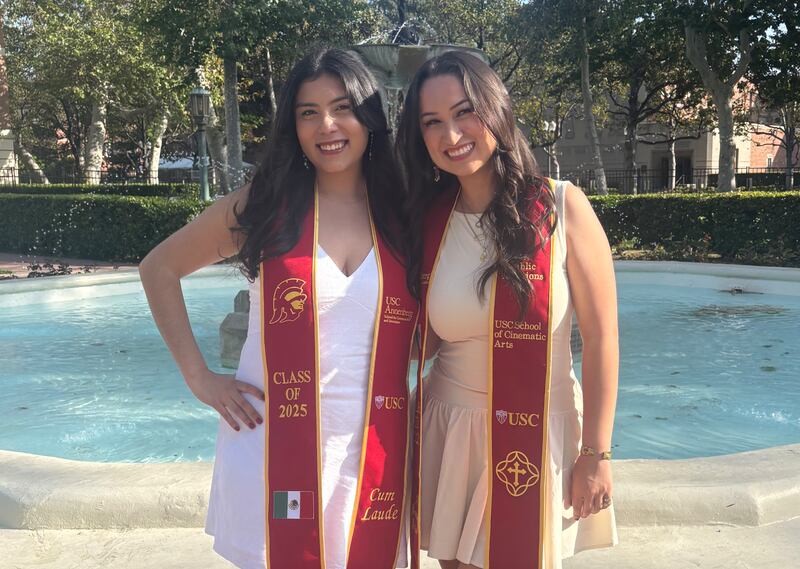
As the two prepared tortas ahogadas, Perez shared that it was during college that she first felt immersed in her Mexican identity.
“I grew up more in a white town, and more whitewashed where we didn’t really practice speaking Spanish,” Perez said, “or people would talk often in the high school I went to about deporting Mexicans.”
Mata also felt othered growing up. Despite being brought up in a predominantly Latino town in the Central Valley, Mata said she was one of just a few Latinos in her middle school.
“I remember taking, like, a torta, and one of the boys, one of my first weeks there, just said, ‘Oh my God, what a big sandwich you’re eating.’ And I’m like, ‘Wait, why are you making fun of me right now?’ ” Mata said.
Mata quickly got over that embarrassment, though. She now thinks of Mexican food as “the best thing in the world.”
“When I need something to ground me back to home, or back to my culture, and I need pride or just a sense of, ‘Oh my God, I’m like, really craving this food,’ I know that I could cook it,” she said.
As the carnitas started to turn golden brown and the sauce bubbled, Mata admited that cooking did not always come easily.
She remembers some advice that her father gave her by way of an old saying: “‘Los que no desperdician, no aprenden,’ which basically just translates into...‘If you don’t mess up, you don’t learn.’ ”
Mata keeps her dad’s words close; she says she cooks to feel connected to her family.
“If I learned the recipe of my grandma’s barbacoa, oh my God, I would be so happy, because it is my favorite food in the whole entire world,” she said. “And if my future children or nieces or nephews get to experience that, too, then it’s the preservation of my grandma’s memory and my grandma’s legacy.”
Perez sometimes resented the kitchen growing up. Her grandmother wanted for her to learn skills traditionally held by women, such as cooking, cleaning and homemaking, which Perez did not want to be limited to.
But as she grows more connected to her Mexican heritage, Perez said, she has been developing other connections, too.
“Through food, I’ve been able to connect with my grandma and learn her dishes, and learn more about why she was brought up this way and what influenced her to have these views on the world,” she said.
As Mata describes it, the two friends’ cooking sessions are truly a labor of love — self-love, and love for their Mexican roots.
“If you know your backstory and you know your ancestry, it helps you understand yourself and who you believe in,” Mata said. “Food just has that power to just bring people together.”
Before long, the apartment was filled with the delectable aroma of carnitas, and more than a few dishes were piled in the sink.
The tortas were ready — and it was time to eat.