
The island community on Maui continues to rebuild after the wildfires in Lahaina devastated the historic Hawaiian town on August 8, 2023. The fires took the lives of over 100 people with many still missing. The community’s residents, animals and businesses are still trying to recover from the fires’ long-term aftermath. Many local organizations on Maui and the neighboring islands uphold their mission to provide resources and support to those affected by the tragedy.
Many respondents from the Maui Humane Society have rescued or provided medical assistance to animals and livestock since the night of the fire. Nikki Russell, Director of Community Outreach at MHS, said that law enforcement officers searched for injured animals and distributed food to droves of people who fled to the beach for safety with their pets immediately after the fires. Shortly after that night, the center received many animals with burns and their veterinarians tended to their wounds.
As of January 16, 2024, MHS brought in 786 animals from the Lahaina burn zone and helped 129 animals get adopted. One hundred and ninety one animals were returned to owners and 152 cats were transferred to the Lahaina Cat Sanctuary. For those that could not be saved, they provided cremations for their owners. Of the nearly 300 animals in their care, about two thirds of them are cats.
“We have sent cats over to Cat Cafe Maui where they are getting adopted into forever homes, so that’s lovely,” Russell said. “They have a lot of people who visit from off island, from the mainland. I know that some of the Lahaina kitties have moved to the mainland at this point.”
For the residents left behind, Maui Food Bank’s Executive Director Richard Yust said the organization continues to provide food, water and other essentials to residents in need. The food bank also partners with disaster relief hubs. Yust said that they provide food for over 20 of them including county distribution hubs.
“We have seen a steady increase in demand for hunger relief,” Yust said. “Pre-fires we were doing roughly 17,000 people a month throughout the county and then it’s slowly been increasing. I would say [in] October [we] probably [had] closer to about 40,000 people that we’ve done food relief for.”
In the three months following the fires, MFB distributed more food than they typically would in a whole year. Yust said the factors that caused the increased need include separated families and job loss. The food bank also saw a rise in demand after the downturn in tourism also negatively impacted the local economy.
“At the beginning, our efforts were geared toward the shelters and then it shifted to the distribution hubs and then to all of our partner agencies,” Yust said. “Now it’s expanded even more up to other organizations throughout the community.”
Eliza Talbot, Vice President of Business Advocacy and Community Relations at the Chamber of Commerce Hawaii, said the organization began a Business Relief Fund to assist businesses in recovery to continue operations. They also set up a resource page on their site as a directory for finding shelter, food and assistance. Additionally, the page includes emergency alerts and grant opportunities.
“There were thousands of affected businesses,” Talbot said. “We’ve also seen that it’s had impacts on businesses throughout the state now because a lot of our businesses do partnerships and different things with a lot of the businesses that were affected in Maui, so it’s really had an impact on the whole state.”
The U.S. Chamber of Commerce made a huge donation alongside other contributing companies like Amazon. Talbot said there is plenty of decision making that happens which involves local lawmakers, businesses and the community to determine what’s best.
“Tourism was the number one industry for Maui, but it’s starting to come back,” Talbot said. “It’s a difficult balance that the state has to really walk a fine line because we need the income. We need to keep the businesses vital and thriving, but we also need to be very mindful about the different challenges that our residents are facing right now.”
The Maui community continues to be in long-term recovery nearly six months after the fires in August. The local organizations first prioritized immediate needs such as medical and housing that funds and support helped tackle. While the focus persists on rehousing residents and finding them enough food, the focus has shifted to finding sustainable solutions for the community and the businesses there. Resources from the rest of the state and the rest of the country continue to be allocated to rebuild properties, find permanent homes for the residents and animals and reestablish local businesses.
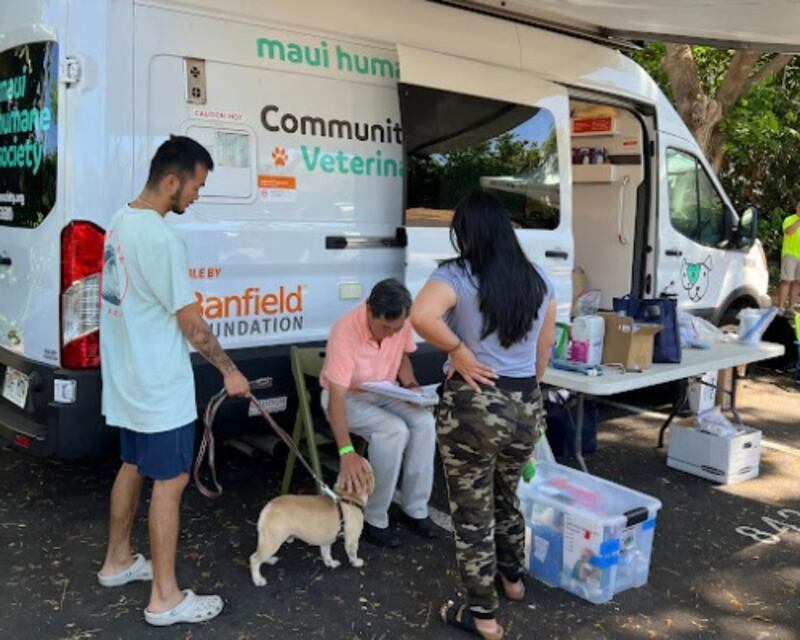
The humane society is working on finding permanent outcomes and homes for the animals. Russell said that it’s stressful for the animals to be in a shelter setting which is why adoption is such a huge focus.
For their owners and other residents, Yust said the best way for people to support them is to host virtual food drives or visit MFB’s website and donate financially. There, he and his team are able to leverage every dollar donated.
“We really need to make sure that Lahaina doesn’t get forgotten,” Talbot said.