
Just a few blocks north of campus, students tethered themselves to a pole with six-foot-long pieces of orange and blue fabric, closed their eyes and fell in trust.
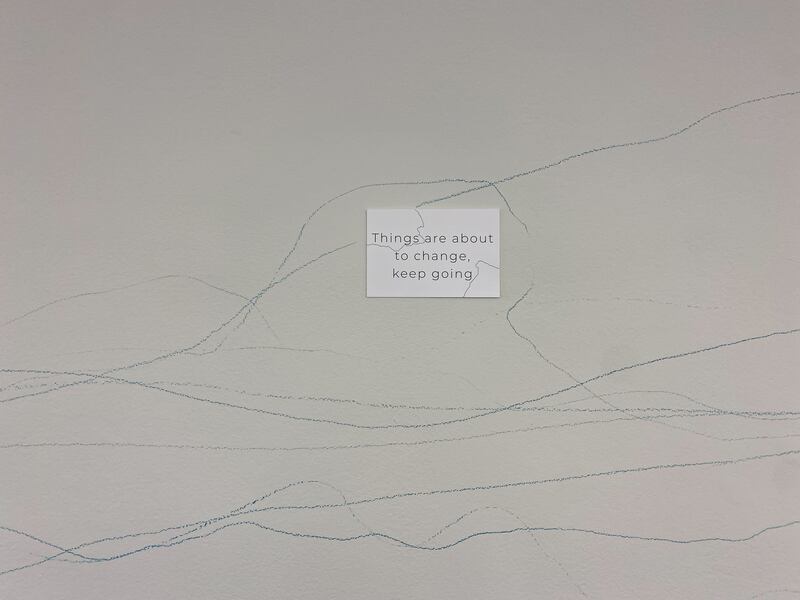
Several feet away, their classmates stacked rocks on their arms. Others piled themselves in blankets and moved slowly beneath while some took a blue pencil and traced Earth’s timeline across a blank white wall.
That’s Touch Library, an installation in “Blood Baby.”
Each of these interactive displays were stationed around the mezzanine of the ONE Archives at USC Thursday. The library is one of the largest queer archives in the world, according to curator Alexis Bard Johnson. For the next week, the space will house the brainchildren of choreographers, visual artists, playwrights and librarians in a Visions & Voices exhibition celebrating the queer family experience.
The exhibition is split into four installations: Carpet Womb, Communion, Primordial and Touch Library. The first two are performances exploring queer sexuality and family as they relate to space and ecology. Or, as the program reads, “a sweaty gay disco ritual.”
Primordial is an audiovisual installation featuring videos of project director Meg Foley, hidden beneath blankets, expanding and moving against a lakefront backdrop. Touch Library means to engage attendees in thought about their geological, physical and mental relationship with art.
The series includes “Continental Collisions,” blocks of foam that participants hold and fall on. There’s “Pangea and the Next Continental Formation,” a table where participants listen to a script about the poetic nature of blood and rock formation, and the similarities to pregnancy. That’s followed by “Plate Tectonics,” a piece of velvet wrapped to a pole where the goal is to hug it.
If it sounds complicated, that’s because it’s meant to be.
“Each set is really designed for a particular physical activation of the audience,” Foley said. “It’s designed this way because of the intricacy and complicated nature of family and gender identity and queer sexuality, and trying to pull those apart.”
Blood Baby is inspired by Foley’s experience co-parenting her child and navigating the experience as a queer family. Before coming to Los Angeles, the exhibition premiered in its entirety in Seattle last September.
But Foley said the space at ONE Archives has shaped the exhibition more than any other location.
Johnson said the nature of the project made it a good fit for the archive.
“It has four to five different components. There’s not a lot of spaces that are actually able to host all of them, and I felt it was really important to try to,” Johnson said. “A space like ONE could do that.”
Foley never imagined holding Blood Baby in a library. But one of her collaborators, Sylvan Oswald, suggested that the project doubles as an archive of her family history in the same way a library archives stories.
Now, they can take advantage of the diverse space to host both outdoor performance events and intimate conversations in bookstacks.
“Being with the books, it feels like being a living room—but also like a library, surrounded by stories,” Foley said.

The collaboration between Foley and ONE Archives began more than two decades ago with a friendship between Foley and Alison d’Amato, an associate professor of practice at Kaufman. Together with curator Alexis Johnson, d’Amato drafted the proposal to Visions & Voices so the university could fund and house Blood Baby.
Today, d’Amato took students in her graduate-level Visual and Performance Theory class, CRIT-560, to the product of her proposal.
“It’s fun to hear that the conversations that we’ve been having for 20 years now are still going, but in another way,” d’Amato said.
The class explores how performance invites participation in art. The professor made an agreement with her class before they explored the installation and its meanings: “It’s OK not to know.”
That summarizes much of the experience of senior theater major Jamie Gallo.
“I don’t think I understand it yet, but I think that’s OK,” Gallo said of Primordial.
“I’m really excited about Touch Library, and interactive pieces—inviting the audience to be participants in the art.”
Gallo’s classmate Venus Green, also felt that the interactive parts were the most impactful parts of the exhibition.
“You arrive to the space and have one particular experience because of your own interests and where you come from,” said Green, a first-year American Studies PhD student. ”But when you’re given a set of instructions or things to pay attention to, it facilitates your experience in a very particular way. It slowed me down.”
Blood Baby is on display daily at ONE Archives until Thursday, Jan. 31. Reservations are not necessary to visit Primordial or the Touch Library, both open from 10 a.m. to 8 p.m. Attendees can RSVP to afternoon and evening performances of both Carpet Womb and Communion at the Visions & Voices website.