
In the 1970s, a group of Los Angeles journalists began to imagine a space where they could create opportunities for Latinos in the news industry.
Those dreams manifested in the creation of the California Chicano News Media Association (CCNMA) in 1972. Over 50 years later, the organization is now known as the Latino Journalists of California.
USC Libraries announced Monday that it acquired decades of archives from the Latino Journalists of California, including images, correspondence records and various reports.
“When CCNMA’s treasurer Joe Rodriguez led the effort to unearth decades of archives that had been sitting in a basement, mostly untouched for years, we discovered a treasure trove of photos, artwork, documents and more representing a vital part of the history of Latino journalists in California,” CCNMA president Laurie Ochoa said in a statement released Monday.
“It was important for us to secure a home for the archives that would help current and future researchers understand the struggles and triumphs of journalism by and about Latinos as it evolved over the years,” she continued.
The Latino Journalists of California is one of the country’s oldest regional organizations of journalists of color. It offers scholarship funding and awards for journalists and students.
The organization also hosts the annual Journalism Opportunities Conference and other workshops for student journalists of color.
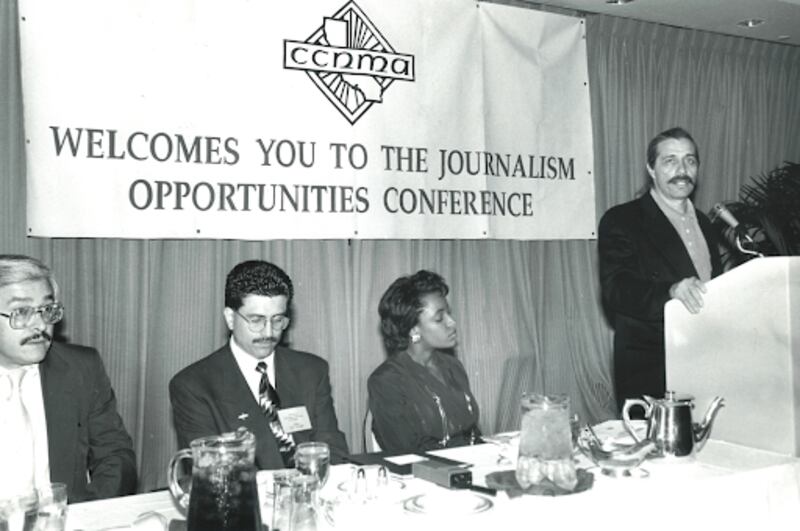
Justino Águila, vice president of the CCNMA, said the archives took weeks to gather and organize to ensure USC got the best collection possible.
“We really spend time literally on our knees, our hands, our bodies, just to make sure we collected all these things,” Águila said in a phone interview Wednesday afternoon. “That’s exciting, especially when I know future generations of students, academics, anybody in the world who wants to access these archives and find out more about Latinos in this space of Los Angeles, California, the U.S. — and what we did to achieve what we achieved.”
The documents portray a historical account of the organization from its founding in the 1970s to present day. That includes everything from the organization’s founding documents to banquet programs and photos of past scholarship recipients.
Águila said it was a “no-brainer” to choose USC for these archives to live on.
“Those milestones are important to have it at a place like an archive within USC, and that’s fantastic news to help achieve our goal of having CCNMA Latino Journalists of California documented in an official way through an archival system,” he said. “I think I can speak for the board that we were very proud that we were able to achieve a special home for archives.”
The archive was created in partnership with USC Annenberg and will serve as a record of Latino journalists in Los Angeles across print, TV and radio.
“Preserving these historic archives for education and research is among the most enduring and impactful ways we can increase Latinx representation in the media,” USC Annenberg Dean Willow Bay said in Monday’s statement. “We are proud to have partnered with USC Libraries and CCNMA to bring this important collection to students and faculty as they seek to learn from the past and build a future in which America’s newsrooms reflect the populations they serve.”
The records are now part of the libraries’ Boeckmann Center for Iberian and Latin American Studies, where they will serve as a resource for Latino journalism advocacy.
For more information about the collection, or to schedule a research appointment, individuals can contact USC Libraries Special Collections at specol@usc.edu or (213) 740-5900.