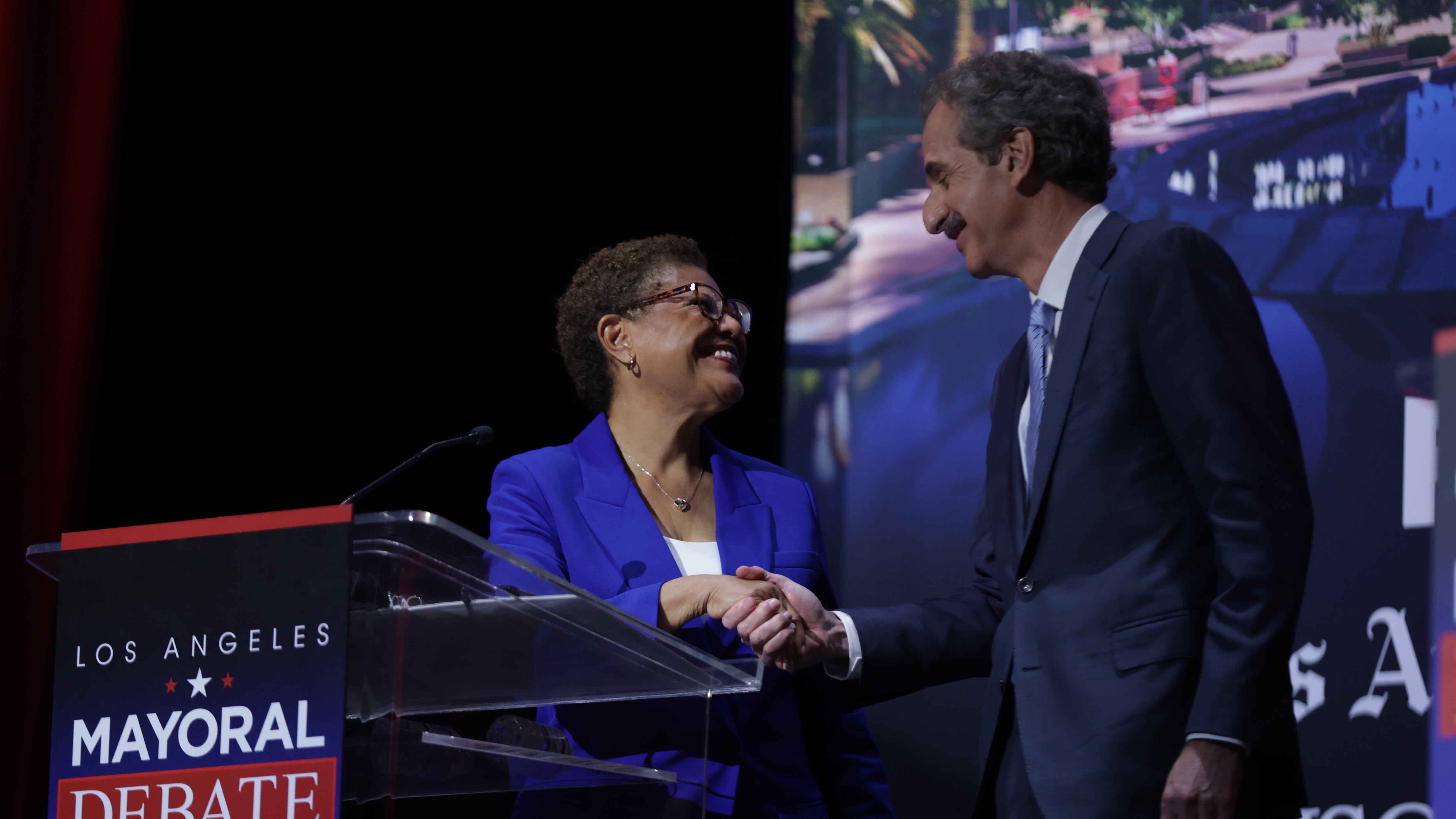
On Tuesday, five mayoral candidates took the stage at Bovard Auditorium for the second televised debate of the race. Among the candidates were Karen Bass, Kevin De León, Rick Caruso, Joe Buscaino, and Mike Feuer. The debate was hosted by Fox 11, the LA Times, and USC’s Dornsife Center for the Political Future, and was moderated by Fox 11′s Elex Michaelson and LA Times’ columnist Erika D. Smith.
While questions ran the gamut, the centerpiece of the debate was homelessness in the city, which the candidates spent a significant amount of time debating. This is the topic that is coming to define the mayoral race as four out of ten Angelenos say that unhoused people in their neighborhood make them feel unsafe. It is impacting how people will cast their ballot.
According to a 2021 article from LAist, there are 63,706 unhoused people in the city, which is a 13% increase from 2019. This is an issue that has been exacerbated by the ongoing coronavirus pandemic as people were let go from jobs, savings were depleted, and a lack of money made their previous living situation untenable. Additionally, in the early days of the pandemic, shelters were told to decrease their density by at least 50% so as to reduce the risk of exposure. Often, those that are experiencing homelessness suffer from a mental illness. The Los Angeles Homeless Authority says 29% of unhoused people suffer from mental illness, but an LA Times analysis says it is upwards of 51%.
Karen Bass, the current representative of California’s 37th District which includes USC, says should she be elected mayor, she would institute a state of emergency on day one. Bass would aim to have 15,000 housed by the end of her first year and would work to utilize the resources currently available. In her statement on homelessness at the debate, she said that she wants to make sure that “it is a number one problem because it is a public health and public safety emergency.”
Kevin De León, city council member for the 14th District, has his own experience with housing insecurity and has at one point in his life been homeless. In an interview with Annenberg Media, De León noted that it: “took [him] years to save enough money to put a down payment on [his] house.” He also noted that during the coronavirus pandemic “the poor got poorer.” Something that he echoed in the debate when discussing the “tale of two cities” that the pandemic has been in Los Angeles, which he says is the epicenter of homelessness nationwide. In his efforts to curb the homelessness crisis, he built the largest tiny home village in the United States and said “if we can build football stadiums and basketball arenas, we can sure as hell build housing for our unhoused neighbors.”
Rick Caruso, who missed the first televised debate at Loyola Marymount University, is a billionaire developer most noted for the Grove shopping center in the Fairfax district. He noted that his plan to end homelessness is on his website and that it is “very comprehensive.” His plan includes building 30,000 temporary beds in 300 days in order to get unhoused people off the streets and into service and treatment programs. Other candidates criticized Caruso’s interest to use the police to remove unhoused people from the streets saying it will criminalize them. In one of his many retorts back to other candidates’ criticism he said: “is it criminalizing poverty to make sure our streets and our sidewalks are clear and safe of encampments? Is it criminalizing poverty to allow people to sit in their filth to sit in human waste? That’s not compassionate.”
Joe Buscaino, a former policeman and city council member for the 15th District, started off the debate with an attack at Caruso in his opening remarks noting how nice it was to finally see the businessman. He noted that 40% of those formerly unhoused in his district now have homes. If elected mayor, he would plan to activate the city’s emergency response center at all hours. Buscaino would also institute a zero-camping law in Los Angeles. His “Safer and Cleaner L.A.” initiative has been critiqued by advocates who have called it counterproductive. The former policeman was not endorsed by the Los Angeles Police Protective League who instead endorsed Caruso.
The fifth candidate is District Attorney Mike Feuer who notes that homelessness is an emergency and should be treated as such. As a result, he believes that FEMA should be on the ground in Los Angeles and on Tuesday said, “if we had a natural disaster, there would be a FEMA general here on the ground, in charge of recovery. I wrote we have the equivalent of that, the disaster is homelessness and no one is in charge.” The article he is referencing was composed in 2018 for the LA Times, he argues that the city needs a “homelessness czar.” In an interview with Annenberg Media, Feuer said: “homelessness is pervasive. It used to be a limited problem and now it is in everyone’s neighborhood.” He also noted that an issue in Los Angeles which used to not be as dire is affordability. In an example, he talked about his grandparents who were store clerks in a small grocery store, but were able to purchase a home in the Fairfax district. Feuer offered that that sort of home would now run upwards of a million dollars.
Los Angeles voters are left with a decision to make about how they want the city to look after nearly nine years with Eric Garcetti as mayor. The Los Angeles primary will be on June 7.